How your organisation can get more value from experiments
Create a future-proof approach to experimentation
- Article
- Scaling experimentation effectively
- Customer Experience


Within your organisation, quite a lot of experimenting is already taking place, perhaps even extensively. Yet there is much debate about the resources and time it requires, and the added value is not always clear. Sound familiar? In this article, you’ll discover how to tackle some of the major challenges in getting value from experimentation.
The five challenges preventing organisations from gaining maximum value from their experiments
These are five common challenges seen with clients at experiment level, which often result in experiments failing to deliver their full value:
1. Running experiments on the wrong metrics
If you are experimenting on the wrong metrics, the impact of your experiment does not align with the organisation’s strategy and therefore fails to deliver value. By mapping out the right metrics (for example, with Driver Trees), you can more effectively select a suitable metric, define guardrails (metrics you do not want to negatively influence), and ultimately establish your Overall Evaluation Criteria. Solving this ensures your experiments carry more strategic value and are better aligned with organisational goals.
2. Too much focus on solutions instead of problems
Experimentation often focuses too quickly on solutions rather than on the underlying problem. Too often, stakeholders prioritise their gut feeling over data. Experiments based on real customer problems create more impact and contribute more effectively to the improvement of your product or service.
3. Incorrect analysis method or issues with data quality and interpretation
Carrying out an experiment requires being aware of the right questions. For example: Can we guarantee that users are tracked correctly throughout the experiment? Does the testing tool use the correct statistical analysis? To guarantee a correct analysis, you need clear answers to these questions. This way, your experiments remain accurate, and you get the right insights to improve your product or service.
4. Lack of a standardised approach to experimentation
Different teams often have different levels of maturity in experimentation. When an experiment is carried out, it is essential that all teams follow a comparable working method. This makes experimentation scalable, enables meaningful comparisons, and ensures data is consistently interpreted.
To get the most value from your experiments, all teams must experiment at the highest possible level together. Of course, this is challenging, as not all teams have the same composition, technology, or seniority.
By aligning your experimentation programme across teams as much as possible, you optimise efficiency, transparency, and onboarding. This makes experiments more cost-effective and easier for other teams to interpret.
If you do not do this, the quality of your experiments will not be optimised across the organisation, leading to a negative impact on ROI, test velocity, and other experimentation KPIs. Standardisation is therefore crucial to prevent experiments from underperforming at organisational level.
5. Lack of governance
When running an experiment, it is important to have clear agreements on:
- who conducts the experiment
- who manages it
- what the guidelines and working methods for experimentation are
Without processes and agreements, quality differences arise between teams. Ensure roles are clearly defined to avoid confusion about responsibilities and to keep experiments running smoothly. This prevents experiments from stalling and reduces the time required to complete them.
Improvements at experiment level are not the only way to extract more value. In addition to choosing the right metrics, focusing on the problem instead of the solution, raising the team’s knowledge level, standardising your experimentation approach, and establishing governance, there are other ways to maximise the value of experimentation for your organisation. Think also about programme-level improvements: Can more teams experiment? Can the number of experiments per team increase? Is there a culture that facilitates experimentation?
How Your Organisation Can Get More Value from Experiments
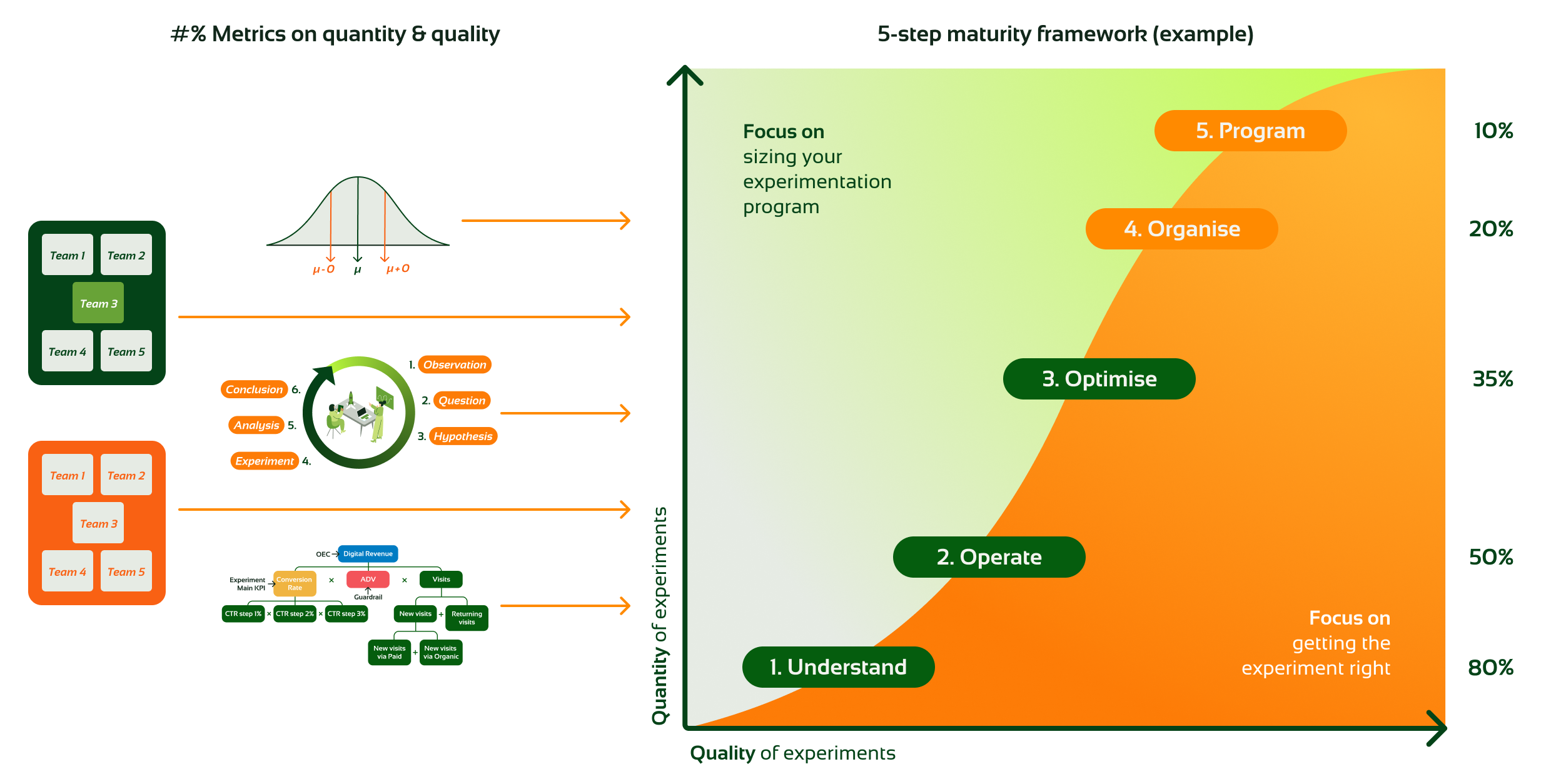
To achieve higher ROI from experiments, your approach must be scalable and you need to run more high-quality experiments.
Get more value from experiments: increase the amount
The number of experiments per team should increase. This accelerates behavioural change within the organisation. The more you experiment, the more you learn. Even a negative outcome teaches you something: namely, that the intended change does not have the desired effect.
Get more value from experiments: increase the quality
The quality of experiments is just as important. This includes how you design an experiment, the hypothesis, the KPIs, and applying the correct statistical analysis. It is also crucial to conduct proper research before the experiment to ensure you are testing a strong variant.
Set up your organisation for scalable and efficient experimentation
To increase both the quantity and quality of experiments, it is essential to establish processes, create guidelines, connect data sources, and raise internal knowledge levels. In addition, you should embed experimentation across multiple teams to broaden organisational value. Finally, you must define clear responsibilities to ensure experiments deliver maximum value.
Increasing both the number and quality of experiments has a direct impact on win rate and organisational learning. By running more experiments, you learn how to execute them effectively, which adjustments are impactful, and you increase the likelihood of success. Well-designed experiments with clear hypotheses, relevant KPIs, and the correct statistical methods significantly raise the chances of generating meaningful results.
Even negative outcomes provide valuable insights into what does not work, enabling smarter follow-up experiments. By scaling experiments and spreading them across teams, you accelerate learning and uncover broader patterns applicable in multiple contexts. This ongoing focus on experimentation improves individual win rates, enriches collective organisational knowledge, and delivers valuable insights. Together, these elements contribute to a culture of growth and continuous improvement.
Every test supports important decision-making. By spotting patterns and incorporating learnings, decisions become increasingly effective. With a clear focus on the relationship between metrics and opportunities, you foster a culture of growth and continuous improvement—instead of doing things without knowing whether they add value.
More value from your experiments: get started!
Our data consultants are happy to help you establish a future-proof approach to experimentation. With Scaling Experimentation Effectively (S.E.E.), your entire organisation will work in an experiment-driven way. We do this in two steps:
- The S.E.E. Framework maps out your organisation’s current state and areas for improvement. For example, how many experiments currently have a clear hypothesis? You receive a thorough analysis, including insights into existing bottlenecks such as outdated technology or silos.
- The S.E.E. Toolbox includes training, templates, and services designed to grow both the quality and quantity of your experiments. Based on the outcomes of the Framework, you receive tailored advice. Sometimes a training session may be sufficient, but we can also help you set up a full experimentation programme.
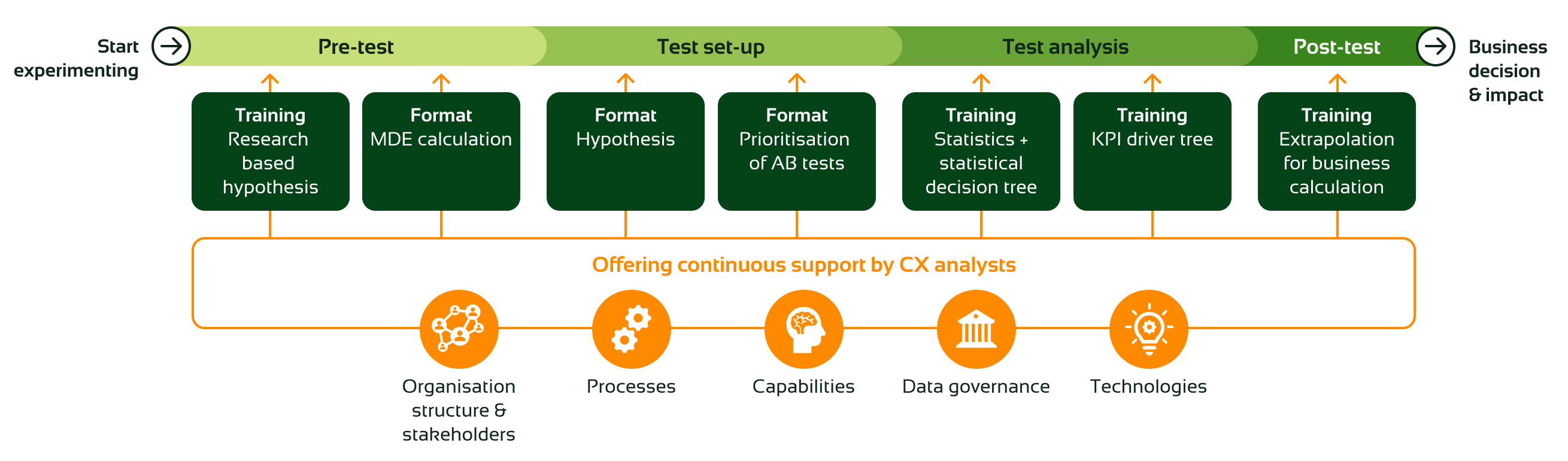
We are eager to work with your teams. Using data, we demonstrate the value of our work so you can be confident of achieving the desired results. Interested? Read more about Scaling Experimentation Effectively or get in touch.
This is an article by Sebastiaan van Buitenen
Sebastiaan is an experimentation expert passionate about creating valuable digital experiences for both users and organisations. His hands-on experience in experimentation enables him to elevate organisations to the next level, both in the quality and quantity of their experiments. With Sebastiaan on your team, experimentation will get a significant boost. His approach, informed by his background in applied cognitive psychology and a focus on research-driven optimisation and psychological heuristics, makes him a reliable partner for driving impact.
Receive data insights, use cases and behind-the-scenes peeks once a month?
Sign up for our email list and stay 'up to data':