The strength of mapping within your optimisation process
Work more customer-driven by visualising journeys and processes
- Article
- Customer Experience
- Insight-driven optimisation


Does your organisation struggle to steer on its KPIs? Or do isolated teams hinder internal collaboration? Mapping offers a powerful solution to these challenges, one that we at Digital Power firmly believe in. Mapping is a strategic tool for visualising situations, whether it's a customer journey such as a purchase process or app usage, or a process like order processing.
By chronologically visualising these customer journeys and processes on a map, you create a single document that can be used by all involved departments for the optimisation process. This helps prevent tunnel vision on specific parts of the customer journey or process.
But how does mapping work exactly? And more importantly, what does it truly deliver for your organisation? Read on to learn more about this.
Mapping, how do you do it?
Step 1. Determine the customer journey/process and your target audience
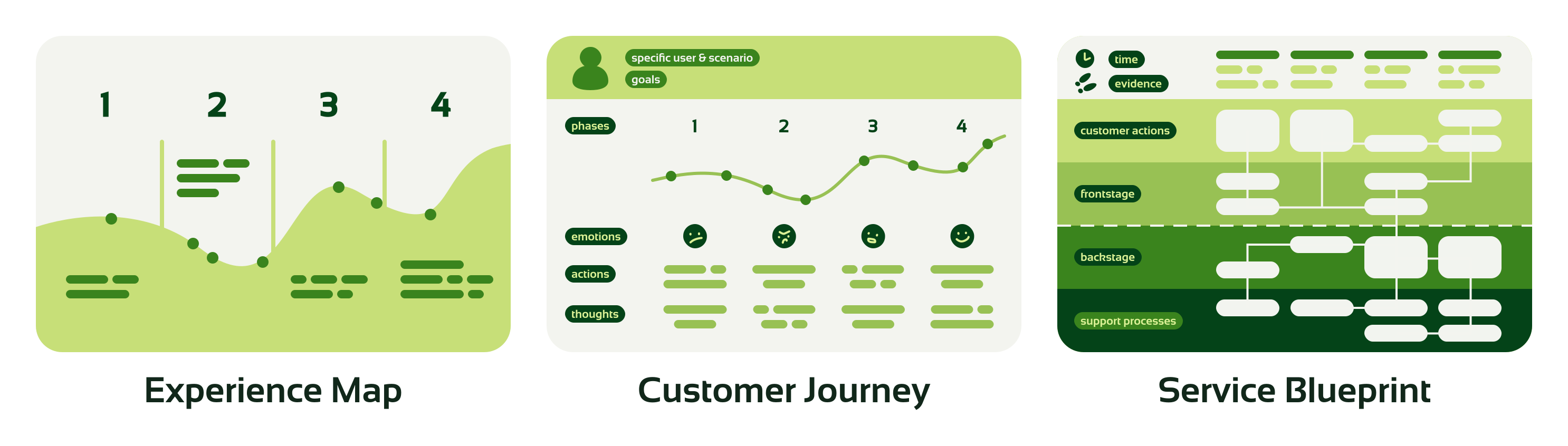
The first step is to determine which situation you want to map out. Is it an existing customer journey or a future one? Once that's clear, you'll decide from which perspective you'll be looking at the journey and what you'll be focusing on by adjusting to a particular target audience. This roughly distinguishes between what's called an experience map, a customer journey map, and a service blueprint.
Read more about these different mapping forms here. In addition, determine whether you want to map an already existing or a future customer journey/process. Once that is clear, you start determining from which perspective you will look at the journey and where you will focus through your target audience.
Step 2. Define the phases and steps in the journey with data
In the next step, you retrieve data that is relevant to form a complete picture of your journey. This consists of pre-existing data, which you can retrieve from a dashboard, for instance, and data that still needs to be retrieved using various research methods (e.g. web analysis, surveys, usability tests, process mining and more).
All this data contains relevant context about the goals, thoughts and expectations a customer has, the actions a customer needs to take, the emotions he/she experiences, but also the underlying systems and data sources that need to take action at a given touchpoint.
It is an option to reverse the process and write down the stages of the journey first and then retrieve the data. Despite being a cheaper method, this is not a neutral way of mapping the journey, as it is influenced by assumptions about what people think the journey looks like. By retrieving data first, you work without these assumptions and put the customer more at the centre.
Step 3. List the fases and touch points of the journey
A customer journey or process is chronological and thus has a starting and ending point. These points can be closely connected.
Mapping out the customer journey or process begins by simply putting down on paper all the phases in the journey. It's important to do this from the perspective of your target audience within the relevant context.
The touchpoints associated with the different phases in the customer journey form the foundation of the visualisation.
The benefits of mapping
Utilising mapping as a tool in your organisation offers numerous advantages. First and fsoremost, it ensures that an organisation becomes more data and customer-driven in its optimisation process. Additionally, there are many more specific benefits. Here are some key ones lined out for you:
1. Insight into opportunities and pain points with mapping
By mapping in a data-driven manner, you gain insight into real existing opportunities and pain points instead of generating ideas based on gut feeling. This automatically places the customer more centrally within your organisation and makes it easier to put yourself in the shoes of the customer.
2. Prioritising opportunities based on the greatest impact
In addition to having customer-focused data, you can also directly prioritise opportunities and pain points based on the highest expected impact on your KPIs. This provides your company with important guidance to always focus on generating the most value at any given time.
3. Breaking through silo thinking and working
By looking at the entire process rather than just a part of it with mapping, you break down siloed operations and encourage cross-domain collaboration within your organisation. This is because different teams gain insight into the dependencies of their work and its overall effect on the customer.
You can break down silos earlier by involving various domains at the outset of the project's mapping and making it a collaborative process. For instance, you can make them responsible for gathering specific data, raise awareness of the impact of their domain-specific KPIs on other KPIs outside their domain, and involve them in brainstorming about solutions for identified pain points.
4. Assigning responsibilities
Mapping reveals touchpoints without ownership, allowing future optimisation with full ownership of the journey. Mapping is not a one-time task because a customer journey never remains the same. By constantly updating it, you transform the optimisation process from isolated initiatives to targeted, continuous optimisation.
5. Knowledge sharing about the journey
By mapping a complete journey, you make clear what steps and customer walks through and what experiences they have in the process. This makes (in)directly collaborating teams aware of their influence and teaches them the knowledge of what the journey looks like at all.
Ready to get started with mapping?
At Digital Power, we have extensive experience in data-driven mapping. With insight-driven optimisation (through mapping), we visualise your entire journey and optimise it based on data:
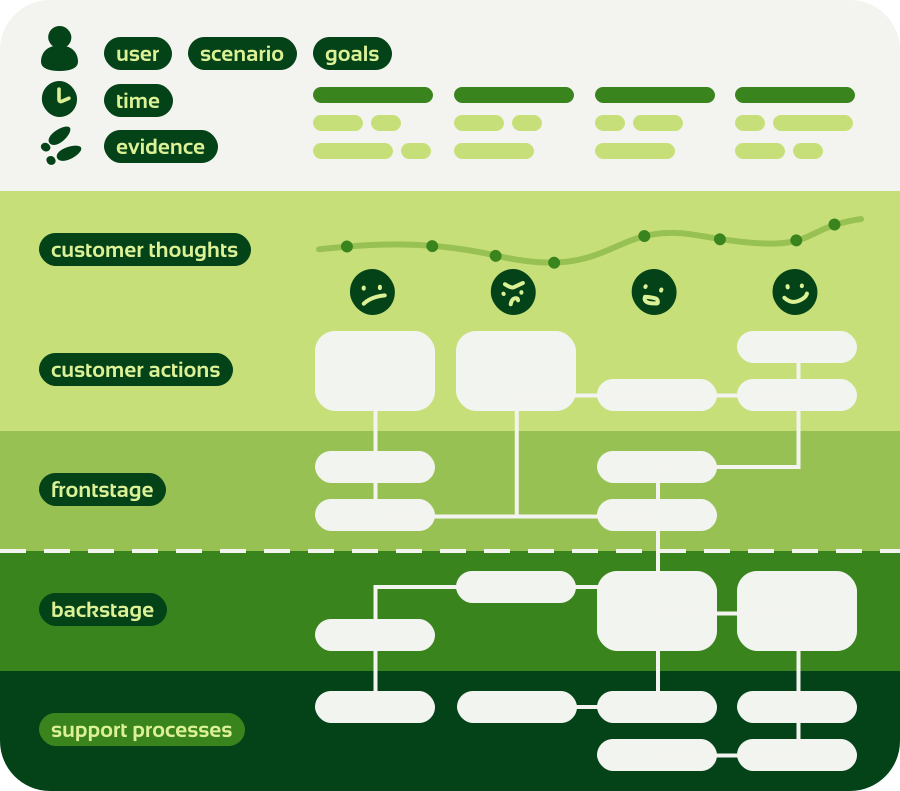
Together, we ensure that insight-driven optimisation becomes the ongoing optimisation process from which your organisation can reap benefits for a long time to come. Contact us for more information.
This is an article by Ezra Soerioroseno
Ezra is a passionate Customer Experience specialist with the mission to amaze as many customers as possible. He achieves this by combining qualitative and quantitative insights to truly understand and solve the customer's problem.
Receive data insights, use cases and behind-the-scenes peeks once a month?
Sign up for our email list and stay 'up to data':