From ambition to activation: how Ennatuurlijk really got moving with data
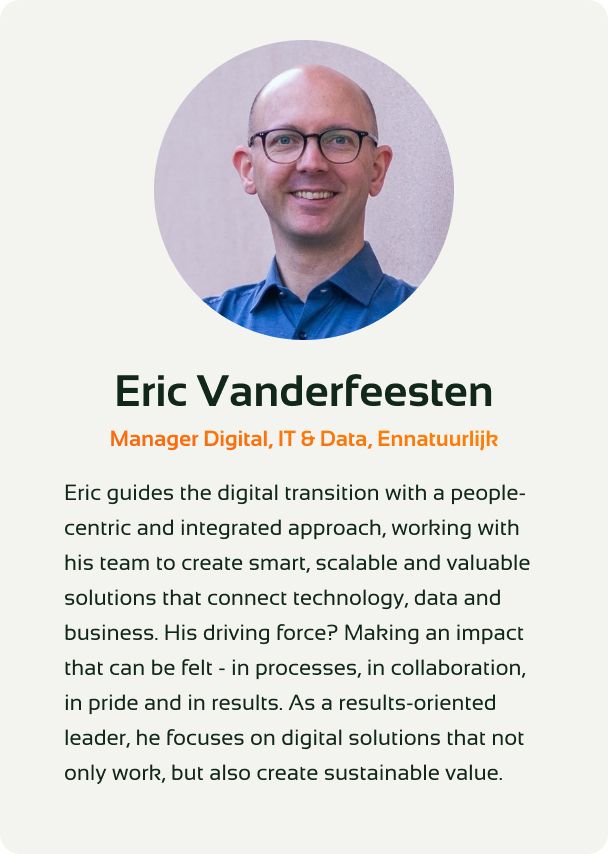
An interview with manager of Digital, IT & Data Eric Vanderfeesten
- Customer case
- Data projects
- Strategy & Transformation
- Customer Experience
- Product & Project Management


At energy company Ennatuurlijk, the belief grew that intuition was no longer enough to set the course. The energy market was changing rapidly, the organization was growing, and the amount of information was increasing every day. IT Manager Eric Vanderfeesten went looking for a data partner who could not only provide strategic advice on data-driven work, but could also strengthen his data team operationally. In this interview, he shares his vision, experience and results from working with Digital Power.
More complex, faster, bigger: the why behind the data strategy
In recent years, Ennatuurlijk has grown considerably. With that growth also came new challenges. ‘We had to deal with more people, more systems, and more complex issues,’ Eric explains. ‘Then you notice: the choices you make can no longer be based on your gut feeling.’
So the desire to work data-driven did not arise from hype, but from necessity. "The world around us has simply become too complex. There are too many variables to oversee everything ourselves. We wanted to be able to make choices based on data and we needed help with that."
Why the choice of an external data partner?
At Ennatuurlijk, external expertise was deliberately chosen. "Strategic thinking requires different skills than execution. When it came to data-driven work, we had not yet developed that competence sufficiently ourselves. You also have to dare to be honest: you can do a lot yourself, but sometimes it's smarter to learn from others who have more specific knowledge of a subject. In addition, a fresh view from outside often works better because an external expert can take a more objective view," Eric says.
Eric started looking for a partner who knew what was happening in the market, could bring in the best practices of other organisations and would bring speed. "I was looking for a one-stop-shop on data-driven working. Digital Power could help us formulate our data strategy as well as the implementation." "We didn't want a niche party that only advises what they can deliver themselves, but neither did we want a corporate with a different culture. Digital Power's data consultants speak our language and have a proven track record."
From strategy to realisation: this is what cooperation looks like
The collaboration is multifaceted. Digital Power specialists work as part of Ennatuurlijk's data team: data engineers build a future-proof data platform, a product owner guides the process and Analytics Engineers and BI Analysts work on dashboards and reports that deliver immediate value. In parallel, the data strategy was developed, including three clear data ambitions and associated roadmaps. The follow-up projects that follow from this are also taken up together.
Eric: "It works because it really is a collaboration. We form a team together. There is a lot of freedom, mutual trust and room for initiative. Both at Ennatuurlijk and Digital Power, we have a pragmatic way of working: we don't think in limitations, but mainly look at what can be done."
Result counts. "The promise that you create value with data-driven work is one thing, but you also have to do it. If people notice that it works, support automatically grows. That is a culture change. You see very clearly that this is being embraced more and more and is spreading like an oil slick within Ennatuurlijk."
An example of an initiative to create more internal support is “Data Tuesday”: a fixed moment in the week when knowledge is shared, successes are celebrated and data becomes literally visible within the organisation. Eric is also enthusiastic about the inspiration session where employees from
What has been achieved so far?
Eric lists some of the results that have been achieved:
- A new data platform: robust, maintainable and future-ready. The migration is in full swing.
- A clear process for the realisation of data products: from intake to realisation, there is structure and ownership and we know what to do.
- Clear data strategy with data ambitions: these have been translated into visual roadmaps, making the impact clearly visible.
- More awareness and support: not only among operational teams, but also among management. "They are now starting to ask themselves whether we support decisions with data. Because we approach the topic of data strategy from both operations and strategy, the conversation thus arises from both sides, with the result that we meet somewhere in the middle."
The biggest change? "Before, from the business you would still get questions like “What is actually being worked on?” and it was unclear what results were being achieved. We all don't see data, but investing in synergy between your data team and the business creates more understanding. People start to realise step by step what issues they need to work together on.
Now the conversation between the business and the data team goes like this: 'You cannot yet get valuable insights from your dashboard because your data is not yet in order.' That clarifies where the work is - and that's a win."
What makes this collaboration special?
According to Eric, it is mainly the human side that makes working with Digital Power special. "We all want it to be a success. There is an open, honest atmosphere where making mistakes is allowed - as long as you fix it again and learn from it."
What sets Digital Power apart? "The combination of strategy and operations. The data consultants not only help think about the direction, but also make sure it happens. And they dare to remain critical, also on the cooperation itself."
Case: From strategy to realisation: a data-driven future for Ennatuurlijk
"With their extensive expertise, Digital Power supports us in the various components of data-driven working. The data consultants think along proactively and are really part of our team. Together, we think about how to create as much value as possible for the organisation. They bring in-depth knowledge from strategy to implementation and are valuable sparring partners for both our management and operational teams. Because they know how to have the conversation in the right language, they create support and help Ennatuurlijk realise our data ambitions."
Case: How a Product Owner ensures data value and visibility
"The Product Owner has ensured that our data ambitions have actually become concrete. This provides guidance in the realisation of new data products."
3 valuable insights from working with Digital Power as a data partner
A successful partnership is hard work for both parties. Eric shares his key insights:
- Be clear in your expectations: soft on people, hard on content. Especially if you enjoy working together, it is important to stay focused on results. Here, mutual accountability applies: the money you spend together must deliver value.
- Reflect on the collaboration: sounds logical, but this is often not done structurally. Dare to ask test questions here: are we still on the right track or do we need to adjust?
- Focus on joint growth: create a climate in which you can learn and grow together and in which making mistakes is allowed as long as you learn from them and do better next time.
The future: building a data-driven organisation
The ambitions are big - and realistic. Ennatuurlijk is the third largest heat company in the Netherlands. The changes in the market are big due to (geo)political developments, a continuous pursuit of more modern and efficient heat solutions and a growing need for insight. "We have embarked on a path where we are not finished for the time being. The basis in terms of technology and culture is in place and the first results are there, but there is still an awful lot to do. Our need for more and better insights from data is only going to increase."
Ennatuurlijk is making great strides towards becoming a mature data organisation. "We want to move from a centralised, to a decentralised model where the business can make its own reports. For this, we are going to tap into and develop new competences. This way, we will continue to have sufficient skills to be in charge. Nevertheless, we will always continue to seek cooperation with a data partner for acceleration, market testing and innovation."
"We are in transition and that never stops. The direction is clear, the foundation is in place and the energy is palpable. We are already looking forward to the moment when we can look back together and say: this was a phase in which we really brought about change."
Also getting started with your data strategy?
Eric shares his advice:
- Work with a partner: this obviously costs money, but your ambition is often greater than your ability to fulfil it.
- Go for a party with expertise in multiple areas: they look more broadly than a loner and have the flexibility and clout to keep up with a changing market.
- Approach it from two angles: strategy and operations. It is difficult to be in operations and look at strategy at the same time. You are then quickly hampered by your translation into current practice. A partner helps you rise above this.
- Live through your data ambitions: you can only really define them if you understand what they mean in practice. This is another reason why the two-way approach is recommended.
- Change takes time: accept that people must be willing and able to move with you.
- Think big and far ahead: communicate from the start that this is a long-term process - even if your budget is limited to a specific period at the start.
- There is no perfect route: you have to start somewhere. Traction is more important than perfection.
- Include stakeholders: you need each other, so include each other in what you do. Share all successes, however small.
This interview complements the (Dutch) e-book “Getting started with your data strategy”. Learn from the valuable insights of our data strategy experts, discover inspiring cases and get started with practical tips.

Want to know more?
René would be glad to tell you more about Digital Power and discuss the opportunities of a collaboration with us.

Receive data insights, use cases and behind-the-scenes peeks once a month?
Sign up for our email list and stay 'up to data':