Net Promoter Score (NPS) as a starting point for better customer experience
How to use NPS to improve customer focus — not to chase a score
- Article
- Customer Experience


If you ever buy something online, chances are you’ve seen this question pop up: “How likely are you to recommend us?” For many organisations, that single number has become a holy grail. Everyone talks about NPS — from marketing teams to senior management. But how valuable is that score really? Many organisations measure NPS on a structural basis, yet struggle to translate it into concrete improvements. The score goes up or down, but remains disconnected from real decisions. In this article, we explain how to use NPS to create insight and impact — and where to be cautious.
Are you responsible for marketing, customer experience or product, and do you use NPS to measure customer feedback? Then this article is for you.
What is NPS (and why do so many organisations use it)?
Why organisations use NPS:
- It’s a single, simple question and therefore easy to explain internally.
- It allows comparison over time, between teams and against competitors.
- It measures likelihood to recommend, which goes beyond satisfaction with a single interaction.
How NPS works
NPS measures whether customers would recommend a product or organisation using one simple question:
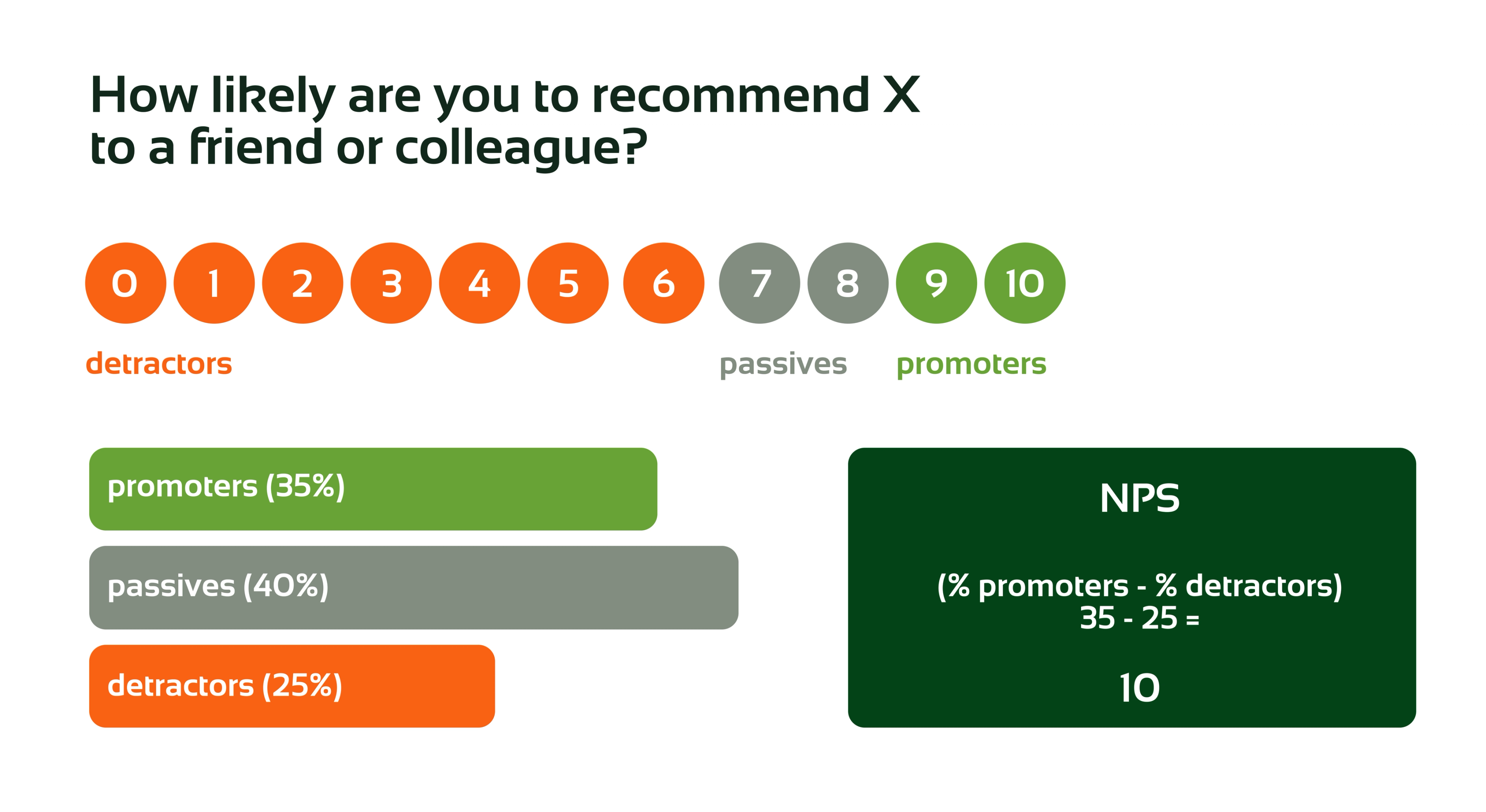
“How likely are you to recommend [x] to a friend or colleague?” Respondents give a score from 0 to 10 and are grouped into three categories:
- Promoters (9–10)
- Passives (7–8)
- Detractors (0–6)
The Net Promoter Score is calculated by subtracting the percentage of detractors from the percentage of promoters, resulting in a score between –100 and +100.
Below you can see a tangible example of the Net Promoter Score, from the 0–10 rating scale to the split between promoters, passives and detractors and the final NPS calculation.
Why context matters when asking an NPS question
Imagine this scenario. You buy a jacket from an online retailer you’ve used before. This time, everything goes wrong: the size isn’t available, the payment module fails and the chatbot can’t help you. Immediately afterwards, you’re asked whether you’d recommend this purchase. Your score will likely be low. A few weeks later, you receive another survey asking:
“Would you recommend our webshop?” Now your answer is more nuanced. Despite the recent issue, previous experiences were positive and you still like the range of products. Your score is likely higher.
This is why organisations often distinguish between two types of NPS:
- Transactional NPS (NPS‑T) measures willingness to recommend after a specific interaction, such as a purchase, delivery or customer service contact.
- Relational NPS (NPS‑R) measures the broader relationship with the organisation, usually via periodic surveys. This gives insight into long‑term loyalty.
Both are valuable — but they tell different stories. Asking a relational NPS question immediately after a single interaction can distort results, as customers tend to base their answer on the most recent experience rather than the overall relationship.
Where NPS often goes wrong
You may recognise this: NPS is treated as a goal in itself — a number to report on, manage or attach targets to. That’s risky. A score of 6 or 9 doesn’t tell you what went well or what needs improving.
That’s why it’s essential to understand why customers give a certain score. By uncovering the reasons behind their willingness (or reluctance) to recommend, you can make targeted improvements. Consider, for example, user testing or interviews with a customer panel to identify which aspects your customers value and where value can be created. This helps you avoid investing in optimisations that have little real impact.
Improving the underlying customer experience requires ownership — for example, a product owner responsible for follow‑up actions. Without that link, NPS remains just a number. Used properly, NPS becomes a starting point for growth, not the end goal.
Common pitfalls when using NPS
Although NPS can be a valuable metric, there are several pitfalls to be aware of:
Cultural bias
NPS originates in the United States, where people are more likely to give a 9 or 10. In countries like the Netherlands (and much of Europe), a 6 or 7 is often considered a decent score. In NPS calculations, however, 7s and 8s are not counted as promoters, and 6s are even classified as detractors.
NPS as a target
Too often, teams focus on improving the number rather than improving the experience. The “why” behind the score receives little attention.
NPS hacking
Some teams try to boost the score without improving the experience — for example by sending surveys only after successful interactions, excluding customers with low scores or subtly changing the wording. This creates false confidence: the score looks good, but doesn’t reflect real loyalty.
Survey fatigue
Asking too many NPS questions leads to lower response rates and less reliable answers.
NPS is not the holy grail
NPS is just one way to measure customer feedback. The key is to match the right metric to the right question, for example:
- Want to know how satisfied someone is with a specific interaction? Use Customer Satisfaction (CSAT).
- Want to know how much effort a customer has to put in? Use Customer Effort Score (CES).
- Want to assess usability of a system or product? Use System Usability Scale (SUS).
- Want to measure overall satisfaction with an interaction or organisation? Use Customer Satisfaction Score (CSS).
- Want to know whether customers actually achieve their goal? Use Goal Completion Rate (GCR).
How to use NPS effectively
NPS is powerful, but only as part of a broader approach. The number itself means little — the value lies in what you do with it. Always explore why customers give a certain score. Combine NPS with qualitative research such as interviews, usability testing or listening in on customer service conversations. Use it as a trigger for improvement, not as a performance target.
Some tips to implement directly when using the NPS:
- Use NPS to understand customer experiences, not to hit targets.
- Always investigate the why behind the score.
- Choose the right metric for the right purpose.
- Avoid NPS hacking — honesty is key.
- Treat your first NPS measurement as a benchmark, then improve step by step through targeted experience improvements.
What does this deliver in practice?
- Clear priorities based on proven customer impact
- Fewer investments in low‑value optimisations
- Stronger internal focus and buy‑in through concrete feedback
From NPS score to better customer experience
A Net Promoter Score only becomes meaningful when you understand why customers would — or wouldn’t — recommend you. We help organisations translate NPS into actionable insights and improvements across the entire customer journey — from first contact to long‑term relationship. No isolated tweaks, but structural improvements in customer experience. Discover how we improve Customer Experience.
This is an article by Mila van der Zwaag
Mila is a Researcher and Customer Experience Specialist at Digital Power. She has a background in Cognitive Psychology and likes to combine this knowledge about people and behaviour with data to arrive at the best solutions.
Customer Experience Specialistmila.vanderzwaag@digital-power.com
Receive data insights, use cases and behind-the-scenes peeks once a month?
Sign up for our email list and stay 'up to data':