Customer and data-driven work with customer journeys
Article
Customer Experience
Insight-driven optimisation
Chantal Snijder
Customer Experience Consultant
5 min
15 Sep 2025
Implementing customer journeys in an organisation is a milestone. You celebrate it, share it, and feel the energy. But then comes the real challenge: how do you scale this success across multiple teams and multiple journeys?
Together with Digital Power, KPN has firmly embedded the customer journey in its way of working. The goal: delivering the ultimate customer experience, based on the principle Digital First, Human Assisted. During the Data Expo, we took visitors through KPN’s digital transformation.
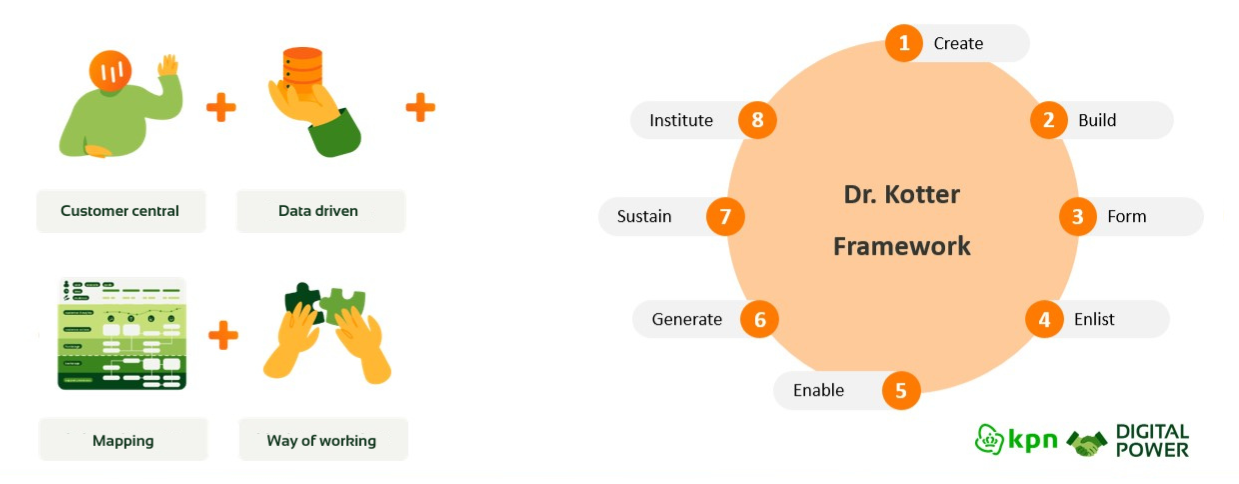
The initial question KPN asked Digital Power was smaller: can you optimise a specific self-service tool? Soon we discovered that isolated optimisations were not enough. To truly make an impact, you need to understand and improve the entire customer journey, placing the customer at the centre and working with data.
Using Kotter’s 8-step change model as our guide, we began the transition to a journey-based approach. We used it not just as theory, but as a practical framework to stay focused on the right steps.
1. Create: Creating urgency for a journey-based approach
At first, the focus was on optimising individual pages to deliver quick wins on key metrics. In team sessions we switched between perspectives, like page, flow, touchpoint, journey, proposition, and uncovered opportunities that had been invisible before. This revealed valuable insights the teams would otherwise have missed.
2. Build: First successes with one multidisciplinary team
One pioneering team adopted the insight-driven optimisation (IDO) approach. The biggest achievement? Customer journey thinking was no longer seen as a project, but became a new way of working. With insight-driven optimisation, developed by Digital Power, continuous optimisation was structurally embedded in the organisation. All improvements were data-driven, combining customer feedback, usage data, and experimentation. Different disciplines worked together towards one shared goal.
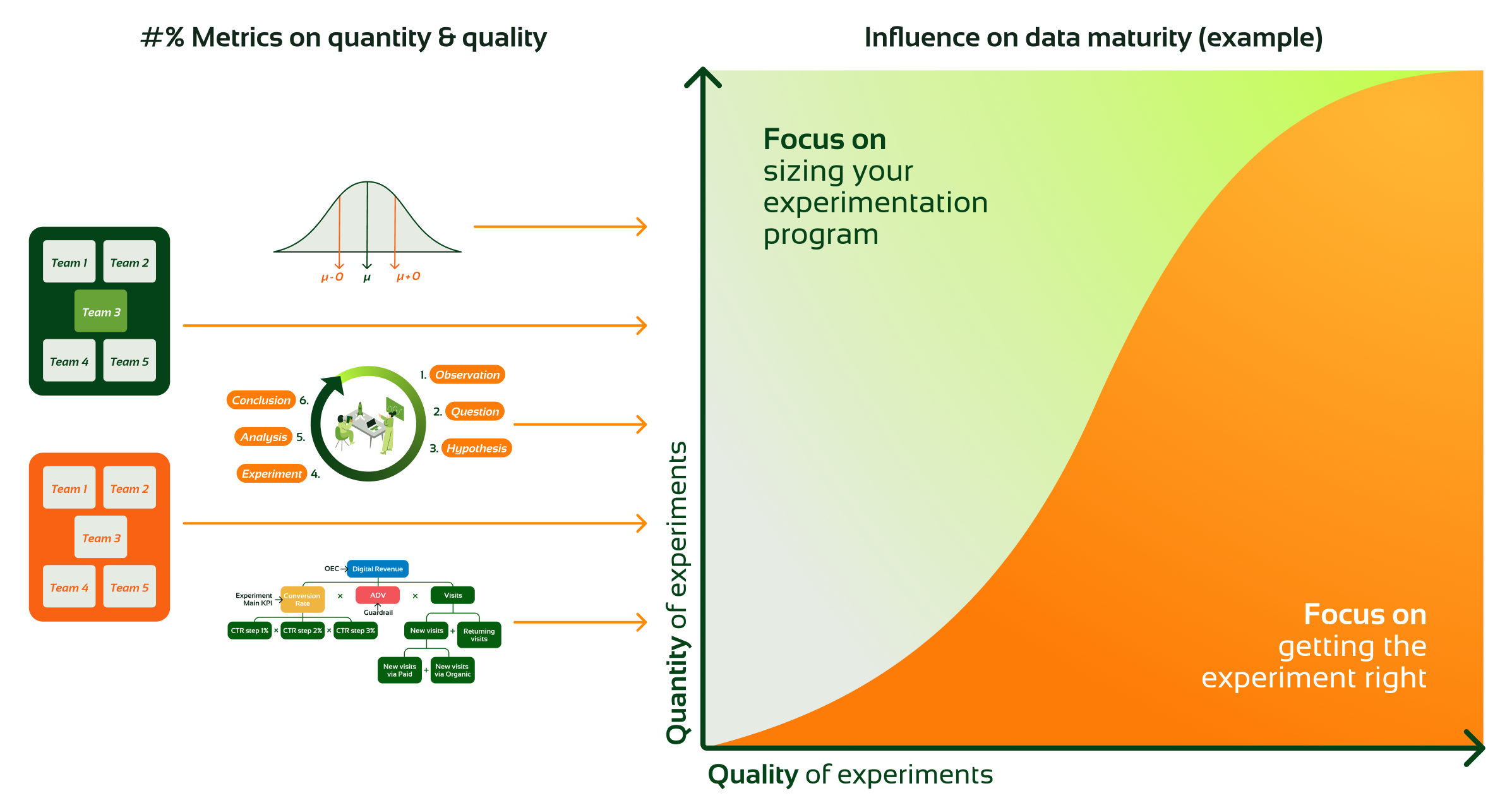
With this multidisciplinary team and a clear purpose, the first results came quickly: the number of experiments increased by 54%, while the success rate rose from 37% to 43%. The value was measurable and visible.
3. Form: The insight-driven optimisation vision
The proven results and strong vision gave confidence to use the upcoming reorganisation as an opportunity. Working in multidisciplinary teams was a major shift. Where disciplines once worked separately, data analysts, UX researchers, content managers, and CRO specialists now collaborated towards one seamless and intuitive customer journey.
4. Enlist: Kick-offs, workshops, trainings and systems
All team members were assigned to a customer journey team. To onboard everyone into this new way of working, we organised training sessions and a kick-off for all teams. It was also crucial to set up systems to support the approach. This made it easier to prioritise with stakeholders. We also introduced a quarterly focus on a sub-journey and adopted sprints, with all activities tracked in a shared overview.
The result: better communication, sharper prioritisation, and a big step forward for the teams.
5. to 8. Enable, Generate, Sustain & Institute: Scaling and embedding the tooling an WoW
Not everyone was immediately ready for the increased focus on customers and data. That’s why we invested in ongoing training—in tools, skills, and supporting processes. By using different tools more effectively, we ensured stronger embedding of the approach across the organisation.
FigJam for collaborative journey mapping
TheyDo for documentation and journey management
Airtable for backlog and experiment management
Jira for development
Optimising the toolstack proved crucial for effective collaboration.
Three challenges to keep in mind
In our collaboration, we brought many people together, worked purposefully on journeys, and created impact on key organisational KPIs. Alongside the positive results, we also encountered several challenges. Below are three examples, though challenges will vary by organisation and maturity level.
1. Acceleration and scaling: Automating with AI
As the customer feedback programme and number of experiments grew, so did analysis time. By using AI for topic and sentiment analysis, we significantly reduced the workload.
2. Collaboration beyond your own transformation
Since other departments were not yet undergoing the same transformation, dependencies arose that slowed down progress. The next step: involving more disciplines in the journey approach.
3. Resource allocation
Different backlogs and priorities across departments made it difficult to deliver large initiatives. By demonstrating proven value, the journey teams secured dedicated resources for their experiments, such as 20% development capacity.
What does this mean for you?
Working at journey level requires multiple disciplines, new skills, and a fundamental change in approach. KPN has shown that it can be done—and that it delivers real value. KPN grew from 73% fully digital customer journeys in 2024 to 77% in 2025.
The question is: are you ready to move from isolated optimisations to scalable, data-driven journey impact?
📩 Let’s connect to explore how we can accelerate your customer journeys together.
Want to know more?
Danny will be happy to talk to you about what we can do for you and your organisation as a data partner.
132% more customers fully supported with conversational AI
Insurer Univé wanted to improve customer satisfaction and reduce pressure on its customer service team by handling more customer questions directly through the chatbot. However, the existing scripted chatbot struggled to deal with different types of questions and context, meaning customers often still ended up speaking to an employee. By replacing the scripted chatbot with one based on a large language model, customer satisfaction increased while pressure on customer service decreased.
Better online services through a scalable experimentation programme
The Municipality of The Hague wanted to use data-driven experiments to improve its services, for example by optimising the website so residents could complete more tasks independently. The web analytics team also wanted to make its contribution to the organisation’s objectives more visible.
How data helps grow annual lending from €3M to €10M
Wakibi connects lenders with entrepreneurs in developing countries and aims to stimulate sustainable economic growth. To increase its social impact, the organisation has set an ambitious growth target: increasing annual lending volumes from approximately €3 million to €10 million by 2030.
Strengthening a data-driven mindset through tailored analytics training
Within Eneco’s Data Driven Marketing Chapter (around 60 colleagues), there was a growing need to better embed data-driven ways of working. The ambition was clear: not only data specialists, but also marketers and other teams should be able to perform analyses independently and make well-founded decisions.
Net Promoter Score (NPS) as a starting point for better customer experience
If you ever buy something online, chances are you’ve seen this question pop up:
“How likely are you to recommend us?” For many organisations, that single number has become a holy grail. Everyone talks about NPS — from marketing teams to senior management. But how valuable is that score really? Many organisations measure NPS on a structural basis, yet struggle to translate it into concrete improvements. The score goes up or down, but remains disconnected from real decisions. In this article, we explain how to use NPS to create insight and impact — and where to be cautious.
Tealium Digital Velocity: AI is moving into production
For professionals in data, analytics, martech and customer experience, Digital Velocity is one of the events where developments become tangible. It brings together practitioners, partners and industry leaders to show how they approach AI, real-time data and customer experience in practice.
Truly enhance the customer experience with customer experience analytics
When you combine quantitative and qualitative data with the aim of genuinely understanding your customers, you create real value. This approach allows you to identify the actual issues customers face and gain insight into their experiences. By addressing these challenges, you make a lasting impact. To achieve this, you need to develop and optimise experiences that are both evidence-based and human-centred. In this article, we answer the most frequently asked questions about customer experience analytics. Discover what you need to focus on if you truly want to improve the customer experience.
Many organisations invest heavily in attracting new customers, but often forget what truly matters: Do users actually see the value of the product? In this blog, we’ll explain what "first value" is and how to effectively measure this moment. We’ll also give you tips on how to help users experience value. This is the first step towards satisfied customers who integrate your product into their lives.
Special Olympics Netherlands is the national sports organisation for people with an intellectual disability. The organisation is committed to making sport accessible all year round. This gives participants the opportunity to develop their skills, enjoy themselves, and share their achievements with those around them.
With Scaling Experimentation Effectively (S.E.E.), you can take your experimentation programme to the next level, or we can help you launch a programme. We listen to your ambitions and scale the quality and/or quantity of your experiments.
Smart text analysis: how our AI tool rapidly categorises large amounts of data
Analysing hundreds or thousands of open answers from surveys, interviews or reviews is time-consuming. To better understand those answers, we group them into themes (for example: ease of use, service, delivery or reliability). At Digital Power, we use Large Language Models (LLMs) to quickly categorise high volumes of open answers. Our team built our own secure, transparent tool that lets us see exactly what happens under the hood. But is AI already advanced enough to replace our human researchers?
A future-proof monitoring process based on quantitative and qualitative data
To improve the liveability of the Woensel-Zuid district in Eindhoven, more than 60 partners joined forces under the name Pact Woensel-Zuid. At the start of the initiative, goals were defined, but translating these into concrete indicators and a monitoring framework to track progress proved challenging. They asked us to develop a monitoring process that provides data-driven insights into the programme’s progress.
Tips for measuring product adoption: pitfalls and solutions
When you launch a new feature, you naturally want to know if people actually use it. Makes sense. Yet measuring adoption is less straightforward than it seems.
What do we even mean by adoption? And when has someone truly started using your product?
In this blog, we walk you through the most common pitfalls when measuring adoption and give you practical tips to measure this metric effectively.
You optimise a form and see that it is completed twice as fast. Great result, right? Until the customer service department is flooded with calls about error messages. In this blog, we show you the biggest pitfalls when choosing metrics and give you practical tips to decide which metrics you should actually focus on.
From ambition to activation: how Ennatuurlijk really got moving with data
At energy company Ennatuurlijk, the belief grew that intuition was no longer enough to set the course. The energy market was changing rapidly, the organization was growing, and the amount of information was increasing every day. IT Manager Eric Vanderfeesten went looking for a data partner who could not only provide strategic advice on data-driven work, but could also strengthen his data team operationally. In this interview, he shares his vision, experience and results from working with Digital Power.
How your organisation can get more value from experiments
Within your organisation, quite a lot of experimenting is already taking place, perhaps even extensively. Yet there is much debate about the resources and time it requires, and the added value is not always clear. Sound familiar? In this article, you’ll discover how to tackle some of the major challenges in getting value from experimentation.
How more insight into user behaviour led to a more active platform
JongPIT is a foundation with a platform for young people with chronic conditions. It allows them to share experiences, organise online activities, and make their voices heard in society. The members and moderators of the foundation are committed to keeping the community active.
Optimised customer journey for KPN thanks to new way of working
Imagine this: you're working from home and everything seems to be going smoothly. Until suddenly, your internet starts acting up. Your emails won't send, Teams doesn't work, and your favourite series keeps buffering. Frustrated, you try to fix the issue yourself using your provider’s website. In this case, KPN. But the self-service tool offered provides no clear solution. You don’t fully understand the instructions, and after several attempts you decide to call. While waiting on hold, you ask yourself: Why is this so complicated? Why can’t I just fix this myself?
Webinar | How to experiment or validate with low traffic
Do you regularly adapt your digital product or service, but not sure if it really works? With few visitors and low conversion rates, traditional A/B testing is difficult, but certainly not impossible. In this webinar, you will learn how to validate ideas and gain valuable insights, even with a small sample size.
Optimised user experience through intuitive UX design
Privacy First is committed to protecting citizens' privacy. With the arrival of the new European law EHDS (European Health Data Space), the medical data of all European citizens becomes accessible to governments, Big Tech, Big Pharma and medical researchers.
From strategy to realisation: a data-driven future
Ennatuurlijk supplies sustainable heat and cold via heat networks to consumers and businesses. The internal Data & Analytics team is tasked with making the organisation data-driven. In doing so, they ran into a challenge: the many requests for data products within the organisation were difficult to manage and the impact remained limited. The management team therefore asked us to help them develop a data strategy, create a future-proof data landscape and drive a data-driven mindset within the organisation.
Optimising product lifecycle and maintenance through data analysis
CitizenM wanted to improve the performance of different product generations in their hotel rooms. This specifically concerned sinks and showers, by improving models and technological, performance and design improvements from manufacturers.
Are you tired of guessing what your customers want? When traffic for your website or digital product is low, creating exceptional experiences can feel challenging—but it doesn’t have to be.
Optimisation opportunities for mobile customer journey insight using mapping
citizenM wanted to understand the customer journey and thus increase the conversion rate of the mobile booking flow. They asked us to identify optimisation opportunities through a two-month pressure cooker. The aim here was to solve customer problems. Where in the flow was citizenM losing customers and what adjustments could result in more hotel rooms booked? Our Experience Analytics experts zoomed in on the mobile customer journey using insight-driven optimisation.
Most organisations that offer digital products, experiences, and services conduct experiments, typically to increase conversions. In practice, alongside many other applications, we see the risks you face if you don’t experiment. In this article, you’ll find answers to the most frequently asked questions about experimenting.
A Perfect Jane is a webshop focused on vegan boots made from apple leather, recognisable by their green sole in the shape of a leaf. The webshop noticed a lot of traffic from marketing activities but felt that these visitors were of low quality, resulting in a low conversion rate. They also perceived a low conversion rate from regular traffic. Additionally, the webshop aimed to reduce the number of returns and increase the average order value. A Perfect Jane enlisted the help of our Customer Experience Analysts for advice.
citizenM is an innovative hotel chain with city hotels in the luxury segment. The digital customer experience is a key element of the customer journey. For example, hotel guests check in themselves online and can control the equipment in their room with a tablet. To better align the website with hotel guests' offline experience, citizenM wanted to revamp their hotel rooms page. They asked our research team to provide insight into the potential impact of this revamp.
Research into the impact of direct mailing campaigns
Resto VanHarte brings people who are lonely together by offering them an affordable three-course meal in one of their community restaurants. Not only elderly people often live in isolation; for example, students and single parents also fall within the target group. A campaign aimed at a broad audience received little response. They asked us to investigate why this was the case, with the aim of learning how it can be improved in the future.
3 mapping methods to understand your customer journey
Understanding the needs of your target group is crucial for the effective development and optimisation of (online) products and services. Putting yourself in the customer's shoes helps your organisation create a user experience that matches the wishes, needs and emotions of that target group. In this article, you will read more about 3 mapping methods to map out a complete customer journey.
Optimal customer experience through enhanced incident insight
citizenM aims to prevent, reduce, and resolve incidents in its hotels more efficiently. They established an Incident Management Product Team to consolidate scattered initiatives and make the working method scalable and future-proof. They asked us to examine the current process and map the desired situation.
UX research for the expansion and optimisation of a banking app
A bank wanted to know whether it was desirable to add a new functionality to their app. This functionality already existed as a separate app from the bank app. Would merging the two apps bring extra value to users? Our researchers explored this via qualitative desirability study.
Digitalisation, digital transformation, start-ups: digital products are being developed all around us. Think of banks that serve users entirely via an app, the entertainment industry that makes content available via an app, and fully digital work processes. One thing is certain: users of a product want to get value from it. Strangely enough, this is often not looked at on a structural basis in practice.
The strength of mapping within your optimisation process
Does your organisation struggle to steer on its KPIs? Or do isolated teams hinder internal collaboration? Mapping offers a powerful solution to these challenges, one that we at Digital Power firmly believe in. Mapping is a strategic tool for visualising situations, whether it's a customer journey such as a purchase process or app usage, or a process like order processing.
Risk reduction through informed business decisions
In this episode of the MIE'24 podcast series, CEO René de Boer discusses risk reduction through informed business decisions with Customer Experience Analyst Youp de Graaf.
Stop unnecessary investments in website optimisation
You strongly feel that your website or a particular page no longer meets your customer needs or brand identity: time for an update! Will you immediately invest in developing something new or will you first invest in research? In this blog, we explain why research prior to website optimisation can save you a lot of unnecessary costs and problems.
How a hypothesis helps determine if you are successful
A well-known scenario: when a product or service is renewed, the assumption is made that an improvement has been achieved. Think, for example, of an adjustment to your website, the implementation of a new product feature or the digital transformation of an organisation to work more efficiently. If you really want to test whether the situation is better after the implemented innovation, you will have to start creating hypotheses prior to the change.
Rapid analysis of a survey with both closed and open-ended questions
Nationale Jeugdraad is an umbrella organisation for 37 Dutch youth organisations. To gain a thorough understanding of youth behavior and opinions, they conducted a survey among a large group of young people. As they did not have the appropriate personnel available themselves, they enlisted our assistance.
Replacing qualitative researchers with AI, a good decision?
Artificial Intelligence seems capable of everything, and sometimes even better and faster than what we can do ourselves. Analysing qualitative data is a time-consuming task, and as researchers, we are curious if it can be done faster and easier. Does AI offer a solution for this? Our researchers investigated.
The Municipality of The Hague was seeking a partner to assist them with their web analysis. In doing so, they had a central goal: to investigate the performance of their future new website and identify opportunities for further optimisation. They enlisted our help to establish and execute the process.
Lean Six Sigma project for optimisation of change management process
A Dutch telecom provider sought to examine and enhance their change management process using Lean Six Sigma. The objective was to maximise successful changes in hardware and software, evaluate risks, inform customers, and conduct assessments. The telco aimed to strengthen operational stability, streamline network and IT maintenance, foster innovation, and optimise service delivery.
KWF is a Dutch charity dedicated to fighting cancer. The organisation was working on the development of a Memoriam Platform. This is a new initiative to create personalised memorial pages for the deceased. On these pages, donations can be made to KWF.
Evaluating brand alignment website with user perception
In October 2022 we launched our new website, in a fresh design style. We asked our partner Kaliber to update our branding and website with a design that fits our brand values. After the website went live, we wanted to know if they succeeded at this. Therefore, our own research consultants designed and conducted a research study to evaluate the effectiveness of the new design in conveying our intended brand values and message.
Comprehensive customer data overview through data warehouse
One of the largest professional service providers in the Netherlands aims to achieve a comprehensive overview of their customer data. They wanted to build a data warehouse or Customer Data Platform (CDP) for this purpose and asked for our help.
A/B testing is a powerful tool for validating the impact of optimisations across a website, app or marketing campaign. In A/B testing, statistics are crucial in determining whether the found results are significant or coincidental.
A job as a Data Analyst at Digital Power: What does this job look like in practice? What skills are required? And what kind of work will you do? Marloes talked to Jasmijn, Customer Experience Specialist, to get an idea. Listen to the Dutch podcast or read it in the article below!
The organisation Doctors of the World offers medical assistance to people in a vulnerable position. They often do not know how to find their way in the Dutch healthcare system. Doctors of the World helps them with this. One of the channels to get informed about the work of Doctors of the World is the website, which will be redesigned.
Dutch citizens living, working or studying abroad must also take care of things like renewing their passports, arranging tax issues and pension with the Dutch government. This can be something of a challenge by being far away from the Netherlands, due to fragmentation of services, time difference and different situations. In a project which lasted from 2018-2022, the Ministry of Foreign Affairs therefore worked together with 12 implementing organisations (e.g. Tax and Customs Administration and RDW) on government-wide access to public services. The service is called Netherlands Worldwide (NWW). NWW is accessible 24/7 on the website, and direct customer contact channels such as telephone, WhatsApp and email.
Data-driven optimisation of offline customer service
For some time now, we have been assisting PostNL's customer service department with the optimisation of their online service & contact environment. Various pilots showed that there was also a lot of potential in improving the offline service.
The 'app rating' as a metric for your product team
Before downloading a new app, consumers often look at the app's rating. This is shown in stars with 5 stars being the highest rating. What does the app rating mean for your organisation? And for your users? The app rating is a metric that accurately reflects the tension field between marketing and product. While the importance of a high rating is obvious, a shortcut can be taken on the way to it. How does your organisation use the app rating?
Data-driven optimisation of your digital service environment
Good service is important for customer satisfaction and loyalty and therefore very valuable for companies. Many companies offer services digitally. Customers can then find information about a product via a website or app. Optimising this digital 'service environment is best achieved with the help of data.
Whereas conversion rate optimisation (CRO) used to be mainly in the E-commerce focus, we now see its application in all kinds of forms and fields. The focus here is on improving a particular conversion goal. Whatever your goal is for your organisation or team, CRO requires a good approach. This e-book will help you get started.
Get more value from your development team with the help of a CX specialist
Is your organisation's backlog of the development teams overcrowded? Then you may be of the opinion that investing in Customer Experience (CX) specialists is not a good idea at the moment. This is based on the assumption that the CX team will come up with suggestions for improvements for the website/app and therefore 'burden' the development backlog even more. Yet there is definitely added value in investing in a CX specialist, even when there is high pressure on the development capacity. PRECISELY when there is a high pressure on the development capacity…
Every day, we collect data. Think of customer data, website visitor behaviour, information about conversions through all your off- and online channels and the performance of different teams within your organisation. But how do you use that data effectively?
Do you want to get more out of your conversion rate optimisation process, or do you want to know which pitfalls there are and how to avoid them? This blog article contains 5 tips on how to professionalise your CRO process so that you can get more value out of it.
You have worked with your product team on developing a new product. You have certain expectations of how users will use the product. The only question is: is this really the case? Are they using the product as you imagined? Who is using the product and who is not? In this article we discuss the Product User Activity Model. This model gives you more insight into the current and potential use of your product to take targeted action for growth.
Process Mining as input for (online) customer journeys
Data is increasingly being used to map customer journeys. Which makes sense, because we collect a lot of data in our analytics tool around the online part of the journey. A technology that can lead to valuable insights but is often forgotten is process mining.
How to measure user goals in a digital environment
When are user goals optimally supported by a digital environment? Everyone has an idea about this, for example 'a pleasant purchase flow' or 'easy login'. How effectively you support the user is challenging to measure. However, it is everything that determines the success of your digital environment. To help you measure your success, or to check if something is missing in your current framework, we share our Customer Experience (CX) pyramid.
Data-driven web and customer experience optimisation
Eneco customers can enter into or change an energy contract via the website, but also purchase a charging station or hire an energy coach, for example. Eneco wanted to bring in more expertise regarding the field of digital analytics. We helped Eneco find an extra Web analyst with whom this ambition could be fulfilled.
There's no denying it. We all work with data and we generate huge amounts of new data every day. The data on our supermarket customer card, the disposal of household waste at the smart container, checking in with public transport, the number of hours our TV is on or refilling our parking meter. But how do you use that data effectively?
Measurable impact Service Design team on UX internal tools
KLM Digital Studio builds innovative digital solutions to make working at KLM more efficient, effective and enjoyable. One of the teams within Digital Studio, the Service Design team, is concerned with user experience. They conduct user research, build designs and test design ideas for new digital solutions. KLM asked us to provide insight into the impact of this team on the UX of its internal tools.
Product analytics for essential insights into usage and usability
KLM employees work with various applications on a daily basis. For example, the ground staff uses Appy2Help. This digitises work processes and supports employees in answering all questions from passengers. iMech helps to free up more time for maintenance instead of administration and the intranet is my. klm is the starting point for everyone within KLM to find information. KLM asked us to support various teams in developing good applications using insights from user data.
As Customer Experience Specialists at Digital Power, we regularly come up with 5 metrics that help us measure user quality. With this we are taking the first steps in optimising the Customer Experience. We are happy to walk you through all 5 of them. Are you going to use them from now on to analyse the user experiences of your product or service?
When we talk about Customer Experience, we mean virtual assistance in the form of voice and chatbot applications. It is expected that these will make interaction with the customer more accessible and easier. Companies like to go along with these kinds of innovative trends to improve their services. Is this indeed what Customer Experience Optimisation is all about?
Customer Experience Optimisation: a structured approach
More and more organisations are aware of the impact of the customer experience on business results and competitiveness. Research shows that 84% of organsations prioritise customer experience more than they did two years ago. In fact to 76%, it is high or top priority. Further research shows that the customer experience is essential to the marketing strategy according to CMOs.
More employee engagement using inspirational sessions about the employee experience
In the tight labour market, professionals no longer choose their new employer only because of the employment conditions. Increasingly, they decide whether or not to come on board and stick around based on employee experience. The 'employee experience' is therefore important in all phases. Not only at the recruitment and selection level, but also, for example, when processing a claim.
Residential investor Vesteda is working on a new website. This must offer (potential) tenants and B2B customers, such as investors and pension funds, an optimal online experience. Buyer personas of the various B2C target groups had already been developed. Together with Vesteda, we also started to map out the B2B target groups. In addition, together with the customer, we developed the optimal customer journeys for the most important buyer personas.
More online conversions thanks to an improved UX thanks to a user experience review
A Smart Security Scan is a tool that allows you to test the security of websites. The reports showed that something went wrong in the flow where people have to verify their IP address to be able to scan. We went looking for a solution. We also gave tips to optimise online conversion.
'How do we make our app more accessible to people from Vietnam?' During a Learning @ Location Day, our multi-disciplinary team of data professionals worked on this Oxfam Novib challenge.
Higher customer satisfaction and increased conversion by setting up an A/B test environment
Vodafone started a 3-month 'digital boost' project with the aim of improving the conversion of the online shop. The project team consisted of external digital professionals, each with their own specialism. As part of this project, we set up an A/B test environment with the aim of improving the user experience and thus increasing conversion.