The importance of the right metrics
Measure not everything you can measure, but what helps your organisation move forward.
- Article
- Customer Experience


You optimise a form and see that it is completed twice as fast. Great result, right? Until the customer service department is flooded with calls about error messages. In this blog, we show you the biggest pitfalls when choosing metrics and give you practical tips to decide which metrics you should actually focus on.
What is a metric?
Dashboards are often filled with impressive-looking numbers – page views, downloads, users, or interaction rates. But what do they really say about success? Often very little. They are mostly metrics that look valuable but are not.Before we dive into the pitfalls, let’s start at the beginning: what actually is a metric?
A metric is something you can measure, count or calculate. But in practice, it is much more than that: it guides you, helps you make the right decisions and makes abstract concepts such as customer experience tangible. You can see metrics as the translation between intangible reality and your strategy.
Still, not every metric is valuable; not everything you can measure should be measured. So what makes a metric good?
A good metric
✅ Is action-oriented and helps you make decisions
✅ Aligns with organisational goals
✅ Has a clear definition
✅ Is reliable
✅ Has an owner
✅ Encourages the right behaviour
✅ Is interpreted in context
✅ Is combined with guardrail metrics
✅ Can be traced back to customer or organisational value
✅ Has a target
Choose metrics at the right level
There are many different kinds of metrics. Some focus on technology or events, others on behaviour or impact. Each individual, team or department has its own metrics and its own role in the bigger picture.
That’s why it is important to think about what the metric actually measures and how you can make success visible at all levels. This way you can connect metrics across levels and create a clear line from activities to outcomes.
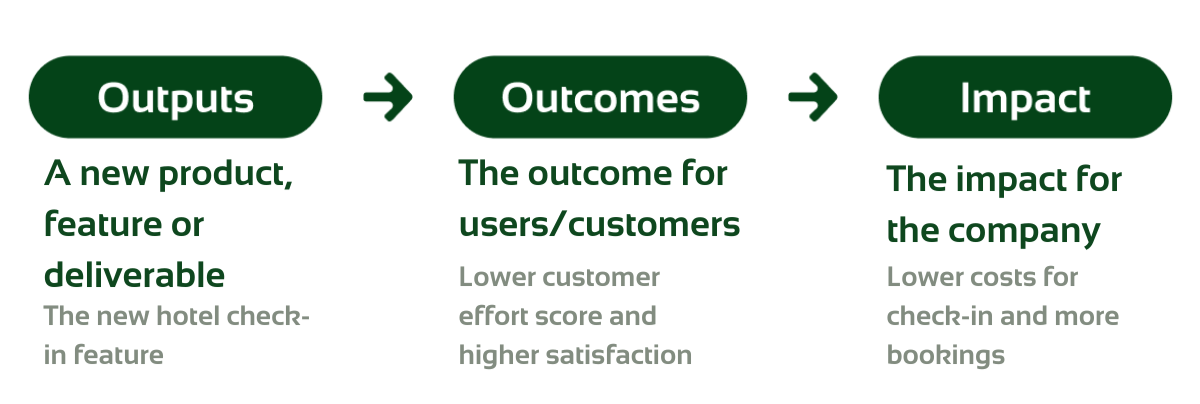
Imagine you work for a bank and want to build a new feature that lets customers automatically save money with each card transaction. This feature impacts several levels:
- Output – The new feature itself
- Outcome – Customers use the feature, save more often, and their average savings balance increases
- Impact – Customers experience more financial peace of mind, the bank benefits from stronger customer loyalty and a higher total savings balance
When measuring the impact of a change, you shouldn’t just look at building the new feature (output), but also at the effect on relevant customer behaviour (outcome). This behaviour should relate to value for the customer, the organisation, or society (impact). Being able to connect what you do with what it delivers, which behavioural change you cause and what value it creates, is crucial.
Every metric needs a target and an owner
Dashboards are full of metrics, but often no one feels responsible for taking action. A good metric must always have an owner: someone responsible for follow-up, interpretation, and actions.
This does not mean this person must solve everything on their own, but it must be clear who starts the conversation if the metric deviates from expectations.
And that brings us to the next point: when does a metric deviate from expectations? When do you intervene and where do you want to go?
Without a target, you know what you measure but not where you want to go. Without a target, a metric often remains “interesting information”, whereas a concrete goal makes sure teams know what they are working towards and makes success tangible.
The pitfalls of vanity metrics
Often “more” is seen as “better”: many users, a high engagement rate, a large number of events.
Many of these so-called vanity metrics look impressive but can be misleading. For example, a large number of users is meaningless if they do not convert. These “biggest meaningless numbers” (BMNs) look impressive but say very little about success.
It should also be clear what you are actually measuring. Are you counting users based on cookies, devices, or unique accounts? And do employees count as well?
When optimisation backfires: the importance of guardrails
What you measure determines what you steer towards, and that can backfire. A form being completed twice as fast looks like a win, but not if users make more mistakes and your team has to call dozens of people. A higher order volume is great, but not if it comes with more returns and negative reviews.
This highlights the importance of guardrail metrics, such as satisfaction, returns, and the percentage of correctly completed forms, which help monitor negative side effects of optimisations.
Measure not just organisational value, but customer value too
In many organisations, the focus lies on extracting value from the market. But you cannot extract value from the market if customers get no value in return.
The exchange between organisation and customer must be in balance for sustainable customer relationships. Measuring customer value is therefore crucial. Reducing production costs has a positive short-term effect, but not if customers become dissatisfied and do not return. Good metrics make both sides of the value exchange visible, helping you build sustainable customer relationships.
Lagging vs leading: look forward
Revenue or profit tells you something about what has already happened – these are lagging indicators. They are important but say little about future success. Leading indicators, on the other hand, predict success.
Measurable behaviours that predict success include product usage over time, but also sentiment measurements like Net Promoter Score (NPS) or Customer Effort Score (CES). This type of behavioural and sentiment data allows you to adjust course: you can experiment, optimise, and see what happens before it impacts your revenue.
This combination forms the basis of evidence-driven product growth (EDPG), where customer behaviour and experience are linked to strategic objectives. This lets you grow based on what users do, why they drop off, and when they are successful.
✅ Checklist: Is your metric a good metric?
Use these questions as a guide for every metric you want to use or report:
- Can you base a concrete decision on it?
- Does it explain or predict behaviour or success?
- Does someone have ownership of the metric?
- Does it contribute to your strategic goals?
- Is the definition clear and consistent?
- Can it be measured reliably?
- Do you view it in combination with other relevant metrics?
- Are possible side effects monitored with guardrails?
- Does it show whether you deliver value for the customer?
- Does the metric have a target?
Take another look at your dashboard: Are you measuring the right things? Does it inspire the right actions?
Struggling to figure it out on your own? Get in touch with our colleagues; we’ll work through your challenges together.
This is an article by Mila van der Zwaag
Mila is a Researcher and Customer Experience Specialist at Digital Power. She has a background in Cognitive Psychology and likes to combine this knowledge about people and behaviour with data to arrive at the best solutions.
Customer Experience Specialistmila.vanderzwaag@digital-power.com
Receive data insights, use cases and behind-the-scenes peeks once a month?
Sign up for our email list and stay 'up to data':