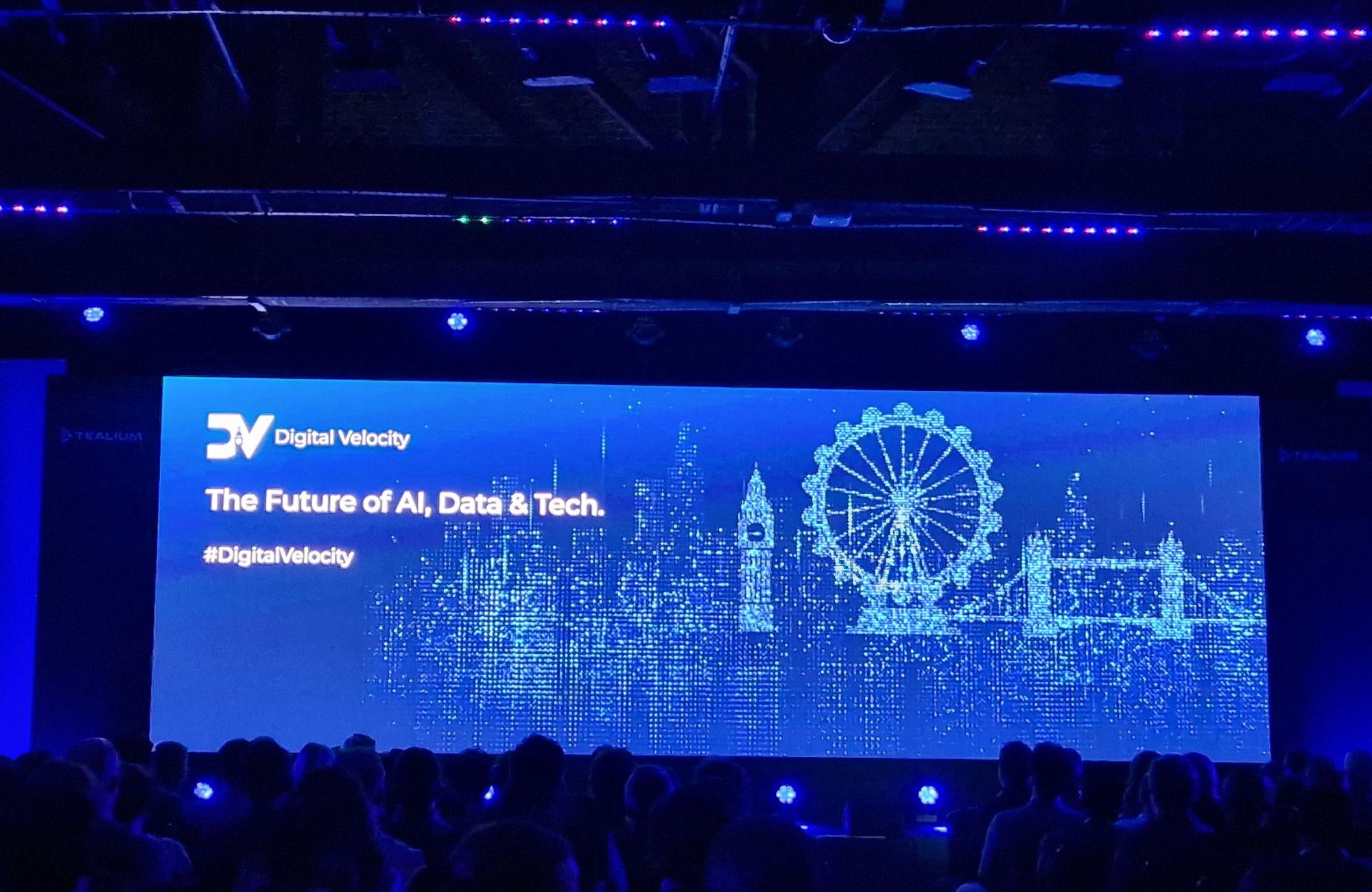
Tealium Digital Velocity: AI is moving into production

Why real-time data is becoming the foundation for scalable AI

  • Article
  • Technical Web Analytics
  • Data Science
  • Customer Experience
  • Data Analytics
Tealium Digital Velocity

For professionals in data, analytics, martech and customer experience, Digital Velocity is one of the events where developments become tangible. It brings together practitioners, partners and industry leaders to show how they approach AI, real-time data and customer experience in practice.

We attended on 16 and 17 March. These were our main observations from this year’s event:

From AI introduction to implementation

In 2025, Tealium’s focus was largely on introducing AI capabilities across its platform. In 2026, that focus clearly shifted towards practical application.

Several organisations shared concrete use cases. LALIGA showed how real-time fan engagement works in practice. BBVA presented cross-sell activation strategies. Radisson explained how it is restructuring its approach around audience-first data.

A clear pattern emerged: AI is increasingly becoming part of operational processes. The focus is no longer mainly on experimentation, but on implementation. That includes deploying models in production, activating data in real time, and scaling use cases across teams.

Tealium’s move towards an AI data layer

During the event, Tealium presented its vision of an AI data layer. This builds on existing customer data capabilities and focuses on making data directly usable for AI-driven processes.

Key developments discussed during the event included:

  • Real-time context for AI models, using consented customer data to improve accuracy and relevance.
  • AI at the edge, enabling on-device processing for faster response times and improved privacy.
  • Agent Engine Optimisation, aimed at preparing digital environments for interaction with AI agents.
  • Real-time decisioning at the source, allowing customer scoring during interactions rather than after processing.
  • Generative AI support for implementation, such as natural-language audience creation and automated data layer configuration.

The direction is clear: reducing the time between data collection, analysis and activation.

What this means in practice

The sessions reinforced one consistent theme: the effectiveness of AI depends heavily on how well data is organised and how accessible it is.

In practice, that usually requires:

  • a reliable and well-structured data foundation;
  • alignment between teams working with data, marketing and technology;
  • clearly defined use cases that connect data to business outcomes.

A structured setup, for example through a composable CDP approach, helps make data usable across systems and teams. It also supports more advanced applications over time. This aligns with our broader view of composable CDPs as a flexible and scalable way to collect, process and activate data.

A practical example

One of the standout moments for us was seeing our client present a use case on stage that we developed together. The session showed how a specific AI-driven application can move from concept to implementation, and what is needed across teams, processes and systems to make that happen.

Looking ahead

The overall direction is clear: organisations are working towards making AI part of their regular processes, supported by real-time, well-governed data.

This does not necessarily require more tools, but it does require better integration between existing systems and a clearer focus on how data is used in practice.

Curious how to apply this in your own organisation? We work alongside you as a Data & AI partner to make AI practical. That means building a strong data foundation, connecting systems, and helping you move from idea to implementation, step by step.

This is an article by Sarah Busson

Sarah works as a Technical Web Analyst at Digital Power. She has worked with both small and large companies to implement robust tracking solutions and her latest focus is on server-side tracking developments.

Sarah Busson

Want to know more?

Stefan will be happy to talk to you about what we can do for you and your organisation as a data & AI partner.

Receive data insights, use cases and behind-the-scenes peeks once a month?

Sign up for our email list and stay 'up to data':

You might also like

Monthly Digital Insights – November 2026

In this monthly series, we share the latest trends, product updates and industry insights in AI, data and analytics that are most relevant to you. We look beyond the update itself and explain what these developments could mean for your organisation, where they may create opportunities and how you can turn them into value.

Read more

50% faster development of Customer 360 functionality with Databricks Lakebase

To provide customers with effective, personalised support, Independer needs a reliable and complete view of each customer. However, its existing Customer 360 architecture was complex and difficult to extend. Together with Independer, we modernised the technical foundation using Databricks Lakebase. As a result, the data team can develop new functionality faster, while laying the foundation for processing more customer data in real time. This improves their customer service.

Read more

Digital Power and SAS CI360 join forces to enable relevant customer interactions

By combining the data expertise of our Digital Power consultants with SAS Customer Intelligence 360 (CI360), you can turn customer insights into personalised, real-time customer interactions. The result: more relevant communication, stronger customer relationships and higher marketing ROI.

Read more

Conversational analytics in practice: Coolgreen demo

Conversational analytics makes data accessible to everyone, without the need to perform complex analyses or navigate multiple dashboards.

Read more

17% improved customer recognition and better cross-device journey insights

Customers rarely book a flight on their first visit to the website or when using the app for the first time. They search, compare, return later, manage their booking and interact across different devices. For Transavia, browser privacy restrictions made it increasingly difficult to connect those interactions over time.

Read more

Monthly Digital Insights – October 2026

In this monthly series, we share the latest trends, product updates and industry insights in AI, data and analytics that are most relevant to you. We look beyond the update itself and explain what these developments could mean for your organisation, where they may create opportunities and how you can turn them into value.

Read more

Piano Academy 2026

Piano is evolving from a digital analytics platform into an AI-driven analytics and activation platform. At Piano Academy 2026 in Amsterdam, we saw how conversational analytics, contextual data and AI integrations are making data more accessible and actionable across organisations.

Read more

132% more customers fully supported with conversational AI

Insurer Univé wanted to improve customer satisfaction and reduce pressure on its customer service team by handling more customer questions directly through the chatbot. However, the existing scripted chatbot struggled to deal with different types of questions and context, meaning customers often still ended up speaking to an employee. By replacing the scripted chatbot with one based on a large language model, customer satisfaction increased while pressure on customer service decreased.

Read more

Monthly Digital Insights – September 2026

In this monthly series, we share the latest trends, product updates and industry insights in AI, data and analytics that are most relevant to you. We look beyond the update itself and explain what these developments could mean for your organisation, where they may create opportunities and how you can turn them into value.

Read more

Which BI tools are most ready for AI?

Artificial intelligence is becoming a structural part of how you work with data. Predictive models, generative AI and automated decision support are no longer experiments. They can be part of daily operations. At some point, you reach a critical question: does your current BI setup still support where you want to go?

Read more

Better online services through a scalable experimentation programme

The Municipality of The Hague wanted to use data-driven experiments to improve its services, for example by optimising the website so residents could complete more tasks independently. The web analytics team also wanted to make its contribution to the organisation’s objectives more visible.

Read more

From dashboard to data-driven working: marketing team takes control of its own data

Retailer EyeCare Groep made the transition from an external to an internal marketing dashboard. This immediately served as the starting point for working more actively with data. Using a central dashboard as a basis, we guided the marketing team towards a new, data-driven way of working. As a result, data has become part of the conversation within the team, marketers can explore insights independently, and they can make decisions more quickly.

Read more