What is S.E.E.?

Everything you need to know about Scaling Experimentation Effectively

  • Article
  • Scaling experimentation effectively
  • Customer Experience
Expert explains S.E.E.

With Scaling Experimentation Effectively (S.E.E.), you can take your experimentation programme to the next level, or we can help you launch a programme. We listen to your ambitions and scale the quality and/or quantity of your experiments.

Are you a CRO lead, digital director, product owner, or working in a role where experimentation is necessary to drive growth? Then this article is perfect for you. Anyone, large or small, can start experimenting.

The Importance of Proper Experimentation

To validate your solutions or new features, you can use A/B testing as a method. Essentially, three key elements are important for an experimentation programme in which you carry out these tests: a solid A/B testing process, the right technical implementations, and the human factors.

At its core, experimentation is about making as many informed decisions as possible. The growth in the number of experiments can come from various areas within a company, such as stakeholders, new features, or research. In all cases, it’s important that KPIs are attached that can be influenced by you or the team you work in.

The success of an experimentation programme depends on the number of decisions you make through experimentation, in relation to the quality of the experiments. Of course, the correct technical setup is important so that you can draw reliable statistical conclusions. The ultimate goal? To make informed decisions and reduce risks.

Sounds simple? In practice, it often turns out differently. We often see that organisations do not fully realise the value of their experimentation programme or that decisions are made based on incorrectly conducted tests. Additionally, we frequently see that the data from tests is inaccurate. The result: a low contribution of the experimentation programme to business objectives, or even misleading the business.

S.E.E. via Digital Power

The people

People are the most important aspect of your (future) programme. S.E.E. focuses on the desired ambitions of your organisation. This includes creating opportunities within the organisation, or scaling the number of individuals/teams that are experimenting. Additionally, we will celebrate successes and visually demonstrate the impact of the experimentation culture to engage stakeholders.

The process

With the process, S.E.E. helps improve the quality of your experiments at every step. We optimise the process, including the execution of each step.

The platform

The platform focuses on improving technical quality. This includes tasks such as continuously recognising users or properly implementing the A/B testing tool.

S.E.E. Solution

Our S.E.E. solution is applicable at both team and organisational levels. To ensure the process runs smoothly, the foundation of this solution is embedded in a framework and toolbox.

Digital Power can take both a guiding and an executing role.

S.E.E. Framework

The goal of the S.E.E. framework is to make opportunities visible, with the aim of improving the experimentation programme. This includes setting up experiments correctly or increasing their number. The value of experiments can be enhanced by focusing on the right opportunity areas and KPIs.
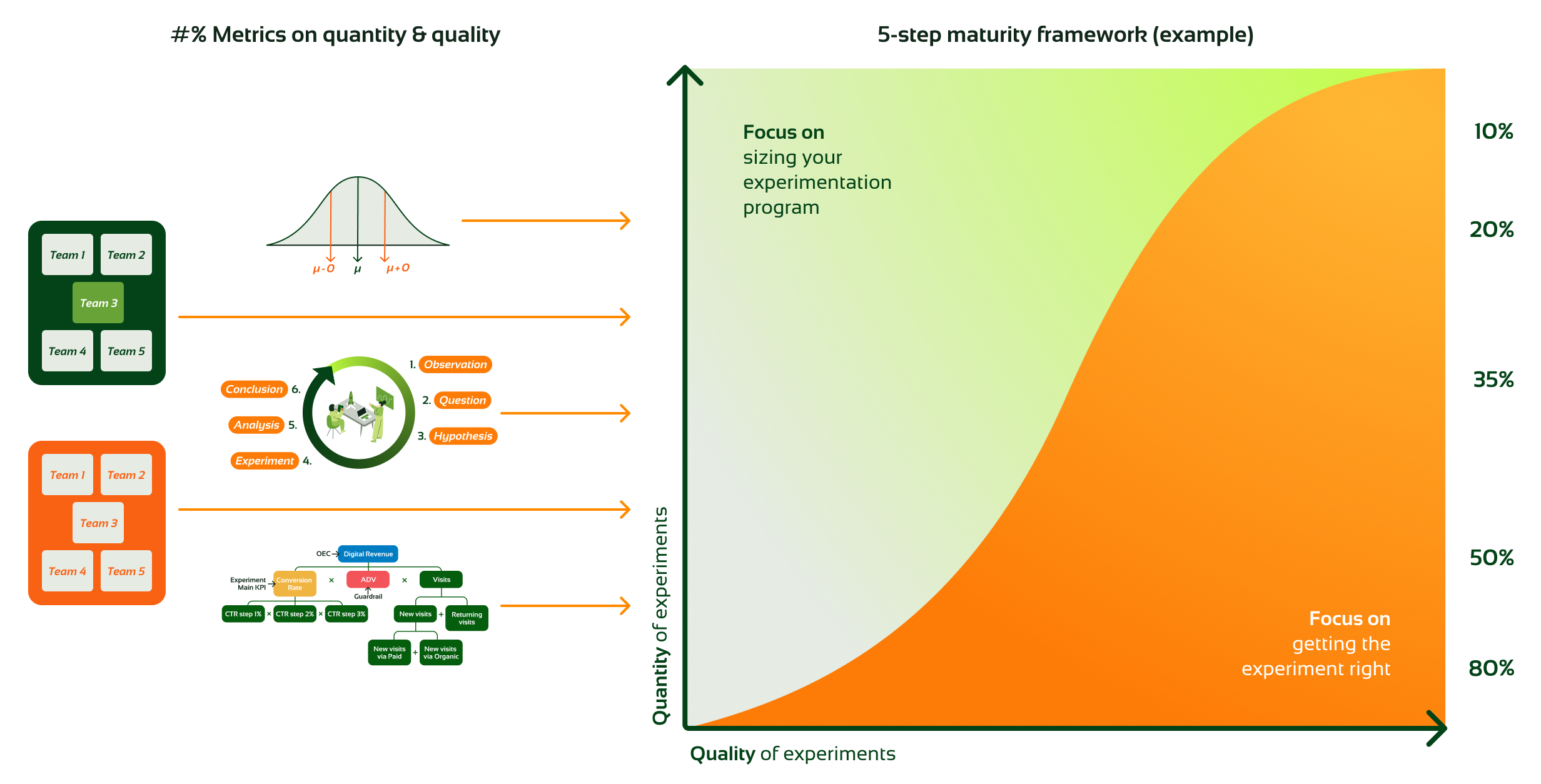
S.E.E. Framework

S.E.E. Toolbox

The goal of the S.E.E. toolbox is to scale the experimentation programme. We focus on training, templates, and support for experimentation. This includes applying the right statistics, improving technical quality, such as recognising visitors, enhancing measurements, and building A/B tests.
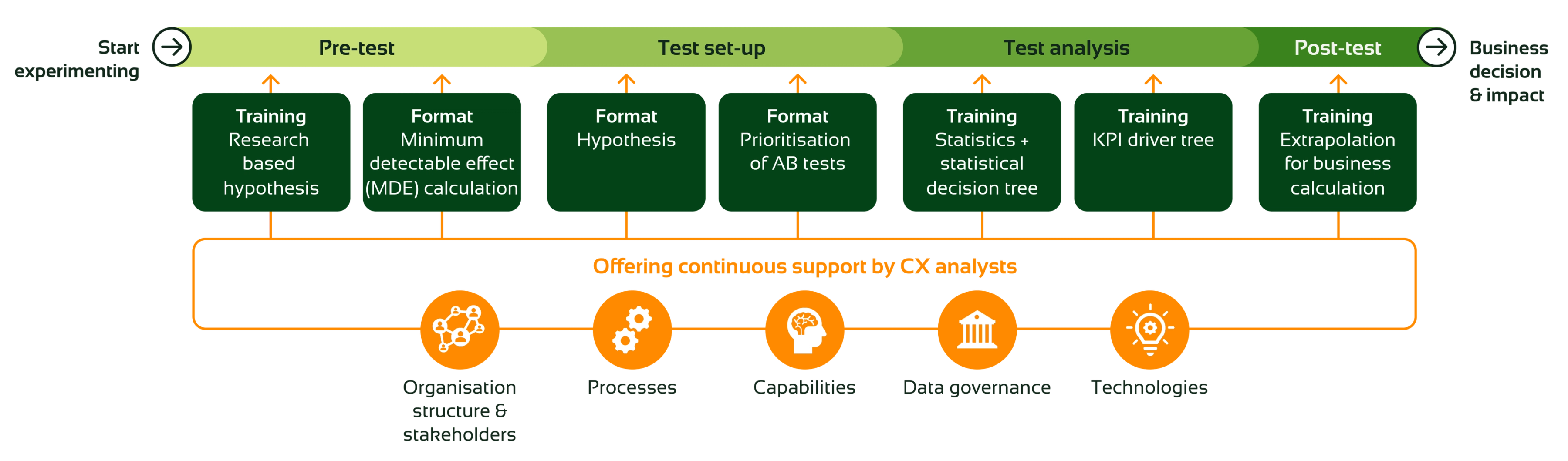
Toolbox

In which phase can we help you?

Through the S.E.E. framework and toolbox, we optimise 5 phases. These are modular and tailored to the needs and requirements of your organisation. The phases are structured chronologically and visualise the steps Digital Power can take in an experimentation programme from start to finish.

Phase 0 – Laying the foundation

The goal of this phase is to get everyone aligned so that they are working towards the same objective. In this phase, we will:

  • Define ambitions.
  • Understand the current status, challenges, etc.
  • Check if your company can experiment; i.e., is there enough traffic?
  • Begin to develop a shared understanding, clarify the scope, and foster team collaboration.

Phase 1 – Understand the Context

The goal is to understand the organisation and define the project. In this phase, we will:

  • Gain a deep understanding of the organisation.
  • Understand data products, such as identifying the landscape and datasets.
  • Gain a shared understanding by mapping out the ecosystem.
  • Align expectations and goals to avoid misunderstandings.

Phase 2 – Analyse the Experimentation Programme

The goal in this phase is to assess where your organisation stands. In this phase, we will:

  • Increase the number of tests and teams running tests.
  • Assess the current (technical) maturity of the experiments.

Phase 3 – Increase Maturity

The goal is to improve the organisation's current position. In this phase, we will, among other things:

  • Create opportunities for the experimentation process within your organisation.
  • Make the A/B testing culture within your organisation visible.
  • Convince stakeholders to start testing using persuasion theories.
  • Optimise hypotheses and link them to strategic KPIs.
  • Apply the right statistical tests.
  • Perform technical checks such as sample pollution or sample ratio mismatch.
  • Optimise technically identified areas for improvement.

Phase 4 – Continuous Development

In this phase, we reassess maturity. We validate whether the optimised topics have had an impact on the maturity of the experimentation process. Additionally, there will be a focus on continuously improving the optimisation loop. This ensures you are always working on improvements and maintaining an efficient experimentation programme.

Want to know more?

Danny will be happy to talk to you about what we can do for you and your organisation as a data & AI partner.

Receive data insights, use cases and behind-the-scenes peeks once a month?


Sign up for our email list and stay 'up to data':

Get inspired about working with an Analytics Translator

Foster data-driven growth by scaling your experimentation approach effectively

Want to get more value from your experiments? Professionalise and scale your approach in a data-driven way with S.E.E.: Scaling experimentation effectively. Discover your current maturity level and advance to the next level of experimentation.

Read more

Your Customer Experience partner

Get insights into your target audiences, customer journeys and processes with Customer Experience. Combine qualitative and quantitative research to discover what drives and holds customers back. Take the customer experience to the next level with data-driven improvements.

Read more

Customer experience solutions

Read more

Digital Power and SAS CI360 join forces to enable relevant customer interactions

By combining the data expertise of our Digital Power consultants with SAS Customer Intelligence 360 (CI360), you can turn customer insights into personalised, real-time customer interactions. The result: more relevant communication, stronger customer relationships and higher marketing ROI.

Read more

132% more customers fully supported with conversational AI

Insurer Univé wanted to improve customer satisfaction and reduce pressure on its customer service team by handling more customer questions directly through the chatbot. However, the existing scripted chatbot struggled to deal with different types of questions and context, meaning customers often still ended up speaking to an employee. By replacing the scripted chatbot with one based on a large language model, customer satisfaction increased while pressure on customer service decreased.

Read more

Better online services through a scalable experimentation programme

The Municipality of The Hague wanted to use data-driven experiments to improve its services, for example by optimising the website so residents could complete more tasks independently. The web analytics team also wanted to make its contribution to the organisation’s objectives more visible.

Read more

How data helps grow annual lending from €3M to €10M

Wakibi connects lenders with entrepreneurs in developing countries and aims to stimulate sustainable economic growth. To increase its social impact, the organisation has set an ambitious growth target: increasing annual lending volumes from approximately €3 million to €10 million by 2030.

Read more

Strengthening a data-driven mindset through tailored analytics training

Within Eneco’s Data Driven Marketing Chapter (around 60 colleagues), there was a growing need to better embed data-driven ways of working. The ambition was clear: not only data specialists, but also marketers and other teams should be able to perform analyses independently and make well-founded decisions.

Read more

Net Promoter Score (NPS) as a starting point for better customer experience

If you ever buy something online, chances are you’ve seen this question pop up: “How likely are you to recommend us?” For many organisations, that single number has become a holy grail. Everyone talks about NPS — from marketing teams to senior management. But how valuable is that score really? Many organisations measure NPS on a structural basis, yet struggle to translate it into concrete improvements. The score goes up or down, but remains disconnected from real decisions. In this article, we explain how to use NPS to create insight and impact — and where to be cautious.

Read more

Tealium Digital Velocity: AI is moving into production

For professionals in data, analytics, martech and customer experience, Digital Velocity is one of the events where developments become tangible. It brings together practitioners, partners and industry leaders to show how they approach AI, real-time data and customer experience in practice.

Read more

Truly enhance the customer experience with customer experience analytics

When you combine quantitative and qualitative data with the aim of genuinely understanding your customers, you create real value. This approach allows you to identify the actual issues customers face and gain insight into their experiences. By addressing these challenges, you make a lasting impact. To achieve this, you need to develop and optimise experiences that are both evidence-based and human-centred. In this article, we answer the most frequently asked questions about customer experience analytics. Discover what you need to focus on if you truly want to improve the customer experience.

Read more

From ‘Aha!’ moment to activated users

Many organisations invest heavily in attracting new customers, but often forget what truly matters: Do users actually see the value of the product? In this blog, we’ll explain what "first value" is and how to effectively measure this moment. We’ll also give you tips on how to help users experience value. This is the first step towards satisfied customers who integrate your product into their lives.

Read more

Increasing donations through website optimisation

Special Olympics Netherlands is the national sports organisation for people with an intellectual disability. The organisation is committed to making sport accessible all year round. This gives participants the opportunity to develop their skills, enjoy themselves, and share their achievements with those around them.

Read more

Smart text analysis: how our AI tool rapidly categorises large amounts of data

Analysing hundreds or thousands of open answers from surveys, interviews or reviews is time-consuming. To better understand those answers, we group them into themes (for example: ease of use, service, delivery or reliability). At Digital Power, we use Large Language Models (LLMs) to quickly categorise high volumes of open answers. Our team built our own secure, transparent tool that lets us see exactly what happens under the hood. But is AI already advanced enough to replace our human researchers?

Read more

A future-proof monitoring process based on quantitative and qualitative data

To improve the liveability of the Woensel-Zuid district in Eindhoven, more than 60 partners joined forces under the name Pact Woensel-Zuid. At the start of the initiative, goals were defined, but translating these into concrete indicators and a monitoring framework to track progress proved challenging. They asked us to develop a monitoring process that provides data-driven insights into the programme’s progress.

Read more

How your organisation can get more value from experiments

Within your organisation, quite a lot of experimenting is already taking place, perhaps even extensively. Yet there is much debate about the resources and time it requires, and the added value is not always clear. Sound familiar? In this article, you’ll discover how to tackle some of the major challenges in getting value from experimentation.

Read more

What is the added value of experimentation?

Most organisations that offer digital products, experiences, and services conduct experiments, typically to increase conversions. In practice, alongside many other applications, we see the risks you face if you don’t experiment. In this article, you’ll find answers to the most frequently asked questions about experimenting.

Read more

Concrete actions for higher conversion rates

A Perfect Jane is a webshop focused on vegan boots made from apple leather, recognisable by their green sole in the shape of a leaf. The webshop noticed a lot of traffic from marketing activities but felt that these visitors were of low quality, resulting in a low conversion rate. They also perceived a low conversion rate from regular traffic. Additionally, the webshop aimed to reduce the number of returns and increase the average order value. A Perfect Jane enlisted the help of our Customer Experience Analysts for advice.

Read more