How to navigate tracking and privacy with white label and third-party integrations
Practical solutions and best practices
Article
Technical Web Analytics
Data collection compliance
Bram Ooms
Technical Web Analyst
6 min
31 Mar 2025
Many organisations choose to integrate external tools to speed up development or add new functionality. Third-party tools (solutions built and managed by another company) and white label tools (which you can rebrand as your own) often seem like efficient choices.
But even if a tool seems like a perfect fit, these integrations can come with unexpected challenges. Technically, they may require extra work to align with your data processes. Business-wise, inconsistent data collection can skew analytics and make data activation less effective. And from a privacy perspective, there are risks, such as legal issues or losing customer trust.
To navigate risks to tracking and privacy by integrating third party tools, organisations should set clear guidelines and perform thorough evaluations of each tool before deployment. For instance, confirm every vendor’s data-handling practices, define strict privacy requirements in contracts, and regularly audit integrations for compliance. By establishing robust processes, verifying vendors, and monitoring performance, you can benefit from external solutions while keeping data protection and trust intact.
(Current article) How to navigate tracking and privacy with white label and third-party integrations – Practical solutions and best practices.
Solutions for tracking challenges
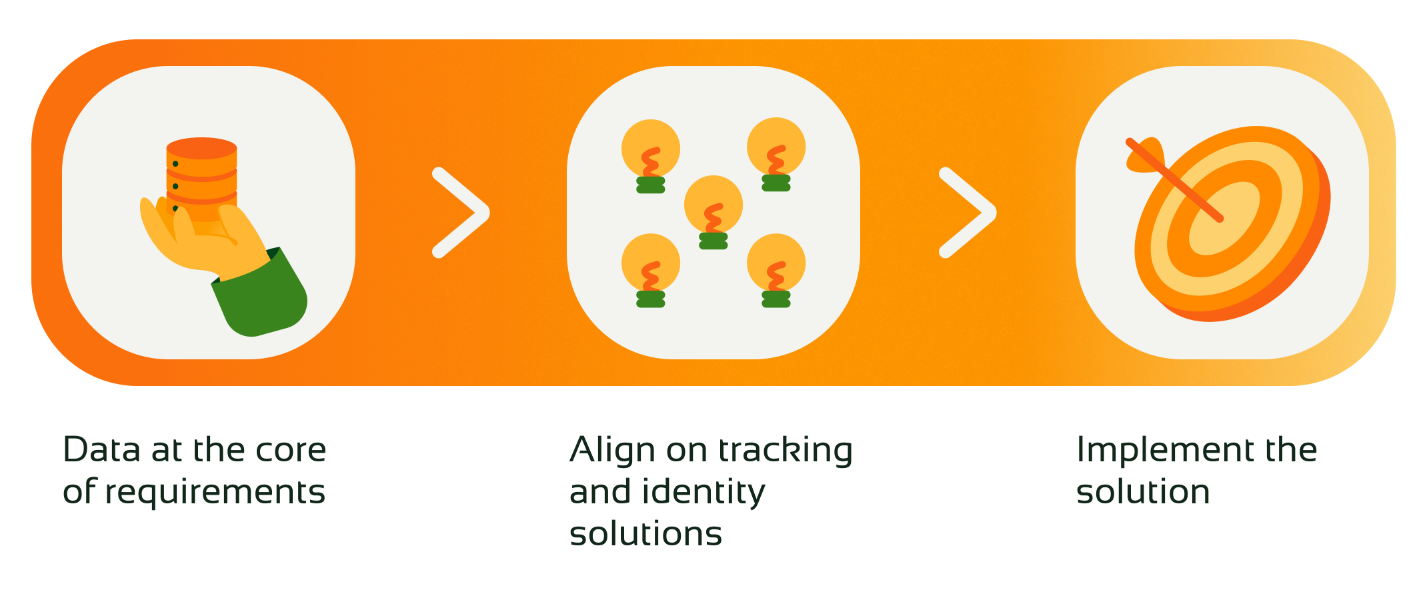
1. Make data a core principle of requirements
Functionality is often prioritised over adhering to the existing data strategy, but to work data-driven with third parties, tracking requirements must be embedded in the requirements of procurement processes. Ensuring data requirements are met from the outset prevents future issues with collection, reporting and activation.
2. Align on tracking and identity solutions
Regardless of the steps you take or the systems you use, your top priority should be integrating your solution into the platform. For white label or third-party platforms, the ideal approach is to host your tag management system on their platform.
If they also collect data for their own purposes, running two client-side solutions is often not desirable, as they may interfere with each other. Make sure you align with both parties on what data needs to be exposed, and work on definitions that meet both organisations’ requirements, or can be developed separately.
This way, you can use two different (server-side) tag management solutions, ensuring that both organisations can leverage the data for their own purposes.
For iFrames, allow the embedded content to pass events to the top-level domain, ensuring your tag management solution captures the data. This allows control over the consistency in the data you collect.
3. Implement the solution
If you run your tag management solution on a different website or domain, you risk losing visitor identity. Most tracking relies on cookies to maintain a unique identifier, and these typically don’t carry over between domains.
One common solution is to pass the identifier in a query parameter, allowing you to transfer visitor information between platforms. Google Analytics 4 offers cross-domain measurement to help with this, but it can be blocked by privacy settings or browser controls.
Alternatively, you can use first-party identity solutions, proxies, server-set cookies, or redirects to enrich third-party platform data with your own first-party data. If you use a subdomain, make sure cookies are set with a leading dot (‘.’) so they’re accessible across subdomains.
The privacy challenges require to be mitigated to reduce risks of non-compliance with the GDPR and ePrivacy. Additionally, the privacy requirements may have implications which can place limitations of how you can track the user.
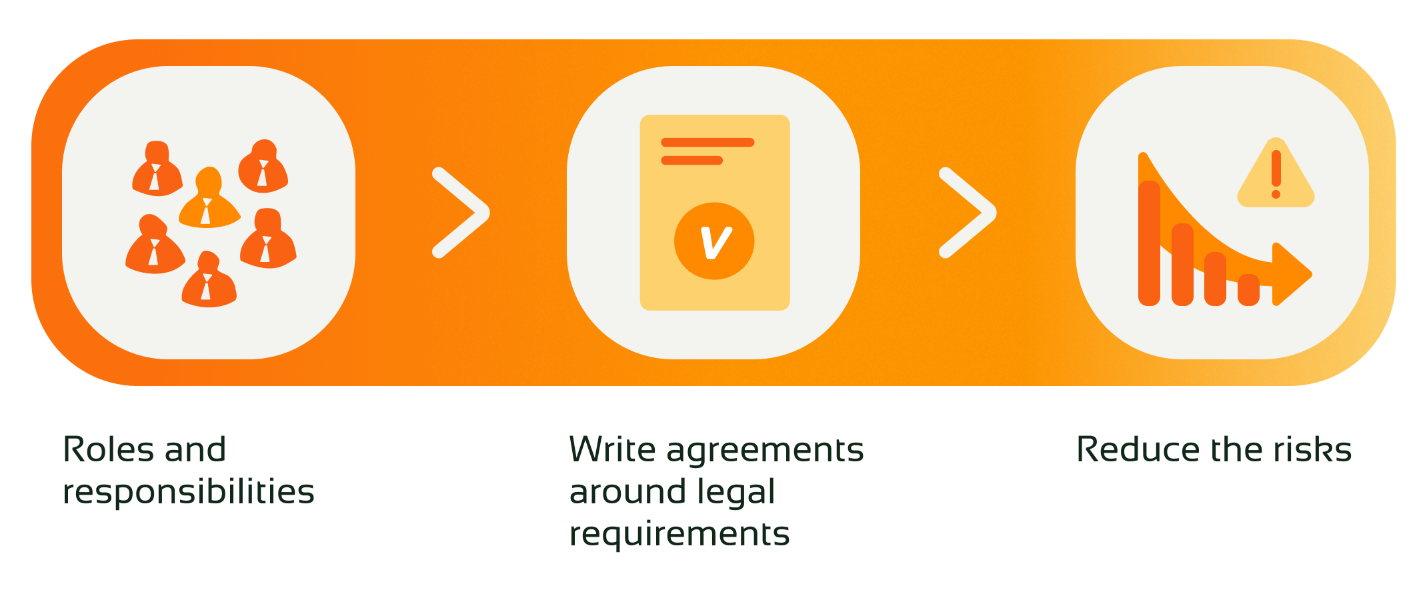
1. Define roles and responsibilities
When integrating third-party solutions, it’s crucial to define roles and responsibilities under GDPR. Is the third party acting as a data processor, handling data solely on your behalf, or a joint controller, using data for its own purposes? Clearly outlining who processes what data and for what purpose ensures compliance and prevents legal or operational risks.
A common issue is that these discussions happen too late in the process, leading to frustration, delays, and potential non-compliance. Without clarity, you may face residual risks that could have been avoided with better planning. A strong data governance framework is essential here; it ensures structured decision-making, proper documentation, and alignment between all involved parties. If your organisation struggles with data control, improving governance should be a priority.
2. Establish written agreements
GDPR requires a written contract, often known as a Data Processing Agreement (DPA) whenever two parties process data in collaboration. This agreement, which is a child-agreement under a parent agreement, should cover:
Roles and responsibilities (who controls or processes the data)
Processing activities (what data is collected and how it’s used)
Sub-processors and third-country transfers (if applicable)
Beyond GDPR, you should also consider ePrivacy regulations, particularly regarding cookies and tracking technologies. Ensuring alignment on how consent is handled and who is responsible for compliance can prevent future legal challenges. This can especially be challenging due to the country specific requirements and interpretations.
3. Reduce the risk
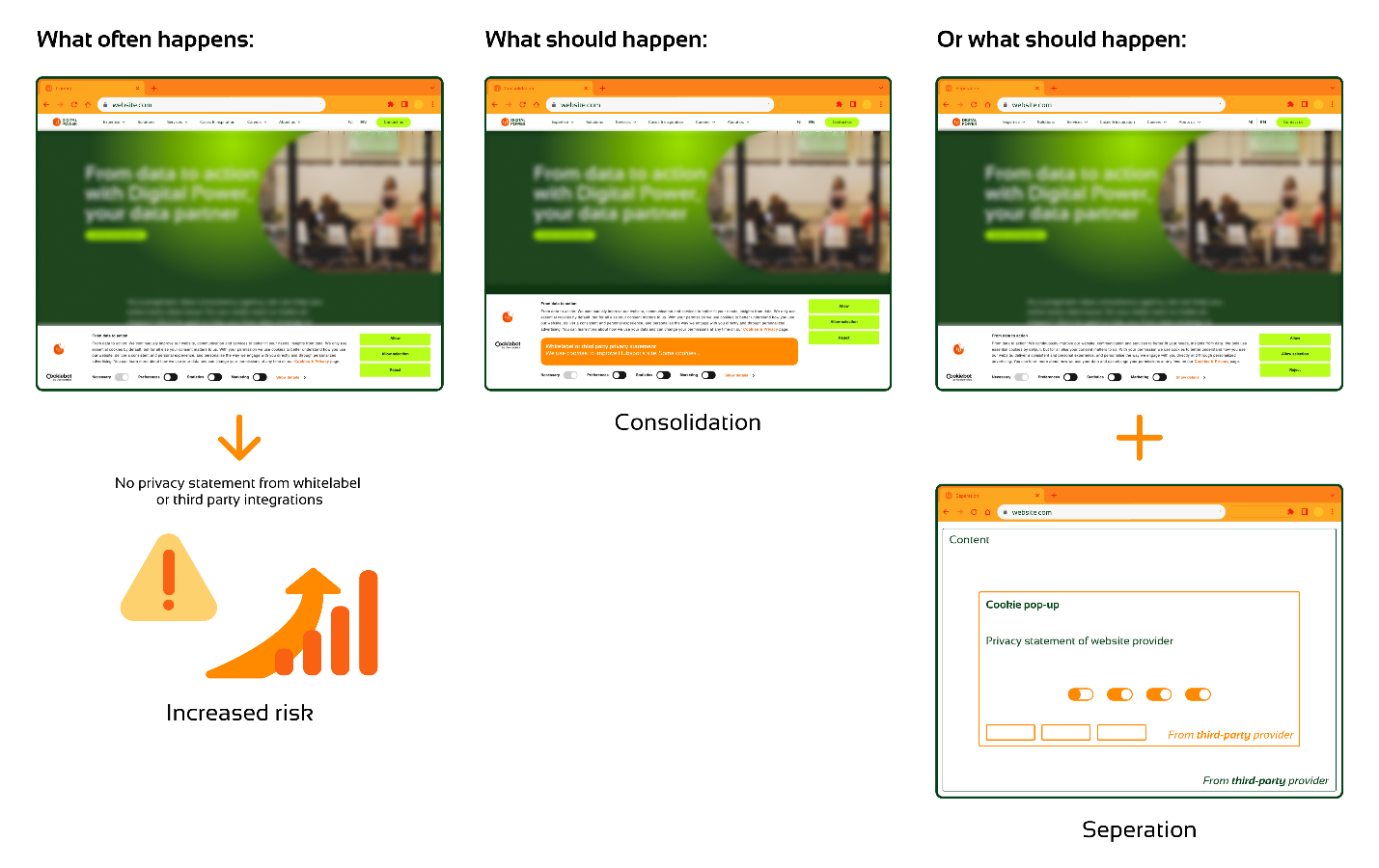
User consent should be managed carefully to avoid friction in the user experience while staying compliant.It is vital to define how users will be informed and grant consent. In order to do this, there are two main approaches to consider:
Singular approach – One cookie banner and privacy notice covering both you and the third party.
Pros: Seamless user experience, reduces abandonment, and keeps conversion rates high.
Cons: Requires ongoing updates to reflect third-party data practices and increases internal compliance workload.
Multiple instances approach – Users see a separate consent request when engaging with the third-party platform.
Pros: Easier to manage as each party handles its own compliance, ensuring more accurate disclosures.
Cons: Can disrupt the user experience, leading to lower conversions and potential frustration.
The best choice depends on the extent of data collection, the level of integration, and available resources. If data collection is extensive or frequently changes, a separate consent process may be more practical. However, for a seamless user experience, a singular approach may be preferred. The key is ensuring users are fully informed and able to provide meaningful consent while balancing compliance and usability.
Think before you integrate
Considering these factors before committing to an integration prevents costly mistakes. If you need help aligning your technology and legal compliance needs, explore our data collection compliance solution or contact us directly.
This is an article by Bram Ooms
Bram started as a Technical Web Analyst in 2019, where he focused on data implementations at clients such as Univé, DPG Media, Boels and Vodafone. Through his experiences with the impact of legislation on enabling data flow he developed an interest in data privacy, which he is now actively pursuing within Digital Power.
Bram Ooms
Technical Web Analyst
Receive data insights, use cases and behind-the-scenes peeks once a month?
In this monthly series, we share the latest trends, product updates and industry insights in AI, data and analytics that are most relevant to you. We look beyond the update itself and explain what these developments could mean for your organisation, where they may create opportunities and how you can turn them into value.
In this monthly series, we share the latest trends, product updates and industry insights in AI, data and analytics that are most relevant to you. We look beyond the update itself and explain what these developments could mean for your organisation, where they may create opportunities and how you can turn them into value.
In this monthly series, we share the latest trends, product updates and industry insights that matter most to professionals in AI, data and analytics. We also share what these developments mean for organisations and where we see the biggest opportunities to create value.
How data helps grow annual lending from €3M to €10M
Wakibi connects lenders with entrepreneurs in developing countries and aims to stimulate sustainable economic growth. To increase its social impact, the organisation has set an ambitious growth target: increasing annual lending volumes from approximately €3 million to €10 million by 2030.
Strengthening a data-driven mindset through tailored analytics training
Within Eneco’s Data Driven Marketing Chapter (around 60 colleagues), there was a growing need to better embed data-driven ways of working. The ambition was clear: not only data specialists, but also marketers and other teams should be able to perform analyses independently and make well-founded decisions.
Higher advertising ROI through conversion tracking strategy
Univé wanted to optimise its advertising campaigns based on approved insurance policies rather than submitted insurance applications. At the time, advertising platforms were optimised using insurance applications submitted by (potential) customers. However, not every application resulted in an approved insurance contract. While every application was counted as a conversion, only approved policies represented the actual business outcome.
What is Tagbird, what do you use it for, and what can you do with it?
Tagbird is a Chrome extension developed by Digital Power. You can download it from the Chrome Web Store and add it to your browser. It is a debug/visualisation tool that provides a simple and clear insight into, among other things, the data layer, tag management events and analytics requests of a website. So you can quickly and easily test your entire analytics implementation with Tagbird.
Tealium Digital Velocity: AI is moving into production
For professionals in data, analytics, martech and customer experience, Digital Velocity is one of the events where developments become tangible. It brings together practitioners, partners and industry leaders to show how they approach AI, real-time data and customer experience in practice.
When people think about the FTG model (function, task, behaviour), they often associate it with government websites. That makes sense. The model, developed by Toon Vuursteen, originated in a context where informing users was the primary goal and commercial objectives played no role.
Understanding website behaviour with GA4 and a central dashboard
Warmte voor de Kinderen is an ANBI charitable foundation that was established in 2003 at the initiative of heating wholesaler Rensa. The foundation is committed to giving children growing up in vulnerable circumstances a warmer future.
Welcome to our monthly update on technical web analytics. In each edition, we share key changes, feature updates, and relevant developments from the analytics landscape, straight to the point and focused on practical impact.
This month: GA4 cost import for Meta and TikTok, and tracking AI traffic in Piwik PRO.
Webinar | Understand online behaviour with the FTG framework
Government websites are often the first point of contact between citizens and the government. Whether it concerns information about regulations, applications or participation, the digital experience determines how well citizens find their way around. But how do you know if your website is really doing what it should?
Welcome to our monthly update on technical web analytics. In each edition, we share key changes, feature updates, and relevant developments from the web analytics landscape, straight to the point, and with a focus on practical impact. This month: track AI traffic in Adobe Analytics.
Migrating to European Tag Management and Analytics platforms
Due to recent geopolitical developments, such as heightened concerns about privacy and legislation, many organisations are reassessing their dependence on US-based software solutions. At the same time, the call for greater control over data and reduced reliance on external parties is growing louder.
AI platforms such as ChatGPT and Google Gemini are rapidly changing the way people find information online. More and more often, users are clicking through to websites via these platforms. Yet in analytics tools like GA4 or Adobe, this traffic often shows up as Direct or Unassigned. The result: missed insights into which content performs via AI and where new opportunities lie.
Welcome to our monthly update on technical web analytics. In each edition, we share key changes, feature updates, and relevant developments from the web analytics landscape, straight to the point, and with a focus on practical impact. This month: Safari beta strips ad tracking IDS.
Webinar | Turning compliance into competitive advantage
Flip the narative and focus on how compliance can be leveraged as a strategic advantage. We adress data professionals who rely on the value of data and see compliance as a threath to the feasibility of their goals. This webinar will enable you to move from reactive to proactive, reducing risk and creating long-term value.
Privacy rules, browser changes, and ad blockers have made web tracking a lot harder. The quick fixes don’t work anymore, and often cost you more in the long run. This e-book shows you how to set things up properly so you can still get the insights you need.
TCF: a smarter way to get a grip on compliance (or not?)
Privacy and compliance have moved beyond mere legal obligations. They have become critical in creating durable, robust, and reliable data solutions that your business depends on to thrive. The Transparency and Consent Framework (TCF), developed by IAB Europe, has emerged as an industry standard. It is designed to simplify compliance with data privacy regulations, such as the General Data Protection Regulation (GDPR) and the ePrivacy Directive.
But what exactly is TCF, and is your organisation ready to embrace it?
Welcome to our monthly update on technical web analytics. In each edition, we share key changes, feature updates, and relevant developments from the web analytics landscape, straight to the point, and with a focus on practical impact. This month: improved item-data import in GA4 and analysing AI traffic.
Is your organisation ready for independence from the US and migrate to EuroStack?
In an era marked by international tensions, rising concerns about privacy, security, and technological sovereignty, you may find yourself re-evaluating your reliance on US technology solutions. The drive towards digital independence isn't just a political goal, but may also be a pragmatic business necessity.
More insight into registrations thanks to smart funnel tracking
Stichting Thuisgekookt mediates between people who enjoy cooking and neighbours who, due to age, mental or physical limitations, could use help with their evening meal. A wonderful initiative that not only provides a hot meal, but also a friendly chat. When it came to data, they encountered a number of questions:
Is Piwik PRO the right tool for your organisation?
In an era where data privacy and regulatory compliance are becoming increasingly important, Piwik PRO offers a robust alternative to US-based tools like Google Analytics. Developed in Europe with GDPR as a core principle, Piwik PRO ensures data stays within the EU and avoids transfer to the US, significantly reducing privacy and compliance risks. This makes it an ideal choice for organisations that want maximum control over their user data.
Welcome to our monthly update on technical web analytics. In each edition, we share key changes, feature updates, and relevant developments from the web analytics landscape, straight to the point, and with a focus on practical impact. This month: Piwik PRO discontinues free Core plan.
Welcome to our monthly update on technical web analytics. In each edition, we share key changes, feature updates, and relevant developments from the web analytics landscape, straight to the point, and with a focus on practical impact. This month: the Dutch Data Protection Authority (AP) calls for joint decisions on responsible generative AI use.
Zero-party data: What’s the hype, and should you care?
The term zero party data is getting more and more traction around marketers. With privacy rules tightening and third-party cookies on their way out , companies are increasing their efforts to obtain this data, At the same time, platforms like Tealium Moments, Usabilla and Qualtrics offer tools for creating interactive experiences that encourage users to share data directly.
The municipality of The Hague continuously works to improve its digital services. Citizens must be able to find their way quickly and easily on the online portal www.denhaag.nl and all linked environments. To improve that experience, good data is essential.
Implementing GA4 server-side tracking for mobile apps
Last year, Google rolled out the GA4 app client for server-side Google Tag Manager, bringing a whole new level of flexibility to how we collect and redistribute data from mobile apps. So, what does this mean in practice? Let’s find out.
From loose data to a data-driven way of working with Adobe Analytics
A financial organisation switched from Matomo to Adobe Analytics to gain better control over digital performance. However, there was a lack of knowledge about data-driven working and clear KPIs. We guided the migration and supported the content team in establishing a data-driven way of working.
Third-party cookies: should I stay, or should I go?
In recent months there has been a lot to do about third-party cookies and their not-so-imminent-anymore end-of-life in the Google Chrome browser. Is this then much to do about nothing or should you brace yourself for a paradigm-changing shift? In this article we will lift the veil over this important topic. Also, we’ll share 7 hands-on tips to prepare yourself for what’s coming.
Greater control of government websites with the FTG framework
Government websites play a crucial role in providing information and services to citizens. But how do you measure the success of such a website? Here, many organisations choose the privacy-friendly Piwik PRO and Toon Vuursteen's data model: The FTG model (Functie [Function], Taak [Task], Gedrag [Behaviour]). This framework provides a structured method for understanding and improving the performance of a website.
Welcome to our monthly update on technical web analytics. In each edition, we share key changes, feature updates, and relevant developments from the web analytics landscape, straight to the point, and with a focus on practical impact. This month: a new feature in Tealium and an update on Google's third-party cookies.
How third-party and white label integrations affect your data and privacy
Many organisations choose to integrate external tools to speed up development or add new functionalities. Third-party tools (solutions built and managed by another company) and white label tools (which you can rebrand as your own) often seem like efficient choices.
How do you implement server-side tracking for privacy protection?
Privacy in digital analytics is more than just a compliance checkbox, it’s a fundamental responsibility. With increasing privacy concerns and regulations like the GDPR limiting traditional data collection methods, organisations must rethink their approach. This is where server-side tracking changes the game. But what does this mean in practice? And how does it differ from other tracking methods?
Building and targeting audiences is a core part of digital marketing. But with third-party cookies phased out and privacy-first browsers limiting data sharing, traditional methods of targeting users are no longer effective.
With third-party cookies disappearing and even first-party cookies under threat, tracking unique users has become a challenge. Inflated user counts can skew metrics like cost per acquisition and average revenue per user, making reliable insights difficult to achieve.
Conversion tracking has never been more complex. Browser updates, ad blockers, and stricter consent requirements disrupt the attribution of conversions to marketing efforts. Traditional client-side tracking methods struggle under these new rules, often leading to data loss and inaccurate metrics.
Web analytics faces growing challenges from stricter laws, browser updates, cookiebanner updates, and ad blockers. These changes make it harder to track website performance and to get a grasp on metrics like Return On Ad Spend (ROAS). Many businesses look for quick fixes to bypass legal and technical issues. However, these shortcuts often fail and lead to higher costs. A better approach is to prioritise ethics, privacy, and a proper technical setup.
What is a composable CDP and why is it the future?
More and more companies are running into the limitations of traditional Customer Data Platforms (CDPs): they lack flexibility, struggle to import and export data, and find it difficult to comply with strict privacy regulations.
To truly work in a customer-centric way, a flexible and powerful tech stack is essential. Customers expect relevant, personalised interactions at the right time and through the right channel. With the right technologies, you ensure every customer feels understood while optimising your marketing efforts.
Discrepancies in transaction figures: How and why?
"How many transactions did we have last week? Our back office reports 12,000 transactions, the database 15,000, and Google Analytics 11,000. Why don’t these numbers match?" In theory, systems tracking transactions should align. However, discrepancies are common across back-offices, databases, and web analytics tools.
A well-structured tag plan forms the foundation of a reliable data infrastructure. It ensures that data is collected consistently and accurately, which is essential for actionable insights and effective decision-making.
GDPR training and advice for lasting impact on data processing
Join for Joy is a non-profit organisation dedicated to quality education, gender equality, and the physical and mental health of children in rural areas of East Africa. Through sports and play activities, the organisation motivates children to attend and stay in school. Important social topics such as malaria and HIV/AIDS prevention, child marriages, menstruation, and the importance of education are addressed in a playful manner.
GDPR compliance for (indirect) victim support communication
MenAsWell provides help and support to male survivors of sexual violence, striving to bridge the gap in support for men post-trauma, while increasing awareness and visibility of male survivors.
Real-time personalisation with server-side tracking
A large telecom provider in the Netherlands wanted to implement server-side tracking to improve their data processing. Previously, their existing process only sent online data to their Customer Data Platform (CDP) once a day. They wanted real-time data to offer personalised content on their website and in their online marketing campaigns. They enlisted our help to implement server-side tracking.
E-commerce companies today want more and more insight into their customer data. But there are all sorts of challenges involved in harnessing this data. A conversation with Bram Ooms of Digital Power on one of the topics that is increasingly in the spotlight: data privacy.
How confident is your company in its web analytics data? In this article, we’ll first explain why web analytics tools can never provide 100% accurate data and why that’s not necessarily a bad thing. Then, we’ll dive into the practical side of things: how reliable are most web analytics implementations?
How to implement Privacy by Design in server-side tracking
In our previous blog, we explored the significance of Privacy by Design (PbD) in server-side tracking to ensure compliance with data protection regulations such as GDPR. Now, we’ll dive deeper into a practical, step-by-step guide to help you implement these essential privacy practices. This ensures data privacy and security at every stage of the ETL process in tag management systems.
Understanding Privacy by Design in server-side tracking
In the digital age, organisations increasingly rely on data to drive decision-making and improve user experiences. That’s why data protection and GDPR compliance is more critical than ever. Privacy by Design (PbD) is an essential approach for embedding data privacy into every step of your IT and business practices, especially within tag management systems for web and app tracking.
Exporting Google Tag Manager (GTM) Tag Trigger and Variable information from your container into a spreadsheet can be useful for many reasons. You might want to do an Audit on the container of your new client, or just clean and organise an old container that you are working with for a long time. However, this functionality is not supported by default from GTM. In this article, we will explore various methods to export GTM container information and help you choose the best option based on your needs.
Eneco becomes the owner of their web data streams using server-side tracking
Eneco has been working with us for years for the (client-side) tracking of their online traffic. When server-side tracking emerged at the end of 2022, it was a logical step for them to ask us to think about the business value of this tracking method. They wanted to compare their existing Google Analytics implementation with a tagging server on Microsoft Azure.
Most consulting firms tout an entrepreneurial culture as one of their key differentiators – but Digital Power actually looks to deliver on that promise. Sarah Busson tells Consultancy.org how she has been supported in developing a new offering from scratch alongside her daily work as a consultant.
Improved customer insight and cross-device tracking through innovative customer recognition
Recent developments in Safari’s web browser, such as Intelligent Tracking Prevention (ITP), have made tracking user behaviour over longer periods more difficult. For Transavia, where the customer journey between booking a flight and the actual departure date can be lengthy, this presented a significant challenge. Without an effective solution, Transavia risked losing crucial customer insights and undermining the effectiveness of their marketing strategies.
In the digital age, where data privacy has become a forefront concern, server-side tracking stands out as a crucial tool for organisations aiming to gather user insights responsibly. Despite its potential, numerous myths surround its use and compliance with regulations. This article dispels these myths, offering a nuanced view of server-side tracking, its compliance with privacy laws, and the role of consent in its execution.
Server-side tracking is becoming a hot topic among agencies, marketeers and analysts. A lot of information is available on the subject, but it is not always accurate. Server-side tracking has often been sold as a miracle solution against data loss, GDPR and other unethical challenges.
The impact of ITP on analytics and the user experience
Intelligent Tracking Prevention (ITP) was launched by Apple in 2017 in an effort to restore "the balance the balance between privacy and the need for on-device data storage". With Intelligent Tracking Prevention, Apple aims to reduce cross-site tracking (following users across websites) by limiting the use of cookies. Find out what this means for you.
How can you tell if your GTM tagging server works?
There are reasons abound for deploying a tagging server on your website. This blog will not be about why it makes sense (or why perhaps in your case it doesn’t) to use server-side tagging. Instead we will jump forward in time and ask ourselves another pertinent question: ‘how can you tell if your tagging server is doing what it is supposed to?’
Three trainees talking about Digital Power's Tracking & Analytics traineeship
Consultancy.nl interviewed our Nissreen, Gianni and Yannick about their experiences on Digital Power's tracking and analytics traineeship. What attracted them to the traineeship? What is the Digital Power company culture like? What project are you running now? What are the highlights and what is the mentoring like?
Implementation of e-commerce tracking for Google Analytics 4
MS Mode & America Today used Universal Analytics (UA) for analysing their online stores. They had fully implemented e-commerce tracking, with KPIs such as transactions, average order value, and abandoned shopping carts visualised in Looker Studio.
Transitioning from Universal Analytics 360 to Google Analytics 4 and Streamlining Data Analysis
There are currently a lot of developments surrounding Google Analytics, including user privacy (GDPR) and the sunset of Universal Analytics. For Miele X, the digital branch of Miele, GA4 was also one of the topics on their agenda as part of their bigger plans towards a more privacy-centric and vendor-agnostic way of data collection. They enlisted our help to support them with the transition from Universal Analytics 360 to GA4.
July got off to a rocky start. First, we saw the Swedish Data Protection Agency (DPA) issued a warning to stop using Google Analytics due to the risks posed to privacy under the lack of an adequacy decision for EU-US data transfers. In the same week, the EU Commission reached an adequacy decision with the US for the third time. Can you now finally share personal data for all purposes with US based organisations or should you change course?
Getting started as a data trainee with JavaScript, HTML and web data
How does the Tracking & Analytics traineeship work in practice? When do you start working on real challenges for clients? And how can you develop yourself during this traineeship? Our trainee Nadine Spijker will tell you more about it.
What does the Tracking & Analytics traineeship look like in practice? When do you start working on real challenges for clients? And how can you develop yourself in this traineeship? Our trainee Jasper van der Meer tells us more about it.
How do you collect data while protecting the privacy of EU citizens?
The world of web analytics is constantly changing due to technological and legal developments. One significant event in the field of technical web analytics is the introduction of server-side tracking, which allows companies to have full control over their data flows.
From 1 July 2024, it will no longer be possible to process data in Universal Analytics 360 (hereinafter: UA360). Wehkamp collected data in UA360 and was keen to be prepared in time for the migration. In addition, they wanted to collect at least 1 year of historical data for UA360's sunset. This allowed Wehkamp to compare the data in UA360 and in GA4. A key desire was to migrate the measurements as-is.
Switching from Universal Analytics to Google Analytics 4 (GA4)
On 14 October 2020, Google launched the new version of Analytics: Google Analytics 4 (GA4). Soon after the launch, it became clear that a number of important functionalities from Universal Analytics (GA3) were missing, and therefore the time to switch seemed far away. Fortunately, we see that the development team on the side of Google has not been idle. Some nice features have since been introduced within GA4 that have narrowed the gap between GA3 and GA4. This article answers the questions that are increasingly being asked about GA4.
ABN AMRO partnered with our team to create a standardised digital data layer, addressing challenges with uniformity, reliability, and efficiency in their migration to a new analytics platform. The new standard allows for consistent tagging of all online components, leading to improved tagging management and reliable digital data for future use.
Google Analytics 4 vs. Google Analytics 3: What are the pros and cons?
If you want to keep track of free statistics about website visitors and their behaviour on your website, you will quickly turn to Google Analytics. With the free version of Universal Analytics (better known as GA3), it only takes a few minutes to set up basic metrics such as users, sessions and pageviews. For more extensive analyses, you have the paid version Google Analytics 360. As of July 2023, GA3 will no longer be supported by Google. Time to switch to the new GA4. Read all about the pros and cons of the new Google Analytics in this article.
Did the following scenario happen to you last week? While enjoying your morning coffee, you take a look at your pride and joy: a meticulously created Looker Studio dashboard built with the GA4 connector. You rub the sleep from your eyes and see your charts are all broken. Frantic phone calls from colleagues are pouring in. What is happening? Find out in this post what the consequences of Google’s newly imposed quota on the Google Analytics Data API are.
Integration web and app data contributes to a 360-degree customer view
Univé is a Dutch insurance company that offers insurance, financial products, and services to both consumers and businesses. The company is focused on providing high-quality service and helping customers make responsible financial decisions. Since 2014, we have been working closely with Univé.
An interest group for homeowners offers a wide range of content and services on its website that can be closed online. In order to serve its website visitors in the best possible way, interactions with the services, funnels and content pages must be properly measured. They already did this with our support, with Universal Analytics (GA3). To be well prepared for the future, they asked us to implement Google Analytics 4.
Getting started as a data trainee with JavaScript, HTML and CSS
What does the Tracking & Analytics traineeship look like in practice? When do you start working on real issues for clients? And how can you develop yourself in this traineeship? Our trainee Bob Wassenaar tells us more about it in the 'From data to action' podcast. Listen to the podcast or find out all about it in the article below.
Being trained as a Technical Web Analyst, why and how?
A new group of trainees Tracking & Analytics will start soon. They will be trained as Technical Web Analysts and can become part of the Digital Power team after their traineeship. But what does a Technical Web Analyst (not) do and what can you expect from this traineeship? In this podcast, Marloes interviews her colleague Jos on this topic.
Digital Power Datahub and Partos launch the Data Awareness series
On February 10, 2022, the Digital Power Datahub and the Partos Digital Lab together kicked off the Data Awareness series with the Intro to Data Awareness. This series of 6 training courses develops the Datahub especially for the members of Partos; non-profits in the development cooperation industry. The aim of the series is to make development cooperation specialists data-wise, so that they can make and measure more impact.
You are almost done with your studies and looking for an employer that offers you the opportunity to learn everything about the field of data. Or you are no longer challenged in your current position and would like to become more technical. In both cases, you do not want to follow unpaid courses, but you would like to get started as soon as possible for real customers, with a serious salary. Does this sound familiar? Then these data traineeships are really something for you.
As a data professional you never stop learning. Your field is developing at lightning speed and you have to continuously develop yourself to keep up. In recent years, for example, new functions have been created such as Data Scientist and Data Engineer. There is also an increasing need for data professionals who can code. But how do you learn to code in Javascript? We developed an internal training programme for this.
Cookies. This word comes up a lot in the world of marketing and online analytics. But what exactly are those cookies? And are there different types of cookies?
Measure ecommerce events in GA4 and Universal Analytics with only the updated datalayer pushes
With our variable in the Google Tag Manager Community Template Gallery it is easy to start using all the new ecommerce analytics capabilities that Google Analytics 4 offers while fully supporting the 'old' enhanced ecommerce of Universal Analytics. Find out how the variable works.
Univé is the only Dutch insurer with a website, App and physical stores. They therefore follow an omni-channel strategy. According to its own '1 digital front door principle', the insurer also wanted to offer customers the opportunity to take out/change insurance policies and report damages via the App. They asked our Data Analysts to make the new funnels measurable.
A tag management system such as Google Tag Manager (GTM) enables you to measure visitor behaviour on your website. You can also implement marketing pixels (such as Google Ads and Facebook) and cookie banners via this platform. This article gives you tips to keep in mind when setting up GTM. This allows you to collect reliable and usable data, and you will be less dependent on your web developers.
A structured, scalable tag plan for Mijn Vattenfall
Nuon became Vattenfall in October 2019. The rebranding was a good reason to optimise Analytics. There was a renewed focus on applying insights from user data in the Mijn Vattenfall environment. The data collected for this was not always reliable. In addition, there was insufficient knowledge and capacity within the department to maintain the Analytics. The energy supplier asked for our help to support them in re-establishing the tagging and analytics of Mijn Vattenfall.
Standardise Adobe Analytics implementation for complete insight into the customer journey
Within KPN, one team is responsible for the implementation of Adobe Analytics, the Digital Performance team. Due to the working method that had developed before the formation of this team, the specialists did not work together optimally.
Streamlining web development using a tag management plan
To have a good overview of the results of multiple websites at the same time, you need a clear structure as a basis. RNW Media has several project websites, some of which are available in different languages. Our own web development team is responsible for the build and maintenance of this. They set to work with a building block model for building new websites. We were asked to provide a structural solution for measuring all websites.
Higher customer satisfaction and increased conversion by setting up an A/B test environment
Vodafone started a 3-month 'digital boost' project with the aim of improving the conversion of the online shop. The project team consisted of external digital professionals, each with their own specialism. As part of this project, we set up an A/B test environment with the aim of improving the user experience and thus increasing conversion.