How do you implement server-side tracking for privacy protection?
Privacy-first data collection: The role of server-side tracking
- Article
- Technical Web Analytics
- Server-side tracking
- Data collection compliance


Privacy in digital analytics is more than just a compliance checkbox, it’s a fundamental responsibility. With increasing privacy concerns and regulations like the GDPR limiting traditional data collection methods, organisations must rethink their approach. This is where server-side tracking changes the game. But what does this mean in practice? And how does it differ from other tracking methods?
*This blog was co-authored with Bram Ooms, Technical Web Analyst at Digital Power.
Privacy challenges in web analytics
The digital landscape has shifted. Users expect greater control over their data, while browsers and regulators continue to restrict traditional tracking techniques. Third-party cookies are disappearing, ad blockers are more effective than ever, and compliance requirements demand transparency.
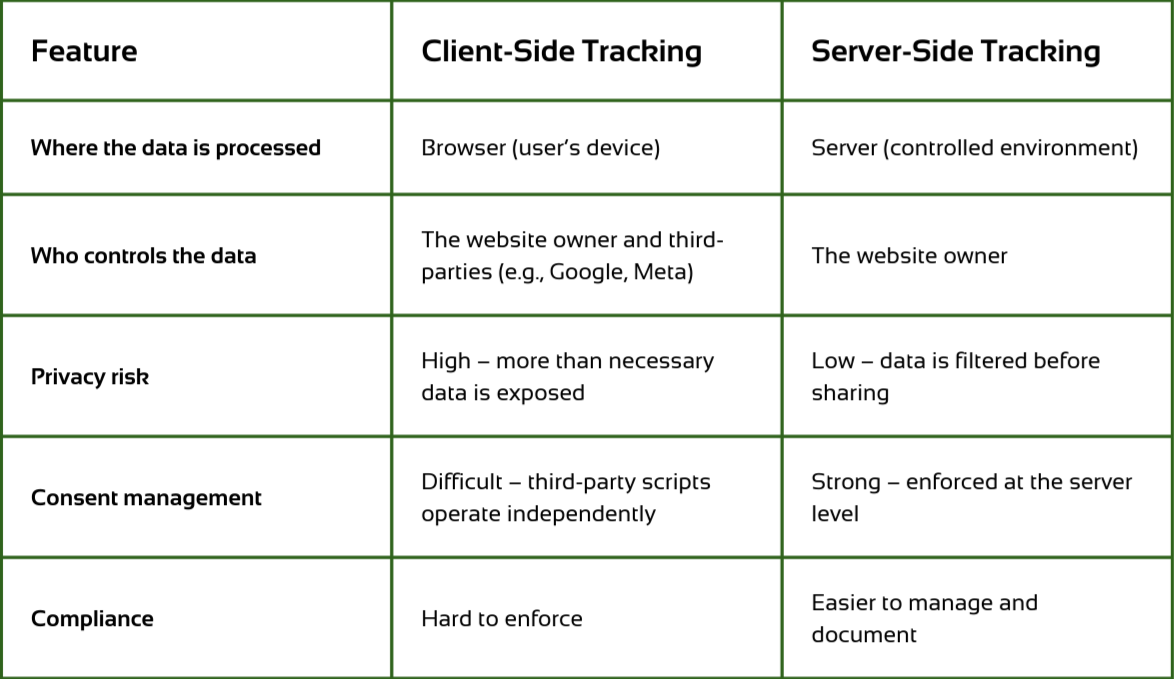
Client-side tracking, where data is collected directly from the browser, has long been the standard, but it presents privacy risks:
- Uncontrolled third-party cookies: Marketing tags and analytics tools collect user data directly, if a third-party cookie is present without clear oversight.
- Client exposure: Sensitive information such as IP-address and user agent are exposed to recipients of browser-based tracking scripts.
- Limited compliance control: Ensuring that every third-party tag fully adheres to privacy regulations is complex and difficult to enforce, which demands privacy by design and zero trust principles.
By transitioning to a server-side approach, companies can improve compliance, increase data security, and ensure ethical data usage.
Server-side tracking vs. client-side tracking: What’s the difference?
To know more about server-side tracking and common misconceptions, read this article.
How server-side tracking enhances privacy
Server-side tracking offers a powerful way to collect, process, and share data while maintaining user privacy. In this way, data collection moves from the user’s browser to a controlled server environment. This means that instead of allowing third-party tools to access user data directly, your server acts as a filter. It gains control over what gets collected, how it's processed, and what is shared.
Here’s how it improves privacy:
1. Data collection within your own environment
With server-side tracking, data flows through your own server before being sent to third parties. This allows you to:
✔ Remove sensitive data before it reaches external vendors.
✔ Anonymise data, ensuring compliance with GDPR and other regulations.
2. Full control over third-party data sharing
Traditional tracking tools often collect more data than necessary. With server-side tracking, you control exactly what is shared with external vendors, preventing unauthorised data exposure.
✔ Block unnecessary data transmission to ad networks and analytics platforms.
✔ Ensure vendors receive only relevant, privacy-compliant data.
✔ Reduce identification risks, as you remove therisk for unintended third-party cookies.
3. Improved consent management
GDPR and other privacy laws require clear consent for data collection. Server-side tracking ensures that user preferences are respected at every stage:
✔ Integrate consent in the server-side data pipeline, enforcing compliance on a detailed level.
✔ Easier management of opt-out requests with full control over stored data within your platforms such as Customer Data Platforms (CDPs) or Data Management Platforms (DMPs)
How to implement server-side tracking for privacy protection
1. Define your data strategy
- Determine what data you actually need.
- Identify which third-party vendors should receive data.
- Work-out a clear data quality infrastructure or data strategy.
2. Implement a server-side tracking solution
- Find the Tag Management System that best suits your needs. Most common are GTM, Tealium or Matomo.
- Configure your tracking strategy and implement Privacy by Design.
- Whether it is a small or complete implementation, Digital Power offers a range of packages to help you get started.
3. Enforce consent mechanisms
- Integrate with a consent management platform (CMP).
- Ensure that tracking occurs based on the given consent.
- Review regularly your privacy compliance with the help of our experts.
4. Monitor and optimise
- Regularly audit data flows to prevent compliance risks.
- Adapt to new privacy regulations and industry changes.
- Choose a transparent and reliable partner.
Conclusion: A privacy-first approach to data collection
The shift to privacy-focused analytics is inevitable. Server-side tracking is a critical step toward achieving compliance, improving data control, and maintaining high-quality data collection. By giving organisations greater control over data flows, minimising unnecessary exposure, and enforcing privacy at the core, it ensures a responsible and future-proof approach to a data driven working strategy.
Whether you want to get started with server-side tracking or are updating your privacy measures, Digital Power can assist you on every step of the process.
Co-written by Bram Ooms
Bram started as a Technical Web Analyst in 2019, where he focused on data implementations at clients such as Univé, DPG Media, Boels and Vodafone. Through his experiences with the impact of legislation on enabling data flow he developed an interest in data privacy, which he is now actively pursuing within Digital Power.

Receive data insights, use cases and behind-the-scenes peeks once a month?
Sign up for our email list and stay 'up to data':