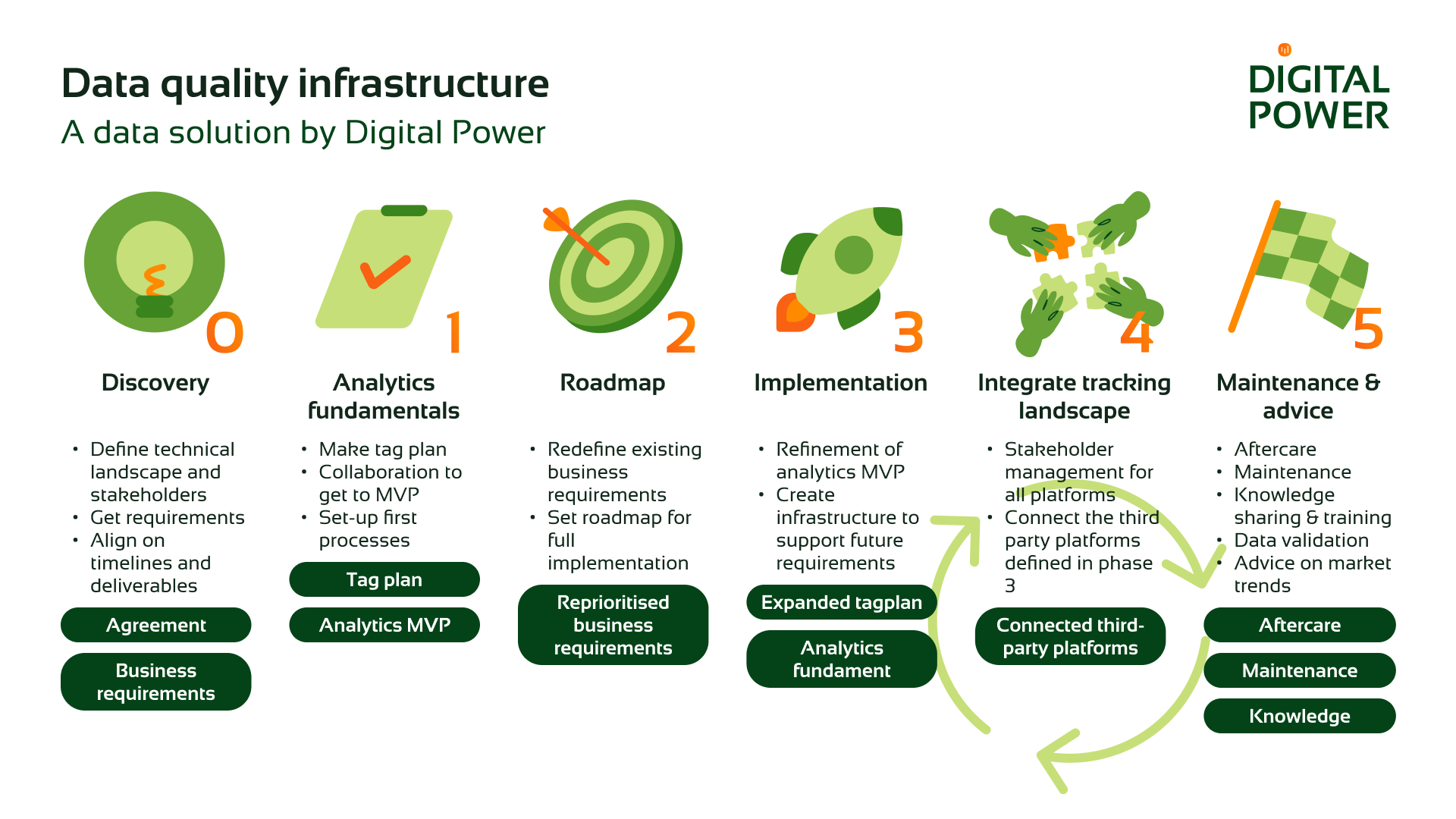
Our data collection compliance solution helps you legally and ethically collect data while safeguarding user privacy and ensuring compliance with GDPR and ePrivacy. By reducing compliance risks, it minimises fines, reputational harm, and rework. Our tailored approach bridges gaps between legal, technical, and business teams, ensuring smoother operations and stronger stakeholder trust.
When is this solution relevant for you?
Are you questioning the reliability of your data, considering an upgrade to your tracking setup, or wondering if your data is both accurate and complete?
Our data quality experts use a combination of technical audits and data validation methods to help you understand:
If your data is well-structured and accurate
How efficiently your data is collected and processed
Whether your current setup aligns with your business goals
With these insights, you’ll be empowered to optimise your data quality infrastructure, ensuring reliable and actionable data.
Our solution improves marketing efficiency by enhancing data quality, leading to more effective campaigns and optimised retargeting. It also helps avoid fines related to consent management. Better trust in your data reduces the need for costly meetings to resolve discrepancies. Employees can focus on their work, instead of spending hours discussing data issues, saving your business potentially thousands of euros each week.
It is a long-term solution that saves money and prevents costly mistakes.
Building a qualitative infrastructure ensures you have a complete understanding of your users' behaviour. This allows for more precise targeting, minimises marketing waste, and optimises retargeting efforts. In the end, it can boost your ROI on marketing campaigns.
No, we provide a tool-agnostic solution, ensuring that you retain ownership of your data and resources, and are not tied to any specific platform or tool.
We can build upon your existing tracking and analytics setup, provided it meets the necessary standards. Our approach is flexible, allowing for customisation depending on your current infrastructure.
Our solution includes processes to prevent data leakage and ensure all data collection is compliant with the latest privacy and consent regulations.
We have experience in implementing Data Management Platforms (DMP) and Customer Data Platforms (CDP) in combination with a qualitative data infrastructure.
In addition, we are experts in bringing DMPs and CDPs together with the cloud (Azure, AWS and Google Cloud) and data platforms (Databricks, BigQuery, Snowflake). We also collect and process data through a server by implementing server-side tracking.
Although tracking ideally takes place on the data layer, we can also enable implementations without developer assistance. Our solution is designed to be flexible and adaptable to your available resources.
Let's discuss the possibilities!
Still have questions, or are you ready to share your challenges and needs? Stefan would be happy to discuss the opportunities of a data quality infrastructure with you.
By 2028, the world will generate 394 zettabytes of data a year, more than double the roughly 181 zettabytes produced in 2025 (IDC, cited by TechTarget). If you work in energy, you'll feel this shift more than most. Much of that data won't come from your spreadsheets or databases. It will come from smart meters, grid sensors and AI systems that never stop reporting.
In this monthly series, we share the latest trends, product updates and industry insights in AI, data and analytics that are most relevant to you. We look beyond the update itself and explain what these developments could mean for your organisation, where they may create opportunities and how you can turn them into value.
In this monthly series, we share the latest trends, product updates and industry insights that matter most to professionals in AI, data and analytics. We also share what these developments mean for organisations and where we see the biggest opportunities to create value.
AI doesn't solve your data problem. It amplifies it.
AI that creates a holiday itinerary or drafts an email in seconds already feels completely normal. That speed creates expectations. You may recognise this within your own organisation: if AI can do this at home, why shouldn't it be able to support business processes just as easily?
From loose data to a data-driven way of working with Adobe Analytics
A financial organisation switched from Matomo to Adobe Analytics to gain better control over digital performance. However, there was a lack of knowledge about data-driven working and clear KPIs. We guided the migration and supported the content team in establishing a data-driven way of working.
Welcome to our monthly update on technical web analytics. In each edition, we share key changes, feature updates, and relevant developments from the web analytics landscape, straight to the point, and with a focus on practical impact. This month: a new feature in Tealium and an update on Google's third-party cookies.
Discrepancies in transaction figures: How and why?
"How many transactions did we have last week? Our back office reports 12,000 transactions, the database 15,000, and Google Analytics 11,000. Why don’t these numbers match?" In theory, systems tracking transactions should align. However, discrepancies are common across back-offices, databases, and web analytics tools.
A well-structured tag plan forms the foundation of a reliable data infrastructure. It ensures that data is collected consistently and accurately, which is essential for actionable insights and effective decision-making.
How confident is your company in its web analytics data? In this article, we’ll first explain why web analytics tools can never provide 100% accurate data and why that’s not necessarily a bad thing. Then, we’ll dive into the practical side of things: how reliable are most web analytics implementations?
The impact of ITP on analytics and the user experience
Intelligent Tracking Prevention (ITP) was launched by Apple in 2017 in an effort to restore "the balance the balance between privacy and the need for on-device data storage". With Intelligent Tracking Prevention, Apple aims to reduce cross-site tracking (following users across websites) by limiting the use of cookies. Find out what this means for you.
Transitioning from Universal Analytics 360 to Google Analytics 4 and Streamlining Data Analysis
There are currently a lot of developments surrounding Google Analytics, including user privacy (GDPR) and the sunset of Universal Analytics. For Miele X, the digital branch of Miele, GA4 was also one of the topics on their agenda as part of their bigger plans towards a more privacy-centric and vendor-agnostic way of data collection. They enlisted our help to support them with the transition from Universal Analytics 360 to GA4.
From 1 July 2024, it will no longer be possible to process data in Universal Analytics 360 (hereinafter: UA360). Wehkamp collected data in UA360 and was keen to be prepared in time for the migration. In addition, they wanted to collect at least 1 year of historical data for UA360's sunset. This allowed Wehkamp to compare the data in UA360 and in GA4. A key desire was to migrate the measurements as-is.
ABN AMRO partnered with our team to create a standardised digital data layer, addressing challenges with uniformity, reliability, and efficiency in their migration to a new analytics platform. The new standard allows for consistent tagging of all online components, leading to improved tagging management and reliable digital data for future use.
Integration web and app data contributes to a 360-degree customer view
Univé is a Dutch insurance company that offers insurance, financial products, and services to both consumers and businesses. The company is focused on providing high-quality service and helping customers make responsible financial decisions. Since 2014, we have been working closely with Univé.