(Re)targeting users in a privacy first browser
How to stay relevant
- Article
- Technical Web Analytics
- Server-side tracking


Building and targeting audiences is a core part of digital marketing. But with third-party cookies phased out and privacy-first browsers limiting data sharing, traditional methods of targeting users are no longer effective.
In this article series we dive into tracking prevention measures. Learn how to deal with the developments in web analytics and optimise your TMS for the future.
This is the final article in our four-part series:
- Why you need to prepare your web tracking setup for the future
- Tracking conversions in a privacy first browser
- Tracking unique users in a privacy first browser
- (Current article) (Re)targeting users in a privacy first browser
In this final article, we look at how organisations can adapt their targeting strategies. We explore alternative methods for audience building and personalisation that align with privacy regulations, and how to leverage your first-party data to maintain meaningful engagement with your users.
The challenge: tracking prevention and user targeting
As explained in the previous article, cookies have historically been used to recognise users for analytics purposes. Similarly, third-party cookies allowed third-party JavaScript (e.g., Facebook’s pixel) to label devices and track users across the internet. This data enabled precise audience segmentation for (re)targeting ads.
However, these practices have been severely impacted:
- Apple and Safari restrictions: Third-party cookies are entirely blocked on Safari and other Apple devices.
- Third party cookies and Chrome: Google recently announced another revision of their strategy for third-party cookies. Where they initially stated they would fully deprecate third-party cookies, their last update introduced a specific opt-in. However, in their newest plan, Google has decided to make no changes to how the Chrome browser currently handles third-party cookie settings.
Organisations must now adapt their strategies by leveraging first-party data and alternative solutions.
Solutions for (re)targeting in the cookielessera
1. Customer Data Platform (CDP)
A Customer Data Platform (CDP) is a critical tool for managing and activating first-party data. It serves as a central hub for connecting data from multiple tools, such as CRM, TMS, and DMP, and allows for building detailed user profiles.
How a CDP works:
- Collects first-party data from website interactions, CRM systems, and other sources.
- Builds user profiles by consolidating data and associating it with unique identifiers (e.g., hashed email addresses or cookies).
- Pushes audience segments to marketing vendors and personalisation tools for targeted campaigns.
Key features:
- Visitor stitching: Automatically recognises users across devices and browsers, especially when they log in, improving the accuracy of user profiles.
- Composable CDPs: A composable CDP can integrate directly with your data warehouse, reducing the need to duplicate data. While they require more technical expertise, they offer greater flexibility and control. Read how we did this for Transavia.
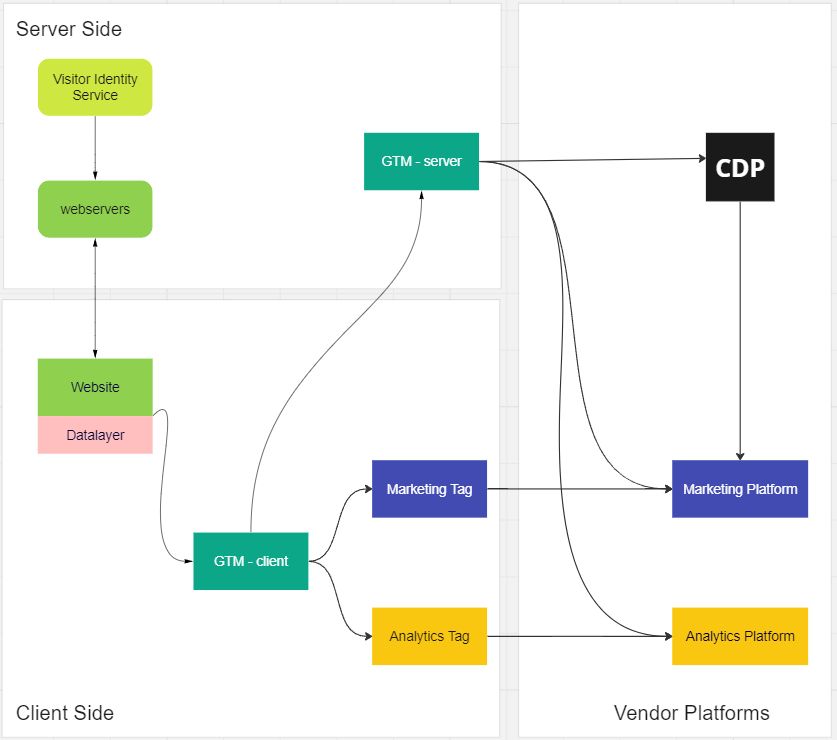
2. A robust infrastructure combining TMS, VIS, and CDP
A comprehensive setup integrating server-side tracking, a Visitor Identity Service (VIS), and a CDP offers the most robust solution:
- Tag Management System (TMS): Collects and processes data in real-time. Ensures conversions and other metrics are tracked accurately through client-side and server-side solutions.
- Visitor Identity Service (VIS): Maintains unique user identification across devices and browsers by associating cookies and other identifiers.
- Customer Data Platform (CDP): Activates first-party data for targeted campaigns and personalisation.
This combination ensures businesses take full control of their data while respecting user privacy.
Best practices for (re)targeting campaigns
- Focus on first-party data: Collect and enrich data from your own systems, such as website interactions and CRM platforms.
- Integrate tools effectively: Ensure seamless communication between your TMS, VIS, and CDP to build accurate user profiles and activate data.
- Respect privacy and compliance: Use data ethically and transparently. Obtain user consent for advanced practices like stitching or sharing hashed data.
- Experiment and optimise: Monitor emerging technologies like Google’s Privacy Sandbox and test them as they mature.
Conclusion: Building a future-proof tag management system
The cookieless era has reshaped how organisations approach (re)targeting and audience segmentation. While traditional third-party cookie-based methods are no longer viable, businesses can thrive by adopting privacy-conscious solutions.
A setup combining server-side tracking, a Visitor Identity Service, and a Customer Data Platform offers a robust foundation for data collection, enrichment, and activation. However, not all organisations need this complete stack—a subset of these tools may suffice depending on your specific challenges and goals. Carefully assess your needs and prioritise solutions that align with your organisation’s objectives.
By taking control of your data and respecting user privacy, you’ll not only stay relevant but also build trust with your audience, positioning your business for success in the evolving digital landscape.
This is an article from Anne Wind
Anne Wind, Technical Web Analyst, combines his marketing background with expertise in data collection. His critical view of data from a marketing perspective led him to the technical side of data analysis. With a focus on accurate data collection, he helps organisations turn insights into impactful actions.
Receive data insights, use cases and behind-the-scenes peeks once a month?
Sign up for our email list and stay 'up to data':