Webinar | How Transavia unified its customer data through a composable customer data platform
In this webinar, Transavia shares how they completely transformed their approach to understanding and serving their customers better.
- Video
- Composable CDP
- Data Engineering



Whether you work for a major fashion brand, supermarket, or in the travel industry, leveraging your customer data to personalise customer experiences is crucial to your success. But it's not easy to achieve. Like most B2C companies, airlines are swimming in customer data from dozens of different places, struggling with data quality, privacy compliance, and real-time personalisation.
In this webinar, you will discover how we helped Transavia convert their customer data into personal experiences that really work. Be inspired and learn how you can use the same strategy to surprise your customers and increase your success.
The results are impressive:
- Client impact: a 5% increase in newsletter conversions, a 4% uplift from personalised push messages in the app, and a 0.5% boost in website performance. Additionally, the recognition rate of visitors on digital channels has increased by 5-10%. and the customer NPS scores have improved.
- Efficiency: a 7% improvement in media spend efficiency and the time to market for advanced personalisation use cases has improved by 400%.
- Costs: licensing costs have been reduced by roughly 40%.
- Data quality: there is an overall improvement in data governance.
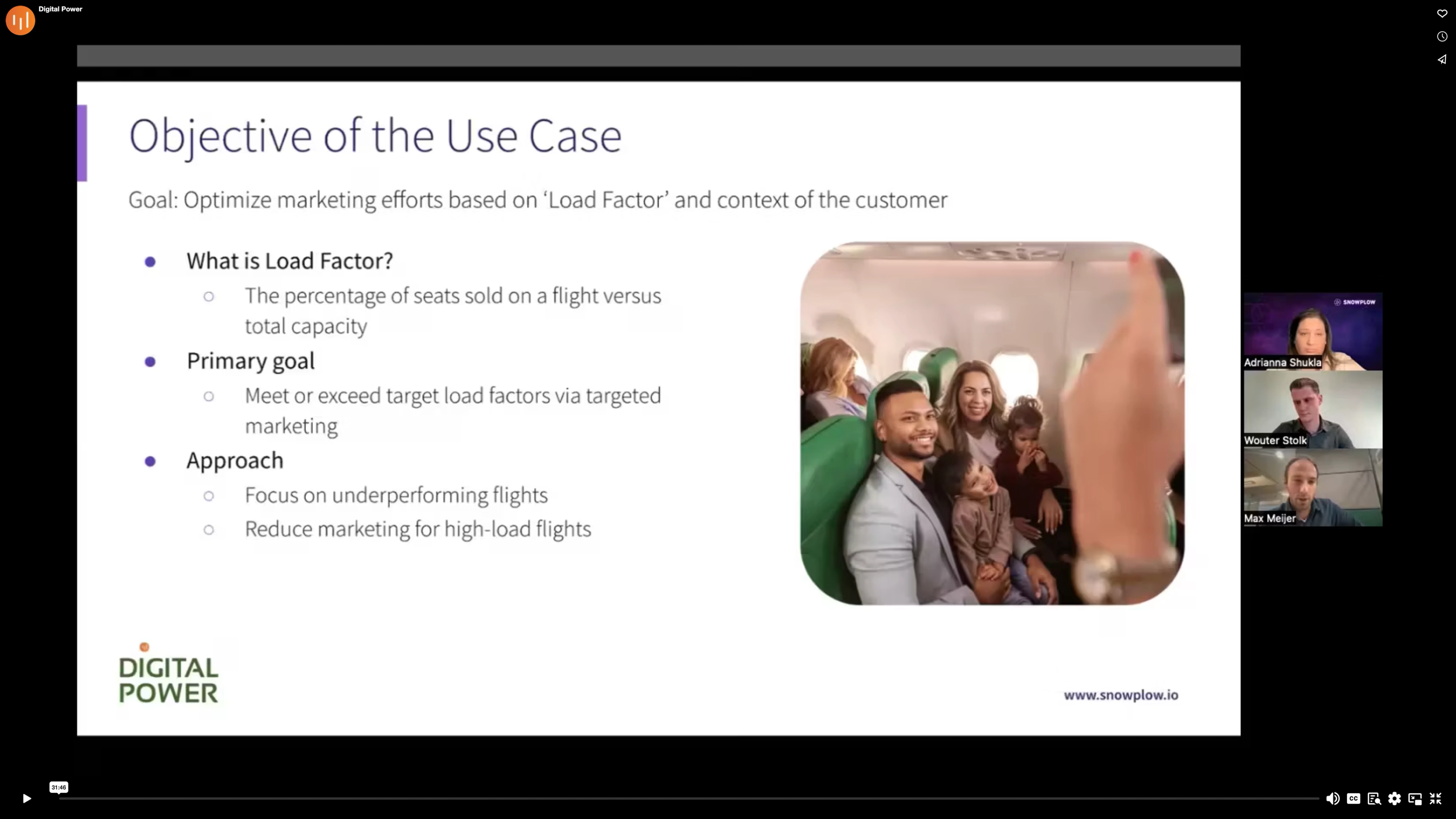
In this webinar, you'll learn how:
- We built a GDPR-compliant first-party data foundation on Azure with Snowplow, Databricks and Census
- Fragmented data sources unified while improving data quality and governance
- We implemented a full feedback loop for personalisation on digital channels, enabling immediate optimisation of the next best action (NBA).
- We deployed AI-powered personalisation across web and mobile touchpoints
- We created a data-driven culture with proactive monitoring and insights
Meet our speaker
Max is Product Owner of the Marketing Automation team. He is responsible for vision and planning. Max works closely with stakeholders to improve marketing processes and deploy technology that makes customer interactions more personal and marketing campaigns more effective.

Receive data insights, webinar invites and use cases once a month?
Sign up for our email list and stay 'up to data':
Read more about Data Engineering and Composable CDP
From smart meter data to real-time decisions
By 2028, the world will generate 394 zettabytes of data a year, more than double the roughly 181 zettabytes produced in 2025 (IDC, cited by TechTarget). If you work in energy, you'll feel this shift more than most. Much of that data won't come from your spreadsheets or databases. It will come from smart meters, grid sensors and AI systems that never stop reporting.
Answering data questions independently within minutes with conversational analytics
Within Digital Power, we wanted to give Finance and Business Support more ownership of management dashboards and give Sales faster, independent access to relevant insights. With a simpler data model and Databricks Genie, users can now ask questions about data in natural language and immediately ask follow-up questions. Finance and Business Support can also make dashboard changes themselves, reducing the amount of time technical specialists spend on recurring questions and changes.
400% faster time-to-market for new personalisation use cases
In September 2023, Transavia asked us to evaluate their Customer Data Platform (CDP): did it still align with their marketing objectives, and was it future-proof considering the stricter regulations around third-party cookies?
How Databricks Genie Agents make data accessible through natural language
Many organisations face the same challenge. Someone has a question about revenue, customer behaviour or operational performance. The data exists, but finding the answer takes time. A dashboard needs to be opened, filters have to be configured correctly, or a Data Analyst needs to perform an additional analysis.
From sensor data to decisions that genuinely improve your operations
More and more organisations are investing in sensors that continuously collect data from their assets, whether buildings, vehicles, production facilities or energy infrastructure. The question is: what value does that data actually deliver?
AI doesn't solve your data problem. It amplifies it.
AI that creates a holiday itinerary or drafts an email in seconds already feels completely normal. That speed creates expectations. You may recognise this within your own organisation: if AI can do this at home, why shouldn't it be able to support business processes just as easily?
Direct insight into sensor data with a self-service analytics platform
Heerema Marine Contractors operates the world’s largest crane vessels, equipped with many sensors that together generate millions of measurements every day. This sensor data is critical for safer operations, lower emissions, better engineering and well-founded investment decisions.
Data governance in Azure Databricks
It is a pattern that repeats itself with regularity: an organisation reports a data breach, customer records end up exposed, and the discussion that follows quickly turns to firewalls, outdated software and malicious attackers.
Gain control of data governance for your data and AI platform in 5 steps
Are you working with a data and AI platform but struggling to realise the value you expected? You're not alone. Many organisations invest heavily in data and AI initiatives, only to encounter the same challenges in practice. Data is difficult to find, definitions vary between teams and responsibilities are unclear.
Configuring Claude Code with CLAUDE.md
There is a clear difference between teams that occasionally achieve decent results with Claude Code and teams that consistently produce high-quality output. That difference rarely comes down to better prompts. In practice, it is usually something more fundamental: the rules and expectations you establish before the agent starts writing.
In 3 steps towards effective data governance
In this four-part series, we explore data governance from why it matters and how to organise it, to its practical implementation within modern data and AI platforms. In this second article, we focus on the organisational foundations. How do you secure buy-in? Which roles and responsibilities are essential? And how do you establish a governance framework that provides clear direction across the organisation?
Why you can’t afford to wait on data governance any longer
In an era where data lies at the heart of business operations, innovation and AI, postponing data governance is unwise. This article highlights why it’s crucial to take action now to gain control over your data, minimise risks, and achieve a competitive advantage.
Why modern data architecture is an organisational challenge
The question is no longer how you technically unlock data, but how you organise your company to create structural value from it. During the DWH & BI Summit in March 2026, data leaders, architects and governance experts came together to discuss data mesh, data governance, data products and data modelling.
Designing value-adding ML systems
Machine learning (ML) is often treated as a modelling exercise. Pick an algorithm, train it, evaluate the metrics, deploy. In reality, the algorithm is one of the least important decisions you’ll make.
Should you run LLMs locally?
Large Language Models (LLMs) have quickly become a standard component in modern applications. Most developers start by integrating models such as OpenAI, Claude or similar providers through APIs. It is fast, convenient and requires very little infrastructure.
Faster AI search results with a scalable streaming data pipeline
Exa is an AI company that develops a search engine and API that enable AI systems to intelligently search and analyse the internet. Their technology is used across domains such as finance, coding agents, news, recruitment and consulting, where large volumes of online data are quickly retrieved, structured and summarised for specific use cases.
Less administrative time in healthcare thanks to secure AI conversation reporting
Dedimo wanted to explore how AI could help automatically transcribe therapy sessions between client and therapist and generate reports.
4x faster personalisation with a composable cdp (Databricks deepdive)
Transavia operates in a highly competitive travel market where customers expect personalised and consistent communication across every touchpoint. Whether on the website, in the app or via email, each interaction needs to reflect customer behaviour and preferences.
How AI is transforming programming: From autocomplete to agentic coding
Artificial Intelligence is transforming how you design, build, and maintain digital solutions. From code generation to data pipeline automation, AI has become a trusted companion in technical workflows.
Data platform audit provides clear insights and concrete optimisations
Volero.nl is a young and fast-growing company that sells rugs through a webshop and a physical store. The company is primarily active in the Netherlands but is growing rapidly across Europe, including Belgium, Germany and Poland. To support this growth, it is essential for Volero to work in a data-driven way.
From ambition to activation: how Ennatuurlijk really got moving with data
At energy company Ennatuurlijk, the belief grew that intuition was no longer enough to set the course. The energy market was changing rapidly, the organization was growing, and the amount of information was increasing every day. IT Manager Eric Vanderfeesten went looking for a data partner who could not only provide strategic advice on data-driven work, but could also strengthen his data team operationally. In this interview, he shares his vision, experience and results from working with Digital Power.
How to migrate your data warehouse
If you’ve decided to migrate your data warehouse to a European environment, taking a structured approach is key. This blog focuses on the steps needed for a smooth and successful transition.
Download: Migration guide for modern data warehousing
This document is intended to provide guidance during the migration of legacy data warehouses or databases to modern Lakehouse solutions such as Databricks and Snowflake. It describes the different steps that are needed for a structured migration process. Migrations are often complex processes that require careful planning and execution to ensure a smooth transition.
What European data warehouse solutions are available?
Due to geopolitical developments and growing concerns about data sovereignty, more and more businesses are looking to reduce their dependence on US cloud providers.
Is your organisation ready for independence from the US and migrate to EuroStack?
In an era marked by international tensions, rising concerns about privacy, security, and technological sovereignty, you may find yourself re-evaluating your reliance on US technology solutions. The drive towards digital independence isn't just a political goal, but may also be a pragmatic business necessity.
Understanding AI, GenAI, ML, and MLOps
Artificial Intelligence (AI) is changing the way organisations operate, from personalised customer experiences to automated or assisted decision making, AI helps your organisation leverage your data. However, navigating through this fast-evolving field can feel overwhelming, with terms like AI, Generative AI (GenAI) & Machine Learning (ML) often causing confusion.
Video | What is a composable CDP?
In this video, I explain what a composable Customer Data Platform (CDP) is, the benefits it brings, and when it’s the right choice for your organisation. I will also share the kind of results you can expect from using this flexible, modular approach to managing customer data.
AI agents demystified
With the ongoing developments in the data and AI industry, the hype around AI agents has no signs of slowing down. Jensen Huang, Nvidia CEO, is a strong proponent of AI agents, envisioning a multi-trillion-dollar opportunity, where agents can perform tasks with a high degree of autonomy and revolutionize how people work and how businesses operate. So, in this article we would like to discuss what exactly AI agents are, what are their main components, how they interact together and the basics on how to build one.
How a start-up starts with data-driven working
An innovative start-up in the baby care sector aimed to work in a data-driven way in order to gain valuable insights and enable strategic growth. They engaged our support to help realise this ambition.
How to build a strong cloud governance framework?
Are you increasingly working in the cloud? Then it’s time to think about governance. With clear agreements and controls, you stay in control of your cloud environment – from costs and security to compliance. That way, you avoid security issues, unnecessary spending or falling short of compliance requirements.
Webinar | Machine Learning operations framework
So you have a data warehouse and developed models proven to generate valuable inferences, but the business impact is not there yet? In this webinar we will show how the right framework can activate these models within minutes to continuously deliver up-to-date predictions. This is the central objective of MLOps.
From strategy to realisation: a data-driven future
Ennatuurlijk supplies sustainable heat and cold via heat networks to consumers and businesses. The internal Data & Analytics team is tasked with making the organisation data-driven. In doing so, they ran into a challenge: the many requests for data products within the organisation were difficult to manage and the impact remained limited. The management team therefore asked us to help them develop a data strategy, create a future-proof data landscape and drive a data-driven mindset within the organisation.
What is a composable CDP and why is it the future?
More and more companies are running into the limitations of traditional Customer Data Platforms (CDPs): they lack flexibility, struggle to import and export data, and find it difficult to comply with strict privacy regulations.
Personalised marketing through a composable CDP
To truly work in a customer-centric way, a flexible and powerful tech stack is essential. Customers expect relevant, personalised interactions at the right time and through the right channel. With the right technologies, you ensure every customer feels understood while optimising your marketing efforts.
Scalable machine learning models thanks to MLOps framework implementation
After we built a data warehouse for Meerlanden, their data scientist began working with the data. We proposed setting up a Machine Learning Operations (MLOps) framework together, allowing them to integrate their models directly into the existing environment. This enabled them to make predictions that improved the efficiency of Meerlanden’s services.
What is data governance?
As the usage of data in organisations becomes ubiquitous, the need to keep control over your data is becoming increasingly important. Gaining control over your data is achieved through effective data governance. However, many people struggle to figure out what data governance encompasses exactly and how to start implementing this at their organisation. This article aims to give you an overview of the crucial components of data governance and how to introduce them at your organisation.
Optimising Machine Learning inference with PySpark and Pandas UDFs
In the world of machine learning, working with large datasets and complex models can quickly become time-consuming and resource-intensive. To speed up this process, parallelisation becomes crucial. This technique involves breaking down tasks into smaller subtasks that can be processed simultaneously across multiple CPU cores or distributed machines within a cluster. By spreading out the workload, you can achieve faster and more efficient data processing on a large scale.
Improving sales effectiveness by predicting students' enrollment
Talent Garden provides masterclasses and training programs to students, engaging with them through various online and offline touchpoints. Online interactions include completed contact forms and information requests, while offline touchpoints involve meetings and calls with Talent Garden’s sales team. Throughout the customer journey, from initial contact to final enrollment, Talent Garden collects extensive data*. With a wealth of raw data at their disposal, they sought to improve their enrollment strategy and the effectiveness of their sales team. To achieve this, they asked us to develop a data model that could better predict the likelihood of a new contact eventually becoming a student.
Using MLOps for fully automated and reliable sales forecasting
A global asset manager, specialising in Quant and Sustainable Investing, offers a range of investment strategies, including equities and bonds. To strengthen their competitive position and proactively respond to changing client needs and market developments, the sales and marketing department aimed to adopt a more data-driven approach.
A scalable data model for the analytics of multiple websites
A digital agency develops and manages various websites and analyses their performance using Google Analytics, sharing the results with clients via dashboards. However, the transition from Universal Analytics to GA4 presented challenges because the data structure in GA4 is different, causing the existing dashboards to stop functioning. The agency asked us to help devise a scalable and future-proof solution that would work for all of their clients.
Comparing the best Python project managers
In the ever-changing world of Python, managing packages, environments and versions efficiently is important. Traditional tools like pip and conda have served us well, but as projects become more complex, so do our requirements. This guide looks at modern alternatives - Poetry, PDM, Hatch and Rye - each of which offers unique capabilities to streamline Python project management.
Sustainable growth through the establishment of a data team
Rapidly growing scale-up EnergyZero needed to expand and establish a strong data team due to their extreme growth. The primary data need was to support and conduct the financial analysis for an upcoming audit. Additionally, they wanted to automate work processes and improve data exchange with B2B partners.
Low-code/no-code or custom coding?
Years ago, you couldn't develop an application or process without knowledge of complex programming languages like Javascript, PHP, and Python. You needed a programmer or Data Engineer. Today, there is a shortage of technical experts, while more and more low-code solutions are appearing on the market. These tools allow you to get started without in-depth technical knowledge. Whether this is the right solution for you depends on various factors. Make the right decision with the help of this article.
What does a (Cloud) Data Engineer do versus a Machine Learning Engineer?
In the world of data and technology, Data Engineers and Machine Learning Engineers are crucial players. Both roles are essential for designing, building, and maintaining modern data infrastructures and advanced machine learning (ML) applications. In this blog, we focus specifically on the roles and responsibilities of a Data Engineer and Machine Learning Engineer.
The organisational benefits of implementing your own AI-chatbot
With the increasing availability of cloud services that enable companies to leverage Large Language Models, it becomes relatively easy to setup your own GPT-model. However, one important question needs to be answered before you start building: what are the benefits for my organisation?
How does the AI Document Explorer work in practice?
The AI Document Explorer (AIDE) is a cloud solution developed by Digital Power that utilises OpenAI's GPT model. It can be deployed to quickly gain insights into company documents. AIDE securely indexes your files, enabling you to ask questions about your own documents. Not only does it provide you with the answers you are looking for, but it also references the locations where these answers are found.
Fast and reliable internal information using AI Document Explorer
Financial institutions need to process large amounts of documentation. For this particular institution, an internal team facilitates this by, for example, creating summaries using text analysis and natural language processing (NLP). They make these available to the various business units. To conduct audits more efficiently, they wanted to develop a question-and-answer model to get the right information to them faster. When ChatGPT was launched, they asked us to create a proof of concept.
Implementing a data platform
Based on our know-how, the purpose of this blog is to transmit our knowledge and experience to the community by describing guidelines for implementing a data platform in an organisation. We understand that the specific needs of every organisation are different, that they will have an impact on the technologies used and that a single architecture satisfying all of them makes no sense. So, in this blog we will keep it as general as we can.
Working more efficiently thanks to migration to Databricks
The Kadaster manages complex (geo)data, including all real estate in the Netherlands. All data is stored and processed using an on-premise data warehouse in Postgres. They rely on an IT partner for maintaining this warehouse. The Kadaster aims to save costs and work more efficiently by migrating to a Databricks environment. They asked us to assist in implementing this data lakehouse in the Microsoft Azure Cloud.
Bring structure to your data
There are many different forms of data storage. In practice, a (relational) database, a data warehouse, and a data lake are the most commonly used and often confused with each other. In this article, you will read about what they entail and how to use them.
Converting billions of streams into actionable insights with a new data & analytics platform
Merlin is the largest digital music licensing partner for independent labels, distributors, and other rightsholders. Merlin’s members represent 15% of the global recorded music market. The company has deals in place with Apple, Facebook, Spotify, YouTube, and 40 other innovative digital platforms around the world for its’ member’s recordings. The Merlin team tracks payments and usage reports from digital partners while ensuring that their members are paid and reported to accurately, efficiently, and consistently.
Migration to the cloud: How does this work in practice?
In the past, all data from companies was stored locally in an on-premise environment. More and more companies are migrating their data infrastructure to the cloud. Cloud computing utilises servers managed and maintained by cloud service providers such as Amazon Web Services, Microsoft Azure, and Google Cloud Platform. In this article, you will read the answers to the questions you may have when considering a migration to the cloud.
What is machine learning operations (MLOps)?
Bringing machine learning models to production has proven to be a complex task in practice. MLOps assists organisations that want to develop and maintain models themselves in ensuring the quality and continuity. Read this article and get answers to the most frequently asked questions on this topic.
Webinar: Data Governance
In this webinar, we discuss the maturity model that we apply to quantify the maturity of different dimensions of data governance. Additionally, we provide concrete steps and implementation tips to start providing added value through data management.
20% fewer complaints thanks to data-driven maintenance reports
An essential part of Otis's business operations is the maintenance of their elevators. To time this effectively and proactively inform customers about the status of their elevator, Otis wanted to implement continuous monitoring. They saw great potential in predictive maintenance and remote maintenance.
Valuable insights from Microsoft Dynamics 365
Agrico is a cooperative of potato growers. They cultivate potatoes for various purposes such as consumption and planting future crops. These potatoes are exported worldwide through various subsidiaries. All logistical and operational data is stored in their ERP system, Microsoft Dynamics 365. Due to the complexity of this system with its many features, the data is not suitable for direct use in reporting. Agrico asked us to help make their ERP data understandable and develop clear reports.
Kubernetes-based event-driven autoscaling with KEDA: a practical guide
This article explains the essence of Kubernetes Event Driven Autoscaling (KEDA). Subsequently, we configure a local development environment enabling the demonstration of KEDA using Docker and Minikube. Following this, we expound upon the scenario that will be implemented to showcase KEDA, and we guide through each step of this scenario. By the end of the article, you will have a clear understanding of what KEDA entails and how they can personally implement an architecture with KEDA.
AWS (Amazon Web Services) vs GCP (Google Cloud Platform) for Apache Airflow
This article provides a comparison between these two managed services Cloud Composer & MWAA. This will help you understand the similarities, differences, and factors to consider when choosing them. Note that there are other good options when it comes to hosting a managed airflow implementation, such as the one offered by Microsoft Azure. The two being compared in this article are chosen due to my hands-on experience using both managed services and their respective ecosystems.
Insight into the complete sales funnel thanks to a data warehouse with dbt
Our consultants log the assignments they take on for our clients in our ERP system AFAS. In our CRM system HubSpot, we can see all the information relevant before signing a collaboration agreement. When we close a deal, all the information from HubSpot automatically transfers to AFAS. So, HubSpot is mainly used for the process before entering a collaboration, while AFAS is used for the subsequent phase. To tighten our people's planning and improve our financial forecasts, we decided to set up a data warehouse to integrate data from both data sources.
Data quality: the foundation for effective data-driven work
Data projects often need to deliver results quickly. The field is relatively new, and to gain support, it must first prove its value. As a result, many organisations build data solutions without giving much thought to their robustness, often overlooking data quality. What are the risks if your data quality is not in order, and how can you improve it? Find the answers to the key questions about data quality in this article.
The all-round profile of the modern data engineer
Since the field of big data emerged, many elements of the modern data stack became the data engineers' responsibility. What are these elements, and how should you build your data team?
Setting up Azure App functions
In the article, we start by discussing Serverless Functions. Then we demonstrate how to use Terraform files to simplify the process of deploying a target infrastructure, how to create a Function App in Azure, the use GitHub workflows to manage continuous integration and deployment, and how to use branching strategies to selectively deploy code changes to specific instances of Function Apps.
Unlocking the power of Analytics Engineering
The world of data is continuously shifting and so are its corresponding jobs and responsibilities within data teams. With this, an up-and-coming role appeared on the horizon: the Analytics Engineer.
A standardised way of processing data using dbt
One of the largest online shops in the Netherlands wanted to develop a standardised way of data processing within one of its data teams. All data was stored in the scalable cloud data warehouse Google BigQuery. Large amounts of data were available within this platform regarding orders, products, marketing, returns, customer cases and partners.
Reliable reporting using robust Python code
The National Road Traffic Data Portal (NDW) is a valuable resource for municipalities, provinces, and the national government to gain insight into traffic flows and improve infrastructure efficiency.
Setting up a future-proof data infrastructure
Valk Exclusief is a chain of 4-star+ hotels with 43 hotels in the Netherlands. The hotel chain wants to offer guests a personal experience, both in the hotel and online.
A scalable data platform in Azure
TM Forum, an alliance of over 850 global companies, engaged our company as a data partner to identify and solve data-related challenges.
A fully automated data import pipeline
Stichting Donateursbelangen aims to strengthen trust between donors and charities. They believe that that trust is based on collecting money honestly, openly, transparently and respectfully. At the same time effectively using the raised donation funds to make an impact. To further this goal, Stichting Donateursbelangen wants to share information about charities with donors through their own search engine.
A day in the life of a Data Engineer
For developing modern data applications, a Data Engineer is essential. But what does it actually mean to be a Data Engineer and what exactly do you do? Our colleague Oskar, Data Engineer at Digital Power, explains.
5 questions for Data Engineer Dennis
In this video, you will find out what a job as a Data Engineer looks like! What does a working week look like, which clients do our Data Engineers work for and what makes working so much fun? Dennis likes to tell you more about it!
5 questions for Data Analyst Dennis
In this video, you'll discover what a job as a Data Analyst looks like! What does a working week look like, which clients do our Data Analysts work for and what makes the job so fun? Dennis is happy to tell you more about it!
5 questions for Data Engineer Oskar
In this video, you will find out what a job as a Data Engineer looks like! What does a working week look like, which clients do our Data Engineers work for and what makes working so much fun? Oskar likes to tell you more about it!
5 reasons to use Infrastructure as Code (IaC)
Infrastructure as Code has proven itself as a reliable technique for setting up platforms in the cloud. However, it does require an additional investment of time from the developers involved. In which cases does the extra effort pay off? Find out in this article.
How do I become a Data Engineer?
A few years ago, the job title didn't even exist: Data Engineer. Nowadays, there is a high demand for Data Engineers. Almost every organisation consciously collects data, and the realisation that this must be done in a structured way is growing. If the data you collect is not well organised and correct, you cannot use it as input for making good decisions. Data Engineers build infrastructures that process data. Therefore, they are indispensable to organisations that want to collect and apply their data in a structured way.
Central data storage with a new data infrastructure
Dedimo is a collaboration of five mental healthcare initiatives. In order to continuously enhance the quality of their care, they organize internal processes more efficiently. Therefore, they use perceptions from the data that is internally available. Previously, they acquired the data themselves from different source systems with ad hoc scripts. They requested our help to make this process more robust, efficient and to further professionalise it. They asked us to facilitate the central storage of their data, located in a cloud data warehouse. The goal was to set up the data infrastructure within this environment, since they were already used to working with Google Cloud Platform (GCP).
Improved data quality thanks to a new data pipeline
At Royal HaskoningDHV, the number of requests from customers with Data Engineering issues continue to climb. The new department they have set up for this, is growing. So they asked us to temporarily offer their Data Engineering team more capacity. One of the issues we offered help with involved the Aa en Maas Water Authority.
EP 1: Almost graduated and ready for your first job as a data professional?
How do you find out what you want, and what do you look for in job vacancies? Will you opt for a large company, a small company, a consultancy or something else? These are some of the questions that our graduation intern Stijn had to deal with. He had a discussion with his colleagues to get answers to these questions. The result? The Data Choice Cast! In this podcast, Stijn asks all his pressing questions and receives tips that help him (and hopefully you, too) to make the right choice in choosing a job in the data world.
Digital Power Datahub and Partos launch the Data Awareness series
On February 10, 2022, the Digital Power Datahub and the Partos Digital Lab together kicked off the Data Awareness series with the Intro to Data Awareness. This series of 6 training courses develops the Datahub especially for the members of Partos; non-profits in the development cooperation industry. The aim of the series is to make development cooperation specialists data-wise, so that they can make and measure more impact.
Making impact measurable
The Designathon Works foundation organises Design Hackathons (Designathons) for children aged 8 to 12. The target? Teaching children from all over the world skills to become a 'changemaker'. They are challenged to design solutions for a better world, for example to combat climate change. From the Datahub, we helped Designathon Works fine-tune the impact measurements free of charge. We also made a first move towards automating data collection, analysis and visualisation.
Which data traineeship is right for you?
You are almost done with your studies and looking for an employer that offers you the opportunity to learn everything about the field of data. Or you are no longer challenged in your current position and would like to become more technical. In both cases, you do not want to follow unpaid courses, but you would like to get started as soon as possible for real customers, with a serious salary. Does this sound familiar? Then these data traineeships are really something for you.
A well-organised data infrastructure
FysioHolland is an umbrella organisation for physiotherapists in the Netherlands. A central service team relieves therapists of additional work, so that they can mainly focus on providing the best care. In addition to organic growth, FysioHolland is connecting new practices to the organisation. Each of these has its own systems, work processes and treatment codes. This has made FysioHolland's data management large and complex.
A scalable machine-learning platform for predicting billboard impressions
The Neuron provides a programmatic bidding platform to plan, buy and manage digital Out-Of-Home ads in real-time. They asked us to predict the number of expected impressions for digital advertising on billboards in a scalable and efficient way.
Why do I need Data Engineers when I have Data Scientists?
It is now clear to most companies: data-driven decisions by Data Science add concrete value to business operations. Whether your goal is to build better marketing campaigns, perform preventive maintenance on your machines or fight fraud more effectively, there are applications for Data Science in every industry.
A Career as a Data Engineer? Shape your training
In June 2020, Sander became part of our team. Although he started in the middle of corona time, he soon noticed that he was greatly stimulated to make contact with his new colleagues. This largely came naturally as part of our onboarding program: "This matched perfectly to my needs: I started calling many colleagues myself to get acquainted! "Read how Sander designs his own training as a data engineer."
The foundation for Data Engineering: solid data pipelines
Basically, Data Engineers work on data pipelines. These are data processes that can retrieve data from a certain place and write it in somewhere. In this article you can read more about how data pipelines work and discover why they are so important for a solid data infrastructure.
What is a data architecture?
Working in a data-driven way helps you make better decisions. The better your data quality, the more you can rely on it. A good data architecture is a basic ingredient for data-driven working. In this article, we explain what a data architecture is and what a Data Architect does.
Measurable impact on social change using a data lake
RNW Media is an NGO that focuses on countries where there is limited freedom of expression. The organisation tries to make an impact through online channels such as social media and websites. To measure that impact, RNW Media drew up a Theory of Change (a kind of KPI framework for NGOs).
Digital transformation and better internal collaboration thanks to insight into offline and online data.
Publisher Malmberg collects a lot of offline and online data. More and more educational institutions are using online licenses in addition to (or instead of) printed teaching materials. To properly make use of this, Malmberg uses monthly reports. The in-house data team compiles these as input for specific departments. Malmberg asked us to strengthen this team and make the internal processes around data more efficient.