In 3 steps towards effective data governance
Practical guide for organisations who want to get a grip on their data
- Article
- Data Engineering
- Data governance


In this four-part series, we explore data governance from why it matters and how to organise it, to its practical implementation within modern data and AI platforms. In this second article, we focus on the organisational foundations. How do you secure buy-in? Which roles and responsibilities are essential? And how do you establish a governance framework that provides clear direction across the organisation?
This article series consists of 4 articles
- Why you can no longer afford to wait with data governance
- (Current article) Effective data governance in 3 steps
- Gain control of data governance for your data and AI platform in 5 steps
- Data governance in Azure Databricks
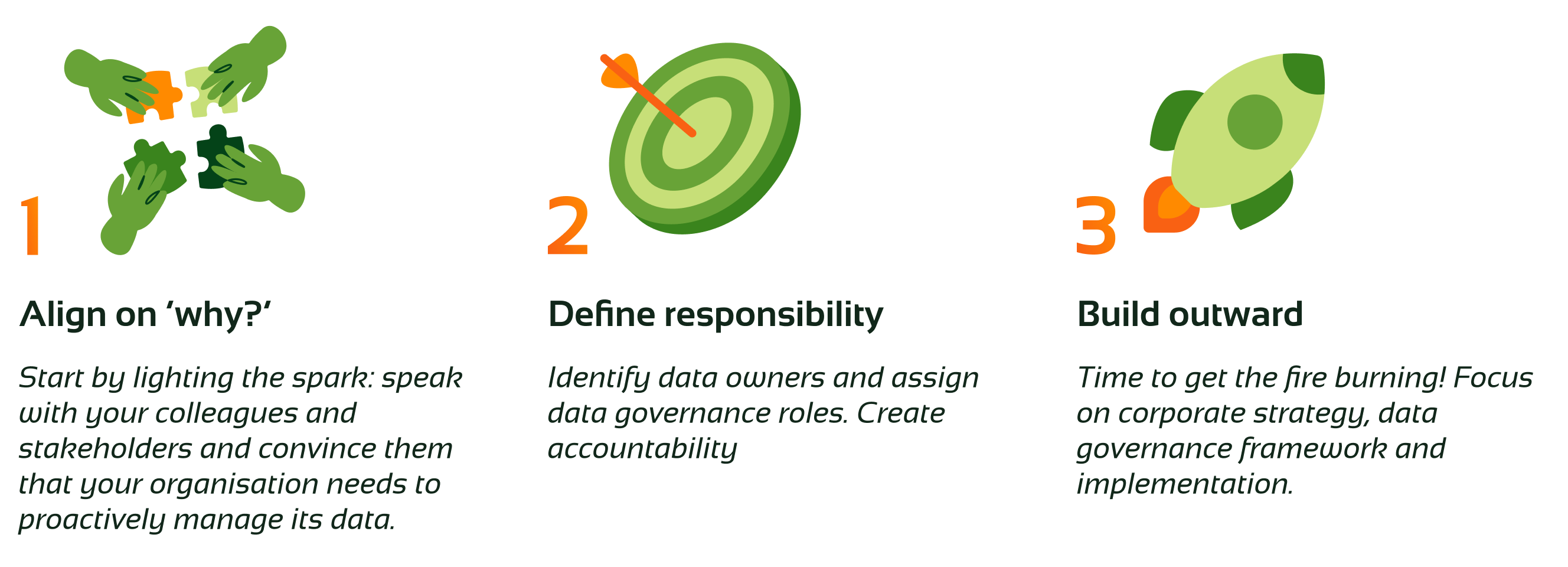
Step 1: Align on the why
Start by lighting the spark: speak with your colleagues and stakeholders and convince them that your organisation needs to proactively manage its data.
Illustrate how poorly managed data and low data quality hinder the execution of corporate strategy and prevent real progress. Show how data governance enables better decision-making, boosts efficiency, is the foundation for AI use cases, supports compliance, and mitigates risk.
And as always, be context-specific: share internal examples that resonate with your audience.
Step 2: Define roles and responsibilities
Data governance requires clear ownership. People only take responsibility when they understand what is expected of them and why it matters.
A good starting point is to appoint:
- Data owners: senior business stakeholders with the authority, budget and overall accountability for their dataset.
- Data stewards: individuals who support data owners in the day-to-day execution of governance activities.
Ensure that data owners report to a Data Governance Council, chaired by a C-level sponsor who can make decisions and resolve issues when needed. This helps maintain oversight of progress and governance decisions.
The purpose of this step is not to operationalise governance, but to define who is responsible for policies, who makes decisions, and how conflicts or exceptions are resolved.
Finally, identify who produces data and who uses it. Effective agreements on data quality can only be made once both groups understand each other's needs and expectations.
Step 3: Build the framework and start small
When all the main stakeholders are on board and roles and responsibilities are clearly defined, it's time to get the fire burning. Here you want to focus on three key areas:
- Corporate strategy: Articulate why data governance is essential for your organisation to achieve its strategic goals. This forms a key part in securing that crucial management buy-in. The senior leadership needs to know: “You can’t trust the numbers without governance”. The good news? You had already thought this through under step 1. 😉
- Data governance framework: Work out the main data governance policies and processes: what needs to be done, and how it will be carried out. Start with the most critical documentation and expand from there. Consider using simple visuals in addition to detailed diagrams and text heavy documents. Involve stakeholders in shaping the framework and secure a formal mandate from the Data Governance Council.
- Implementation: Roll out the data governance framework in phases to give people time to adapt. Start small and gradually expand by starting with high impact use cases that solve existing problems people experience, such as an upcoming data migration, a new data warehouse, master data management or endeavouring operational excellence. A phased approach helps build momentum and allows early learnings to inform the broader rollout.
Pro tip: don’t start with a tool! Use basic documentation first. Buy-in from business users is easier when processes come before technology.
Key takeaways
- Bad data costs more than data governance. Without a structured approach, teams keep fixing the same problems and risks will accumulate.
- Governance isn’t about tools, it’s about people, processes, and breaking silos. The right people must make the right decisions.
- Start small and show early wins. Trust builds with results. A visible success story can go a long way in sustaining momentum.
How do you translate this to a data and AI platform?
With a governance organisation, clear responsibilities and a governance framework in place, you have established the foundation. The next challenge is to make governance an integral part of your data and AI platform.
In the next article, we show how to operationalise ownership, data quality, metadata and data lineage within a modern data and AI platform.
This is an article by Guus van Loon
With more than 10 years of experience in data, strategy and innovation, Guus helps organisations turn complex ambitions into sustainable business value. As Head of Research & Development at a market research scale-up, he worked on strategic challenges for international clients. He is a valuable bridge between technical specialists and business stakeholders, as well as a trusted adviser to senior management.
Receive data insights, use cases and behind-the-scenes peeks once a month?
Sign up for our email list and stay 'up to data':