Why you can’t afford to wait on data governance any longer
Delaying data governance comes at a steep cost: in time, money, and trust
- Article
- Data Engineering
- Data governance


In an era where data lies at the heart of business operations, innovation and AI, postponing data governance is unwise. This article highlights why it’s crucial to take action now to gain control over your data, minimise risks, and achieve a competitive advantage.
In this article series we dive into the importance of data governance and we provide a practical guide to implement data governance at your organisation.
This article series consists of 4 articles
- (Current article) Why you can no longer afford to wait with data governance
- Effective data governance in 3 steps
- Gain control of data governance for your data and AI platform in 5 steps
- Data governance in Azure Databricks
Let’s begin with a short real-life example of what could potentially happen if you continue to ignore Data Governance in your organisation any longer:
“The highest prio dashboard that didn’t need building”
A data team member was tasked with migrating several dashboards from an outdated dashboarding software to a new one. One dashboard, marked as highest priority, came with no clear end user. After weeks of chasing requirements, escalating the issue, and even ingestingadditional, necessary data into the warehouse, they finally tracked down the supposed stakeholder - only to find out that someone outside the designated data team had already rebuilt the dashboard using the new software months ago.
No one had informed the data team. No documentation existed. And now, the team had to audit this unknown dashboard to ensure it met standards and business needs, wasting even more time.
The takeaway? Without clear ownership, communication, and governance, teams can spend weeks on work that’s already been done, poorly or redundantly. Good data governance could have saved everyone hours, if not days. However, data governance is still ignored, how could that be?
Data governance is critical but so often overlooked
In the world of data, the time pressure is high and the race to deliver impactful insights faster than competitors is what makes the difference. As data professionals, we try to deliver dashboards, AI applications and useful automations faster every day. Quick wins reign supreme and data quality concerns are seen as inconvenient administration.
And fair is fair: data governance just isn't as exciting as AI, MLOps or Data Mesh. But here comes the plot twist: to properly address those ‘sexy’ topics, data governance is a must.
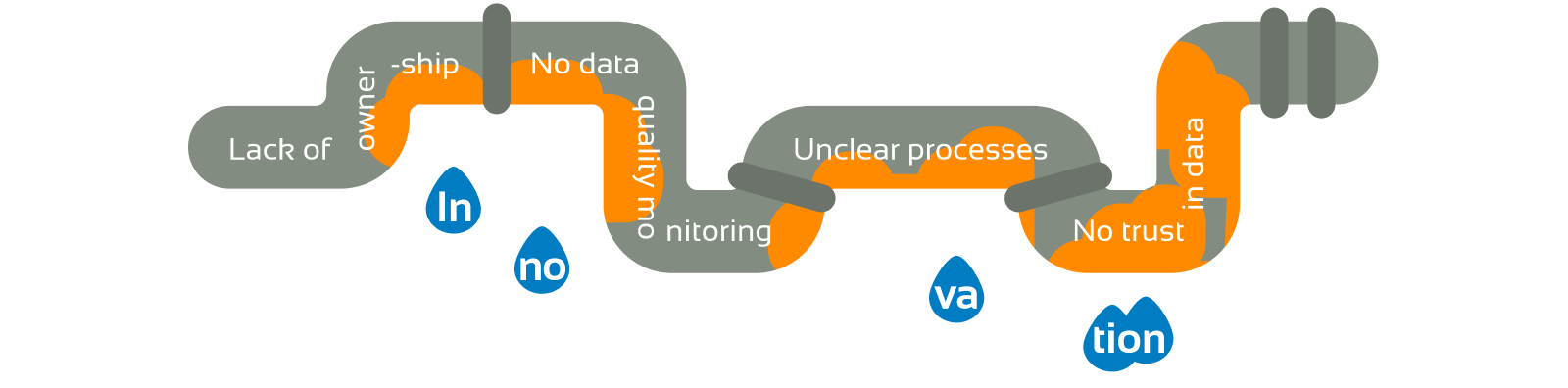
Think about it. How complete and reliable is the data your machine learning model is running on? Is it actively monitored within your organisation? And what if it accidentally contains sensitive customer data that really shouldn't be used? No one noticed because everyone was focused on speed. Until an audit comes along. The financial damage is huge and your reputation takes a big hit.
So before you invest heavily in the hype: make sure your foundation is in place. Your future self will thank you.
What effective data governance brings to the table
“Data governance is proactively managing your data to support your business in achieving its strategy and vision.” When implemented correctly (and not necessarily extensively!), it enables strategic decision-making.
- Clear ownership = smarter decisions: It starts with assigning the right ownership. IT may manage infrastructure, but they are not the subject matter experts for Logistics, Sales, HR, or Finance. When ownership lies with the actual business experts, decisions improve in speed, ability, and clarity - and when issues arise, escalation is clear.
- Compliance & risk management: Most organisations already manage various risks. But when it comes to data, the approach is often far less mature. Meanwhile, regulatory requirements around privacy and security are only increasing. A robust data governance framework ensures data is handled compliantly, avoiding fines and protecting reputation.
- Sustainable data quality from the start: A strong data governance foundation also means less manual rework. With clearly defined processes and accountability, data quality is embedded from the start, resulting in sustainable improvements rather than constant firefighting.
- Trust in data = confident decision-making: Perhaps most important of all, governance builds trust in the data. If every meeting starts with “This data must be wrong,” something’s broken. Data governance corrects this by standardising definitions, enforcing consistency, and eliminating discrepancies. The result? Stakeholders can finally make confident, data-driven decisions.

In short:
Data governance is the foundation for efficient, compliant, and trustworthy data management. While its ROI may take time to surface, it is essential for scaling data-driven decision-making and ensuring long-term success.
Curious how to put this into practice? Read the follow-up article here.
This is an article by Iga Jarosz
Iga worked as an Analytics Engineer at Digital Power. She is dedicated to ensure data quality and embrace design thinking principles. She combines her background in cognitive psychology with more technical skills in areas of analytics, data modelling, and visualisation. Iga is passionate about topics such as cognitive ergonomics, human-centred design, and systems thinking.
Receive data insights, use cases and behind-the-scenes peeks once a month?
Sign up for our email list and stay 'up to data':