The organisational benefits of implementing your own AI-chatbot
Enhancing knowledge and efficiency in your organisation

With the increasing availability of cloud services that enable companies to leverage Large Language Models, it becomes relatively easy to setup your own GPT-model. However, one important question needs to be answered before you start building: what are the benefits for my organisation?
In this blog, we discuss several benefits for your organisation when building your own AI-chatbot. In addition, we provide example use cases to demonstrate the impact.

Manage the diffusion of knowledge
In many companies, we see an immense knowledge base being built up over the years. This knowledge base consists of documents on processes, regulations, best practices, jargon and all other kinds of domain- or company- specific knowledge.
Usually, these documents are widespread across several (digital) filesystems (such as Sharepoint or OneDrive) and it’s hard to find the specific information when needed. In this situation it is advisable to invest in a central knowledge base. This location should be easily accessible and provide accurate answers to your employees' questions.
Instead of wasting time searching for the relevant documents based on an exact search term match, the focus can be on simply asking the right questions in your own AI-chatbot. Several departments are then put in charge of updating this central index to make sure that both existing and new employees have the right knowledge. The answers from the AI-chatbot will always be verifiable since the reference sources used will be listed.
Next to helping existing colleagues find accurate information, the onboarding of new colleagues can also strongly benefit from a central knowledge base. By uploading all the documentation that have been created over the years in a central index, it is up to the new employee to ask all questions they need to be answered to properly understand your business context.
Automate repetitive and time-consuming tasks
In most companies, there are many time-consuming and repetitive activities, such as copying and pasting text. These tasks can often be automated and speed up to a high extent by using generative AI solutions. Consider, for example, automating responses to sales or customer service enquiries. You want to include your own company specific information based on the products that you have available and you would like to include a personal touch.
Previously, you had to copy and paste the relevant product information from several systems (product catalogue, stock warehouse, documentation, etc). After implementing your AI-chatbot and entering the relevant datapoints, you can simply ask it to generate the response for you based on the customer inquiry.
Another category where custom GTP models help with time-consuming tasks is content creation and generation. The models can be trained to use specific writing styles and information related to your specific industry or company. This helps automate the writing of blogs, social media posts, product descriptions and much more.
These are just a few simple examples of numerous use cases where manual efforts are automated. Ultimately, automation will provide major time and cost savings. In addition, the automated tasks are likely to become less error prone. Besides that, the manual effort can be focused on the interesting work.
Enforcing standard way of working
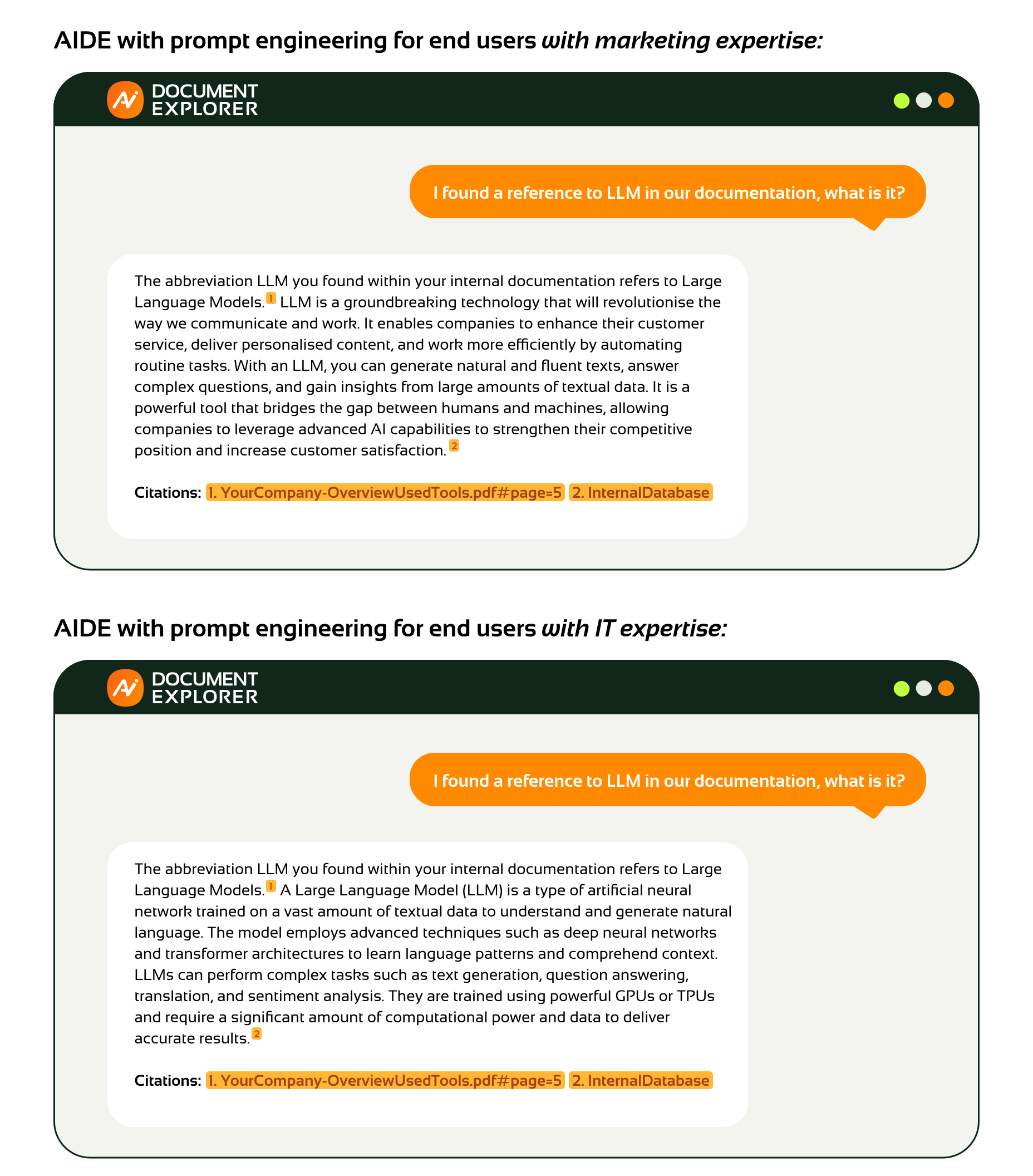
Companies have their own way of working depending on the business context and industry standards. Enforcement of this standardised way of working appears to be difficult, especially for larger companies. By implementing your own AI-chatbot, you can ensure consistency and adherence to company standards. Using prompt engineering, it’s possible to make sure the answer always follows a predetermined format or structure.
A prompt is a question given to a language model to generate a response. Prompt engineering is the process of designing and refining these prompts to optimise the quality and relevance of the model's output.
Depending on the type of users, you can customise the responses. For example, if the end users are developers, the AI-chatbot can be programmed to provide responses based on relevant coding principles and best practices. When there is code pasted into the system that contains error, it’s possible to not only signal the error but also reformat the code according to best practices and return this in the solution.
When the end users are from IT support, the AI-chatbot can offer a step-by-step guide, including questions to ask, to quickly identify the root cause of the technical issue. This guide can be based on previous research that shows how to optimally solve computer issues. But it can also include specific details that are relevant to the software your clients work with.
Conclusion
In conclusion, building your own GPT-model can offer significant benefits to your organisation in terms of:
- Knowledge management: centralising company knowledge enables quick access to accurate information for both existing and new employees.
- Task automation: AI-chatbots automate repetitive tasks, such as customer inquiries and content generation, saving time/cost and reducing errors.
- Standardisation: Enforce a standard way of working in your entire organisation, improving consistency and ensuring adherence to company standards.
Curious about the possibilities for your organisation? We would be happy to discuss how we can effectively deploy the AI Document Explorer! Feel free to contact us for more information or schedule a meeting.
This is an article by Casper Damen, Data Engineer and Team Lead at Digital Power
Casper Damen is a senior Data Engineer and Team Lead. He has a passion for automation, cloud- and data pipelines. By applying software development best practices to analytics, he ensures more reliable, maintainable and scalable data solutions. Over the years Casper has built several data platforms in multiple cloud providers.
Data Engineercasper.damen@digital-power.com
Receive data insights, use cases and behind-the-scenes peeks once a month?
Sign up for our email list and stay 'up to data':