Securely search through your confidential documents with the AI Document Explorer
The AI Document Explorer is a secure, AI-driven tool to improve your work efficiency. Streamline your work by quickly finding answers and accessing your documents, all in one secure place. Take the step towards working more efficiently and easily!
Work more efficiently, implement the AI Document Explorer
- Verify answers effortlessly with included references
- Utilise semantic search for improved understanding
- Seamlessly integrate with your existing systems
- Improve AI reliability through custom prompts
- Protect sensitive data and proprietary with your own AI model
- Access internal documentation from various sources
Discover the benefits of the AI Document Explorer

Enhance efficiency and productivity
Streamline workflows and processes, reducing time spent on searching for information and completing tasks.

Facilitate decision-making
Provide accurate and reliable information, empowering decision-makers to make informed and timely choices.

Reinforce data security
Ensure the protection of sensitive information and proprietary knowledge through secure access controls and hosting in your own Azure environment.

Accelerate knowledge building
Foster learning and understanding by providing access to comprehensive and relevant knowledge resources.
Embed AI into your organisation
We can guide you through all your data questions and the activation of the AI Document Explorer with our data strategy pressure cooker. During this 1-day workshop, we work together with you to map out the pain points, opportunities, and wishes regarding the use of data.
How does the AI Document Explorer work?
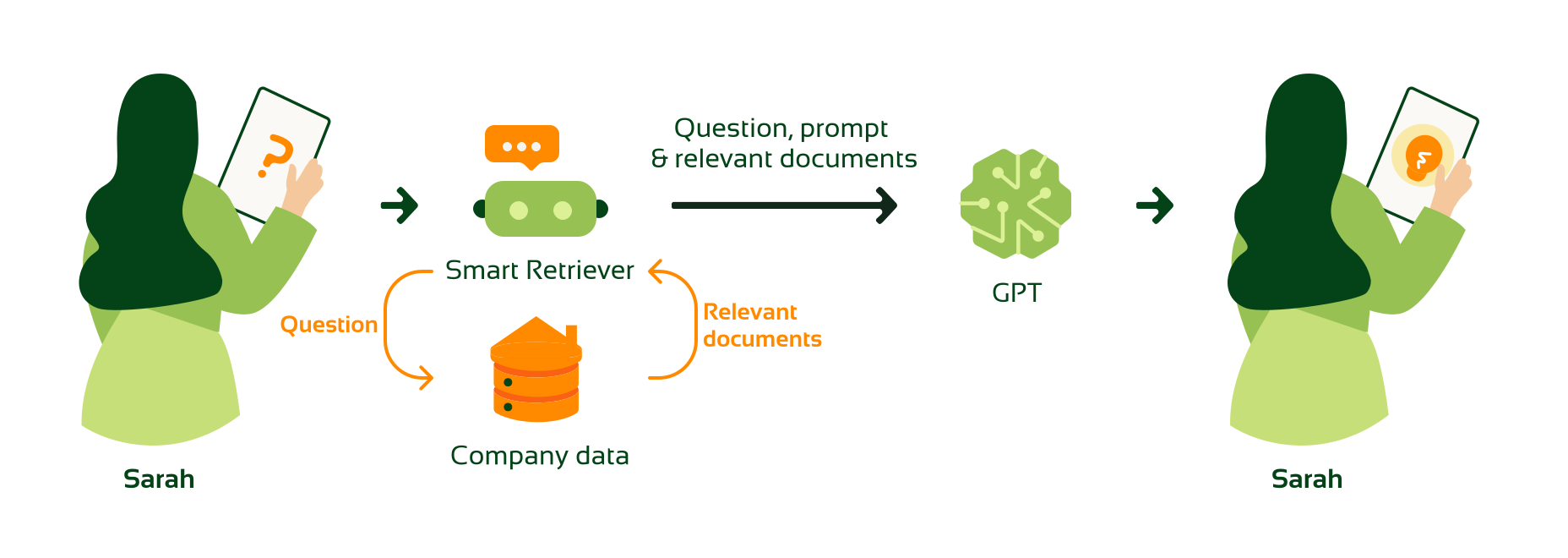
The AI Document Explorer uses several components. First, users (like Sarah) ask questions via a web application, these questions are then processed via a Smart Retriever. After this, they are forwarded to a private instance of a GPT-model. This model uses embeddings to generate answers within the Azure AI infrastructure. Learn more about how it works in this article.
Everything you need to know about the AI Document Explorer
Investing in the AI Document Explorer enables you to leverage AI technology effectively, enhance decision-making processes, and gain a competitive edge in your industry.
Contact usTogether with you, we assess the requirements and determine the necessary access. We prioritise transparency and only require limited access to the infrastructure.
The AI Document Explorer operates as a private instance of the OpenAI GPT model, ensuring that your data remains confidential and is never shared with third parties.
The AI Document Explorer adds value in multiple ways. The main benefits are:
- By providing quick access to information and insights, efficiency is increased and time is saved.
- Information scattered across various sources can be found in one central location.
- Offering an intuitive and user-friendly experience enhances employee engagement.
To securely use the AI Document Explorer, you can implement access controls to manage user permissions. This helps ensure that only authorised users have appropriate access to the tool, enhancing security within your organisation.
The AI Document Explorer provides references to specific documents, enhancing transparency and allowing users to verify the sources of information.
We provide data strategy pressure cooker sessions, where we collaborate to identify pain points, opportunities, and strategies for maximising the AI Document Explorer's effectiveness.
Let's discuss the opportunities of AI for you
Still have questions, or are you ready to discuss your challenges and needs? Joachim would be happy to meet you.

Commercieel Manager Data Engineering+31(0)20 308 43 90+31(0)6 23 59 83 71joachim.vanbiemen@digital-power.com
Related cases & articles
Monthly Digital Insights – July 2026
In this monthly series, we share the latest trends, product updates and industry insights that matter most to professionals in AI, data and analytics. We also share what these developments mean for organisations and where we see the biggest opportunities to create value.
Configuring Claude Code with CLAUDE.md
There is a clear difference between teams that occasionally achieve decent results with Claude Code and teams that consistently produce high-quality output. That difference rarely comes down to better prompts. In practice, it is usually something more fundamental: the rules and expectations you establish before the agent starts writing.
Implementing AI applications that deliver business value
AI is developing rapidly. From generative AI and copilots to AI agents, predictive models and intelligent automation, organisations have more and more opportunities to apply AI across their processes and services.
Tealium Digital Velocity: AI is moving into production
For professionals in data, analytics, martech and customer experience, Digital Velocity is one of the events where developments become tangible. It brings together practitioners, partners and industry leaders to show how they approach AI, real-time data and customer experience in practice.
Should you run LLMs locally?
Large Language Models (LLMs) have quickly become a standard component in modern applications. Most developers start by integrating models such as OpenAI, Claude or similar providers through APIs. It is fast, convenient and requires very little infrastructure.
Faster AI search results with a scalable streaming data pipeline
Exa is an AI company that develops a search engine and API that enable AI systems to intelligently search and analyse the internet. Their technology is used across domains such as finance, coding agents, news, recruitment and consulting, where large volumes of online data are quickly retrieved, structured and summarised for specific use cases.
Less administrative time in healthcare thanks to secure AI conversation reporting
Dedimo wanted to explore how AI could help automatically transcribe therapy sessions between client and therapist and generate reports.
How AI is transforming programming: From autocomplete to agentic coding
Artificial Intelligence is transforming how you design, build, and maintain digital solutions. From code generation to data pipeline automation, AI has become a trusted companion in technical workflows.
Gaining more control over AI initiatives with the support of an Analytics Translator
When the regular Analytics Translator of a service organisation went on maternity leave, the team sought our help to ensure ongoing AI projects ran smoothly. At the same time, the organisation wanted a fresh, external perspective: how was the role being filled, and where could improvements be made?
Data platform audit provides clear insights and concrete optimisations
Volero.nl is a young and fast-growing company that sells rugs through a webshop and a physical store. The company is primarily active in the Netherlands but is growing rapidly across Europe, including Belgium, Germany and Poland. To support this growth, it is essential for Volero to work in a data-driven way.
Smart text analysis: how our AI tool rapidly categorises large amounts of data
Analysing hundreds or thousands of open answers from surveys, interviews or reviews is time-consuming. To better understand those answers, we group them into themes (for example: ease of use, service, delivery or reliability). At Digital Power, we use Large Language Models (LLMs) to quickly categorise high volumes of open answers. Our team built our own secure, transparent tool that lets us see exactly what happens under the hood. But is AI already advanced enough to replace our human researchers?
Understanding AI, GenAI, ML, and MLOps
Artificial Intelligence (AI) is changing the way organisations operate, from personalised customer experiences to automated or assisted decision making, AI helps your organisation leverage your data. However, navigating through this fast-evolving field can feel overwhelming, with terms like AI, Generative AI (GenAI) & Machine Learning (ML) often causing confusion.
AI agents demystified
With the ongoing developments in the data and AI industry, the hype around AI agents has no signs of slowing down. Jensen Huang, Nvidia CEO, is a strong proponent of AI agents, envisioning a multi-trillion-dollar opportunity, where agents can perform tasks with a high degree of autonomy and revolutionize how people work and how businesses operate. So, in this article we would like to discuss what exactly AI agents are, what are their main components, how they interact together and the basics on how to build one.
Why it is important for organisations to invest in AI training now
Many organisations are feeling the pressure: AI suddenly seems to be high on the agenda everywhere. New tools are following each other at lightning speed, colleagues are experimenting with ChatGPT, customers are asking smarter questions, and in the media, the word “AI” is unmissable. It feels like a train has taken off, and no one wants to be left behind.
Improving sales effectiveness by predicting students' enrollment
Talent Garden provides masterclasses and training programs to students, engaging with them through various online and offline touchpoints. Online interactions include completed contact forms and information requests, while offline touchpoints involve meetings and calls with Talent Garden’s sales team. Throughout the customer journey, from initial contact to final enrollment, Talent Garden collects extensive data*. With a wealth of raw data at their disposal, they sought to improve their enrollment strategy and the effectiveness of their sales team. To achieve this, they asked us to develop a data model that could better predict the likelihood of a new contact eventually becoming a student.
What is social listening?
The internet provides a massive amount of interesting social media posts, likes and shares. A wealth of information, especially for organisations wanting to make more impact online. But where do you start? What data will you collect, how will you analyze it and how can you convert insights into concrete action points? To answer these questions, it is important to start with the mission and goals of the organization.
The organisational benefits of implementing your own AI-chatbot
With the increasing availability of cloud services that enable companies to leverage Large Language Models, it becomes relatively easy to setup your own GPT-model. However, one important question needs to be answered before you start building: what are the benefits for my organisation?
How does the AI Document Explorer work in practice?
The AI Document Explorer (AIDE) is a cloud solution developed by Digital Power that utilises OpenAI's GPT model. It can be deployed to quickly gain insights into company documents. AIDE securely indexes your files, enabling you to ask questions about your own documents. Not only does it provide you with the answers you are looking for, but it also references the locations where these answers are found.
Fast and reliable internal information using AI Document Explorer
Financial institutions need to process large amounts of documentation. For this particular institution, an internal team facilitates this by, for example, creating summaries using text analysis and natural language processing (NLP). They make these available to the various business units. To conduct audits more efficiently, they wanted to develop a question-and-answer model to get the right information to them faster. When ChatGPT was launched, they asked us to create a proof of concept.
Replacing qualitative researchers with AI, a good decision?
Artificial Intelligence seems capable of everything, and sometimes even better and faster than what we can do ourselves. Analysing qualitative data is a time-consuming task, and as researchers, we are curious if it can be done faster and easier. Does AI offer a solution for this? Our researchers investigated.
20% fewer complaints thanks to data-driven maintenance reports
An essential part of Otis's business operations is the maintenance of their elevators. To time this effectively and proactively inform customers about the status of their elevator, Otis wanted to implement continuous monitoring. They saw great potential in predictive maintenance and remote maintenance.
Insights into market dynamics for a stronger competitive position
FrieslandCampina Global facilitates local teams in Europe, Asia, and Africa. They want to gain a better understanding of the market and provide the teams with new insights. The goals are to strengthen their competitive position and to identify new opportunities for expansion.
What is Data Science?
Everywhere at events and online, stories are told about what 'data science' is all about. Definitions are anything but consistent. They go from 'getting something of value out of data' to 'it's basically the same as statistics'. And a Data Scientist is 'a data analyst who lives in Silicon Valley' or 'a socially skilled IT person who does something with data'. But what is it really?
The COVID-19 Violence Tracker
The outbreak of the corona pandemic in early 2020 has turned the world upside down. In addition to countless infections, hospitalisations and deaths, we also saw an outbreak of violence in many countries. Citizens took to the streets, sometimes violently, to protest against the measures taken, but domestic violence also increased in many places and fear and frustration played a role in racism.
Digital Power wins prizes at SME Data Science top 50
At the 'MKB Data Science Top 50', 50 agencies competed for the title 'the fastest-growing SME data science agency in our country'. Even before the event, we heard that we were in the top 3! During the Den Bosch Data Week, Marieke got to pitch our organisation.
Social listening in the real estate market
Vesteda was curious if social listening – monitoring and analysing social media discussions about a brand, competitors, products or hashtags/keywords – could add value to the organisation. To this end, we started a project that consisted of two parts: exploring possibilities for social listening in the Corporate Communication department and applying social listening in an ongoing Data Science project.
Social Network Analysis at Election Time
Tuesday, 3 March 2020, was known as Super Tuesday, the day on which several American states vote simultaneously for the Democratic presidential candidate. We use this day as a case for the application of Social Network Analysis. This example is about elections, but you can also apply the same method to a commercial case where you replace the names of the candidates with, for example, different brand names.
How to use Social Network Analysis to understand public opinion
The Corona measures are a much discussed topic on Twitter. The crisis team not only fights against Corona's effects on public health, but also tries to maintain legitimacy for the decision to keep certain measures in place among the public. With this practical case we explain how you can make public opinion on Twitter transparent with Social Network Analysis.
Social Network Analysis: how to gain insight into social media networks
If your organisation is active on social media and you want to optimise the online strategy, you need to know what is happening online around you and the impact of your activities. Social Network Analysis can help you with that. We explain what it is, how it works and the purposes it serves.
How text analysis helps RNW Media to listen and take action
RNW Media builds online communities in countries with limited freedoms. In these communities, young people can read and discuss sexual and reproductive health and rights (SRHR) and civil rights. In addition, RNW Media is working on advocacy – putting the interests of young people on the map with governments.
How do you find the right data scientist?
More and more organisations are getting started with data science. A logical consequence of this is clearly a growing number of related vacancies. But how do you set up a useful job description for a data scientist – and mostly: how do you actually pick the right one? We're giving you some hints on what to do, and what not.
From ethical data to action
The introduction of the new privacy law (GDPR) in 2018 has ensured that many organisations put privacy high on the agenda. In this article you can read about the 5 ethical risks of working digitally and using data. We also share a concrete solution: the Responsible Data Framework.
Determining the location of gardens using Data Science
Residential investor Vesteda is working on a new website. If an available rental home has a garden, the location of the garden must be listed on the webpage of that home. This information was not yet available in the database. We were instructed to determine the location of the garden based on the coordinates of the homes.
How does Data Science work in daily practice?
Organisations wanting to get started with data quickly ask for Data Science solutions. Data Science is often seen as the holy grail of data-driven working. But what does a successful Data Science project actually look like in practice? And how can it serve your organisation? In this series of articles, we take you through all the elements you need to achieve success for your organisation with Data Science.
Application of Natural Language Processing (NLP) and text mining for process improvement.
Fair Wear is a non-profit organisation that aims to improve the working conditions of employees in garment factories. The NGO has collected a lot of documentation about its activities in recent years, for example in the form of reports from a complaint line for factory employees, reports of audits that check whether factories comply with the guidelines, and reports of training for factory employees. This information is stored as typed text, usually in Word or PDF format.
Reliable insight into crowds on trains and stations using an algorithm
An increasing number of people are traveling by public transportation. Several stations in The Netherlands are being rebuilt or renovated to keep up with the growing number of train passengers. For the rebuilding and layout plans, information was needed on station traffic. NS Stations also wanted to improve transfer safety in collaboration with ProRail.