How AI is transforming programming: From autocomplete to agentic coding
An overview of the AI tools we use when programming
- Article
- Data Science
- Data Engineering
- AI


Artificial Intelligence is transforming how you design, build, and maintain digital solutions. From code generation to data pipeline automation, AI has become a trusted companion in technical workflows.
At Digital Power, we see this evolution every day. What began as simple code suggestions has grown into intelligent agents that understand entire projects, refactor files, and even review pull requests. These systems free us to focus on architecture, analytics, and creativity: the parts of our work that make the biggest impact. At the same time, they introduce new responsibilities: we now spend more of our effort guiding these tools, validating their output, and ensuring they strengthen the long-term quality of our solutions.
In this article, you'll get a clear view of how AI-assisted coding has evolved, how different types of tools fit into modern development, and which platforms currently define the landscape. You'll also gain insight into the trade-offs and emerging responsibilities that come with this new way of working.
From autocomplete to agentic coding
Early AI tools worked like predictive text: completing lines of code based on what you were typing. That alone saved time. But the newest generation goes far beyond.
Modern assistants now reason across whole repositories. They can plan a change, edit multiple files, run tests, and verify the results. Some even suggest improvements to infrastructure or data models. We call this shift agentic coding: AI that collaborates with us instead of simply following prompts.
In data and software projects alike, these tools have changed how we think about development. Instead of asking “what should I type next?”, we ask “how should this system behave?” The AI helps bridge that gap between intention and implementation, allowing faster iteration.
What the data shows: Global trends in AI programming
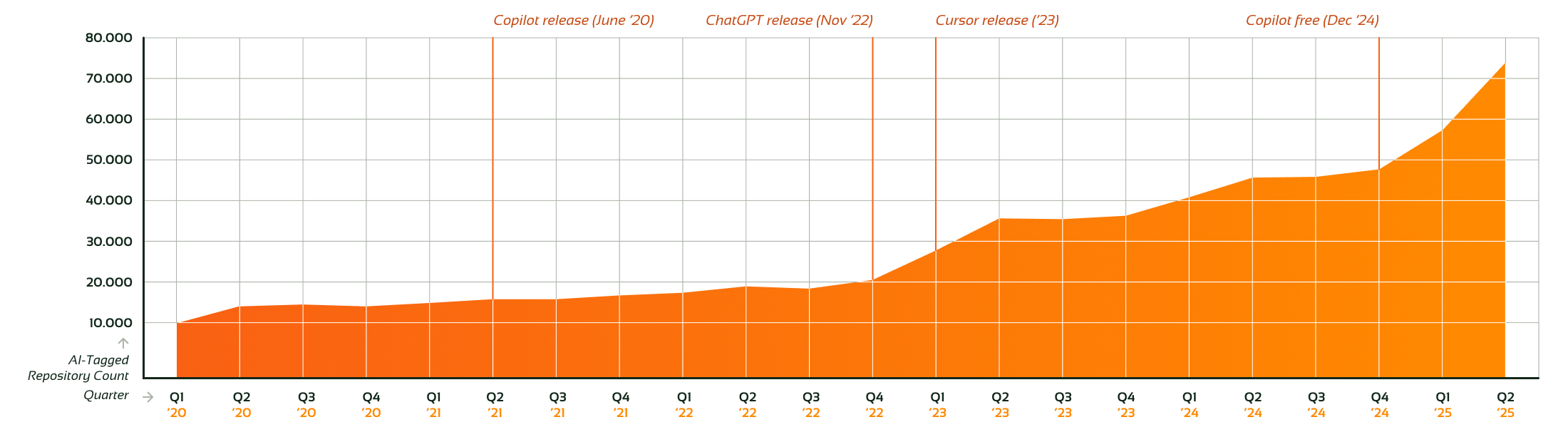
The graph shown here uses data from the GitHub Innovation Graph and focuses specifically on public repositories tagged with AI technologies. This subset is useful for showing the trend over time. It highlights clear spikes in developer activity following major AI milestones, such as the launch of ChatGPT, the rise of AI coding environments like Cursor, and the introduction of the free mode of GitHub Copilot.
As for the overall numbers, GitHub Octoverse 2025 reports that more than 180 million developers now build on GitHub, with over 36 million new developers joining in the past year, who collectively pushed nearly 1 billion commits in 2025, a 25.1% increase YoY.
The types of AI coding tools
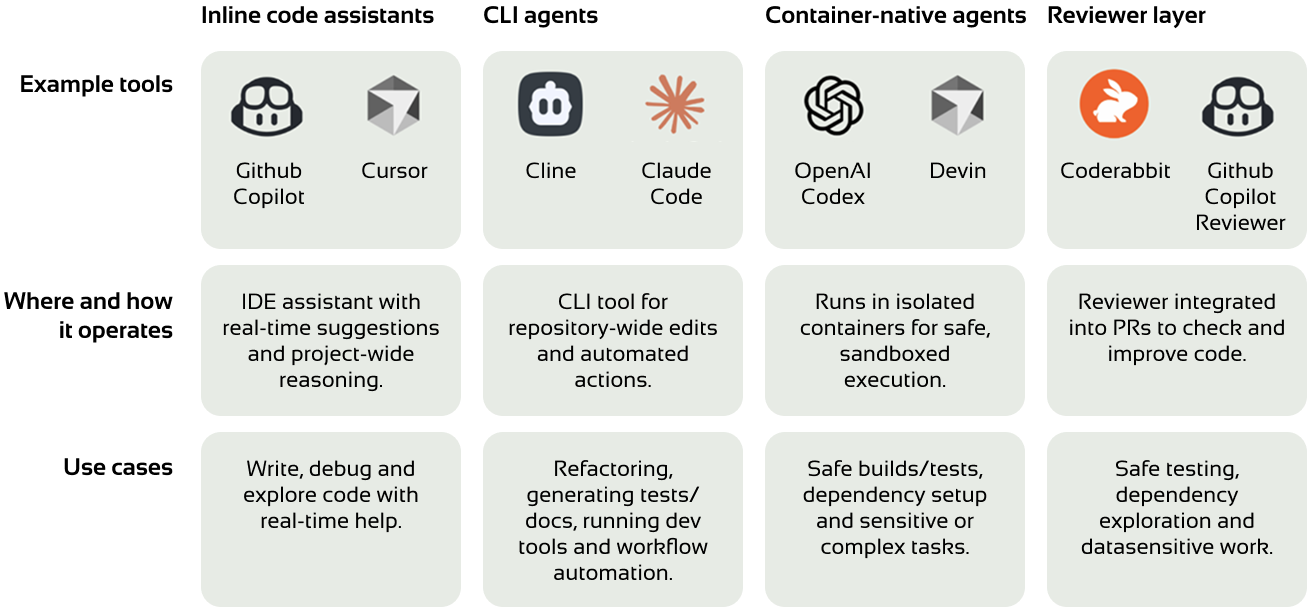
AI-assisted coding now comes in several distinct types, each fitting a different stage of a technical workflow. These can be grouped by how they integrate into your workflow and how they collaborate with you.
Choosing the Right Fit
Selecting the right AI tool depends less on programming language and more on workflow.
- IDE based agents such as Cursor and GitHub Copilot support everyday development inside your editor. They help with writing, debugging, and exploring code, and many now integrate with the terminal to run commands and act across multiple files.
- CLI tools like Claude Code or Cline operate through the command line and work efficiently across whole repositories. They are strong options for large refactoring tasks, automation, and generating tests or documentation.
- In secure or regulated environments, container native agents such as Devin offer isolated workspace where tasks run safely without touching your main system.
- Reviewer tools like CodeRabbit or GitHub Copilot can analyse pull requests and provide automated feedback for teams that want an extra quality check.
Ultimately, the right tool depends on your goals and workflow. Each category serves a different need, and the best fit is the one that supports how you work.
Looking ahead
As AI coding tools continue to evolve, the role of the programmer is changing too.
Writing code is no longer the bottleneck. Understanding business context, designing systems, and ensuring reliability are becoming the real differentiators.
By taking over repetitive and mechanical work, AI gives you more time and focus to work on what truly matters: delivering business value. At the same time, it introduces new responsibilities. You need to validate AI output, safeguard code quality, monitor long-term maintainability, and remain in control of architectural decisions. The craft of programming is shifting from producing code to shaping solutions; from execution to direction.
At Digital Power, we see this as an opportunity to elevate our impact. We explore and adopt these tools thoughtfully, balancing speed with responsibility, always with one goal in mind: empowering people to create data-driven solutions that make organisations smarter, faster, and more future-proof.
This is an article by Paul Hoekstra
Paul is a Data Engineering Consultant at Digital Power. He focuses on building automated data pipelines, scalable data models and reliable ETL transformations. With a hands-on and analytical approach, he helps organisations turn complex data landscapes into clear insights that truly make a difference.
Receive data insights, use cases and behind-the-scenes peeks once a month?
Sign up for our email list and stay 'up to data':