Conversies tracken in een privacy-first browser
Client-side versus server-side implementatie
- Artikel
- Technical Web Analytics
- Server-side tracking


Conversies meten is nog nooit zo ingewikkeld geweest. Browserupdates, adblockers en strengere toestemmingsregels maken het lastiger om conversies toe te wijzen aan je marketinginspanningen. Traditionele tracking aan de kant van de gebruiker werkt steeds minder goed, met als gevolg dat data verloren gaat en je cijfers niet meer kloppen.
*Het artikel is geschreven in het Engels voor een betere leesbaarheid.
In this article series we dive into tracking prevention measures. Learn how to deal with the developments in web analytics and optimise your TMS for the future.
This article series consists of 4 articles:
- Why you need to prepare your web tracking setup for the future
- (Current article) Tracking conversions in a privacy first browser
- Tracking unique users in a privacy first browser
- (Re)targeting users in a privacy first browser
In this article, we explain the differences between client-side and server-side tracking, and why a hybrid approach is often the best way forward. You’ll learn how server-side tracking works, its benefits, and the steps needed to implement it in a way that respects user privacy while restoring conversion insights.
Understanding conversion tracking
Let’s start with the fundamentals of tracking conversions. Imagine the following setup:
- Website server: The central hub for delivering content to users.
- Client-side (browser): Represents the user’s browser where tags and data collection occur.
- Third-party servers: External endpoints (e.g., Meta, Google) to which collected data is sent.
When a user visits a website, the website’s server delivers the requested content. Simultaneously, a data layer is created within the user’s browser. A tag management system (TMS), such as Google Tag Manager (GTM), is loaded shortly thereafter to manage data collection. This data is then sent to analytics or marketing platforms.
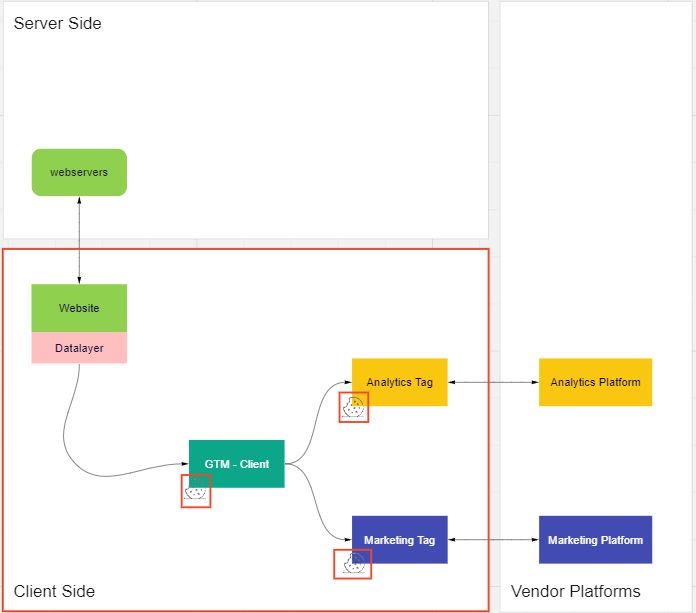
The challenges of client-side tracking
Conversion tracking via client-side methods faces two primary challenges:
- Browser and ad blocker restrictions: Browsers and ad blockers maintain lists of known tracking endpoints and block requests made to them. For example, a request from the browser to Facebook’s tracking endpoint may be entirely blocked.
- Cookie limitations: Depending on the type (first-party or third-party) and the browser, cookies can be blocked or restricted in their lifespan. When cookies expire or are blocked, conversions cannot be accurately attributed to their source, such as an ad campaign.
A solution: server-side tracking
One widely adopted solution is server-side tracking. While not a complete fix, server-side tracking addresses many challenges and serves as a foundation for more advanced strategies.
How server-side tracking works:
In a server-side setup, data is collected on the client side but sent to your server-side solution before being forwarded to external marketing and analytics platforms. Unlike traditional methods, these requests are proxied through your own infrastructure (e.g., a CDN or load balancer). To the browser, these requests appear to come from your website, not a third-party tracker. This can bypass certain ad blocker and browser restrictions.
Hybrid tracking: combining client-side and server-side
A hybrid setup leverages both client-side and server-side tracking. In this model:
- Data is collected on the client side and sent to both the client- and server-side solutions.
- Some conversions may be tracked by one method but not the other, while in cases where both methods track the same conversion, deduplication ensures only one instance is recorded.
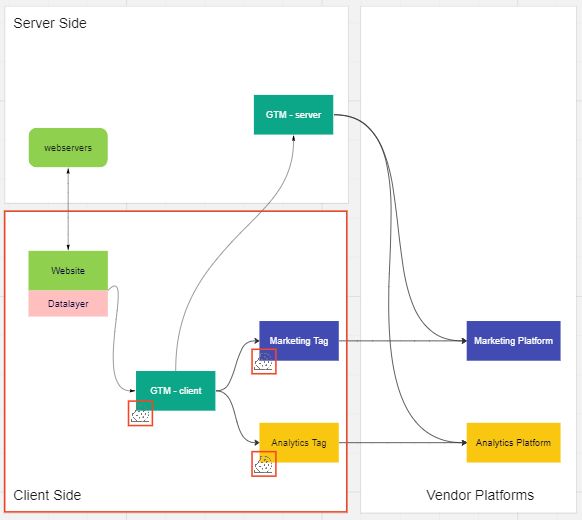
Important note: To comply with Apple’s Intelligent Tracking Prevention (ITP), the server must be configured correctly on the same domain and load balancer as your website. Without this configuration, cookies may still be restricted or blocked. Proxying client-side requests through your CDN or load balancer can address this issue. More on this in the next chapter.
Moving forward
Server-side tracking is an essential step for future-proofing your analytics, but it’s not a one-size-fits-all solution. Cookie limitations, ad blockers, and tracking restrictions still pose significant challenges that require innovative approaches. In the next article, we’ll explore how to maintain the viability of first-party cookies and ensure the accuracy of user tracking in a cookieless world.
By adopting a privacy-first mindset and leveraging hybrid tracking setups, businesses can stay ahead of the curve, protecting both user privacy and data integrity.
Dit is een artikel van Anne Wind
Anne Wind, Technisch Web Analist, combineert zijn marketingachtergrond met expertise in datacollectie. Zijn kritische blik op data vanuit marketingperspectief bracht hem naar de technische kant van data-analyse. Met focus op nauwkeurige dataverzameling helpt hij organisaties inzichten om te zetten in impactvolle acties.
1x per maand data insights, praktijkcases en een kijkje achter de schermen ontvangen?
Meld je aan voor onze maillijst en blijf 'up to data':