Unieke gebruikers tracken in een privacy first browser
Hoe behoud je de bruikbaarheid van first-party cookies
- Artikel
- Technical Web Analytics
- Server-side tracking


As third-party cookies become obsolete, organisations are turning to first-party cookies to track unique users. However, even first-party cookies face challenges due to tracking prevention measures, leading to inflated user counts and unreliable metrics such as cost per acquisition.
*Het artikel is geschreven in het Engels voor een betere leesbaarheid.
In this article series we dive into tracking prevention measures. Learn how to deal with the developments in web analytics and optimise your TMS for the future.
This article series consists of 4 articles:
- Why you need to prepare your web tracking setup for the future
- Tracking conversions in a privacy first browser
- (Current article) Tracking unique users in a privacy first browser
- (Re)targeting users in a privacy first browser
This article explores how tracking prevention affects first-party cookies and presents strategies to maintainaccurate unique user measurement. We’ll also cover how to build a compliant, privacy-focused data strategy that ensures the long-term viability of your analytics.
The challenge: first-party cookies under tracking prevention
Modern browsers are placing increasing restrictions on first-party cookies through tracking prevention measures. These restrictions make it harder to recognise users across multiple sessions. As a result, metrics like unique visitor counts can become inflated—especially for users on browsers such as Safari, where tracking prevention is more aggressive.
For example, many analytics dashboards show a sharp increase in unique visitors from Safari users. This is misleading, as the rise is often caused by tracking prevention distorting the data. To address this, organisations need to take proactive steps to preserve the effectiveness of first-party cookies and maintainaccurate user tracking.
Solutions for maintaining first-party cookies
1. Setting cookies server-side
One common issue is that first-party cookies set on the client side are often deleted after seven days due to tracking prevention rules. This leads to unreliable metrics, such as inaccurate unique visitor counts, incomplete conversion data, and flawed A/B test results.
The solution is to set first-party cookies server-side. For example:
- Server-Side Google Tag Manager (sGTM): When configured correctly on the same domain and load balancer as your website, sGTM can set cookies server-side. This ensures the cookies persist beyond the limitations imposed on client-side cookies.
- Revalidating cookies: Implement a process where all client-side first-party cookies are sent to your server, which then sets these cookies again server-side. This ensures that they are recognised as first-party cookies by the browser (see image below).
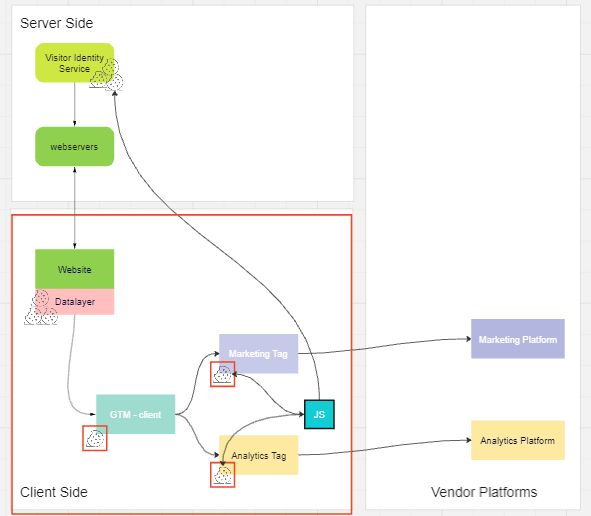
This server-side approach helps maintain cookie viability, but it has limitations. Some browsers may eventually detect and block practices where cookies are set server-side for marketing or A/B testing purposes.
2. Visitor Identity Service (VIS)
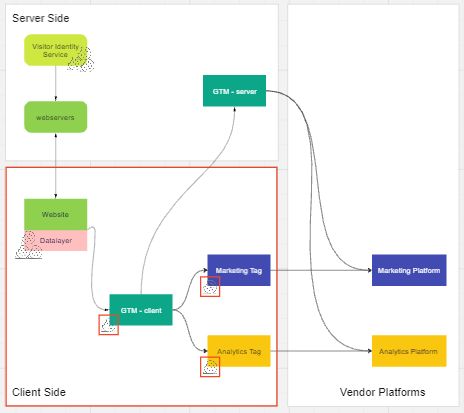
To address the limitations of server-side cookies, organisations can implement a Visitor Identity Service (VIS). A VIS enables you to recognise and track users more reliably by creating associations between cookies and user identities.
How VIS works:
- VIS runs on the same server as your website.
- When a user visits your website, VIS sets a first-party cookie if the user has not been recognised before.
- This cookie acts as a key, allowing VIS to retrieve any associated cookies or data for that user.
- Since the VIS cookie is set server-side, it is not affected by tracking prevention measures.
Advanced feature:
- Integration with CRM data: You can enhance VIS by integrating customer data (e.g., email addresses or login IDs) to identify users when they log in.
These techniques should only be used with explicit user consent.
While VIS can resolve many issues with first-party cookies, businesses must ensure these practices comply with privacy regulations and obtain user consent where necessary.
Best practices for a reliable strategy
- Combine server-side tracking with VIS: Use server-side tracking to address blocked requests and VIS to maintain user recognition across sessions and devices.
- Ensure privacy compliance: Practices like stitching and CRM integration should be implemented only with explicit user consent and in line with data protection laws.
- Stay updated: Regularly review browser updates and privacy frameworks to adapt your strategy accordingly.
- Monitor analytics metrics: Continuously assess your metrics to identify and address discrepancies caused by tracking prevention.
What’s next?
Server-side tagging and Visitor Identity Services resolve many challenges with tracking unique users in the cookieless era, but one critical issue remains: how to effectively retarget users and customers. In the next article, we will explore strategies for (re)targeting users while respecting privacy and compliance.
By adopting these solutions, businesses can maintain reliable metrics, respect user privacy, and future-proof their data strategies in a rapidly changing digital landscape.
Dit is een artikel van Anne Wind
Anne Wind, Technisch Web Analist, combineert zijn marketingachtergrond met expertise in datacollectie. Zijn kritische blik op data vanuit marketingperspectief bracht hem naar de technische kant van data-analyse. Met focus op nauwkeurige dataverzameling helpt hij organisaties inzichten om te zetten in impactvolle acties.
1x per maand data insights, praktijkcases en een kijkje achter de schermen ontvangen?
Meld je aan voor onze maillijst en blijf 'up to data':