Your strategy is sound. Your organisation isn’t ready for it.
Why successful change requires more than a good strategy
- Article
- Strategy & Transformation


Your strategy is right. The leadership team has signed off on it, the presentation has been delivered, and the plans have been agreed. Yet the change fails to materialise. Where you expected momentum to build at the start of the programme, implementation is proving difficult and you are encountering resistance across the organisation. Sound familiar? In this article, we explore what is going wrong and how to address it.
Read this article if you are responsible for a digital transformation, organisational change initiative or strategic programme.
Why a good strategy often fails to deliver successful change
Most strategies that fail are not fundamentally wrong. The analysis is sound, the market direction is clear, and the priorities make sense.
The challenge usually lies not in the strategy itself, but in the connection between what is decided and what happens every day. Not in the boardroom, but on the shop floor. Not in the presentation, but in the conversations that follow – or fail to happen.
A strategy only becomes valuable when it changes the way people act. Until then, it is primarily a document.
This is where the gap between strategy and execution often emerges. Organisations invest considerable time in developing plans, but far less in understanding how employees interpret, understand and apply those plans in their daily work.
Why change programmes stall despite a clear strategy
We see three recurring patterns in organisations that struggle to turn change into real momentum.
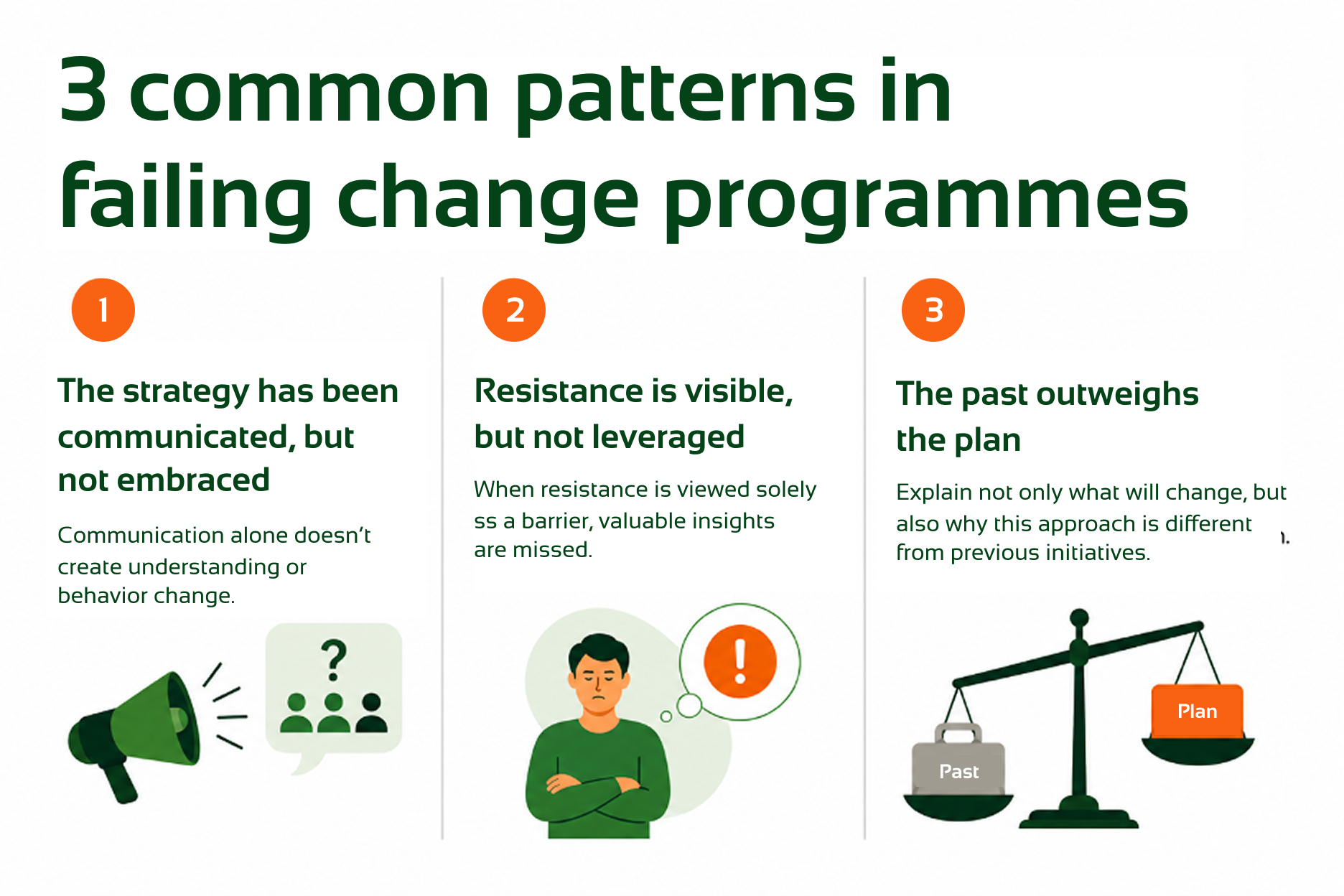
1. The strategy has been communicated, but not embraced
A meeting has been organised, the presentation has been shared, and everyone has seen the slides. But if you ask three managers tomorrow what the strategy actually means for their team, in their own words, you’ll probably get three different answers. Or no answer at all.
2. Resistance is visible, but not leveraged
Almost every organisation has people who are sceptical. The problem is not that sceptics exist; the problem is that their objections are rarely turned into useful information. They are managed rather than listened to.
3. The past outweighs the plan
Every organisation has a previous programme that failed to deliver fully. And people remember that. The question is not whether there is scepticism about the new approach; the question is: why should it be any different this time? If that answer is not clear, the organisation will fill in the blanks itself.
Seven questions that reveal whether your organisation is ready for change
These aren’t questions for hindsight. These are questions you can ask yourself, your team and people outside your immediate circle right now.
- Can your managers explain what the strategy means for their team, in their own words, not in boardroom jargon?
- What has changed in recent months that means this transformation now really demands attention?
- Who in the organisation stands to gain from the current situation remaining unchanged? Have you had that conversation with them?
- How many people on the shop floor believe this programme will be different from the previous ones? Ask three people outside your immediate team tomorrow.
- Is there anyone who openly criticises the strategy? If so, are you listening to them? If not, why not?
- What would need to be in place to turn the people who are currently the most sceptical into the most enthusiastic supporters?
- If this transformation hasn’t succeeded in two years’ time, what is the most likely reason? And what are you already doing about it?
Question four is the most informative. Not because the answer changes the plan, but because it shows you just how big the gap is between what you see and what the organisation is experiencing.
How do you increase the likelihood of a successful transformation?
Research by BCG covering more than 300 transformation programmes shows that organisations that transform successfully create, on average, 66% more value.
The difference does not lie in the strategy itself. It lies in who carries and supports that strategy.
Success depends not primarily on the quality of the strategy, but on the extent to which people understand the change, support it and help make it happen.
For organisations, this requires more than communication. It means creating ownership, taking resistance seriously and involving employees in the changes being asked of them.
A successful strategy requires more than a good plan
A good strategy and an organisation that is ready for it are two different things. Both are necessary. Although
The good news is that the gap can be bridged. But not through more communication. Not through a better presentation. Rather, by taking resistance seriously, engaging the sceptics in dialogue, and narrowing the gap between decision-makers and the shop floor, rather than ignoring it.
Don’t start with the first of the seven questions above. Start with the question that makes you feel most uncomfortable.
Turn strategy into measurable change
Many transformation programmes struggle because the organisation is not ready to adopt the change. We help organisations assess change readiness, create stakeholder alignment and translate strategy into practical execution.
Get in touch or schedule a meeting to discuss the possibilities.
This is an article by Elias Hassing
With a background in product management and over 15 years of experience leading international development teams, Elias helps organisations develop their data strategy. With his expertise in product development and experience as Head of Product at companies such as Coolgradient and Infinitas Learning, Elias guides digital transformations from strategy to execution.
Principal Data Strategy Consultantelias.hassing@digital-power.com
Receive data insights, use cases and behind-the-scenes peeks once a month?
Sign up for our email list and stay 'up to data':