Are your IT department and the business working at cross purposes? Your organisation isn’t the only one. Many organisations struggle with business–IT alignment: bringing business objectives and technological initiatives into line.
We see that cultural differences, poor communication and a lack of shared goals are often the biggest stumbling blocks. IT is frequently viewed as a separate entity, with its own language and priorities. This leads to misunderstanding and mistrust, causing collaboration to stall and projects to slow down.
Business-IT alignment is the process of directly linking IT and data initiatives to the organisation’s strategic goals. In this way, technology is not merely supportive but a true driver of success.
How to get business and IT on the same page
Discuss each other’s goals and challenges in joint sessions.
Communicate to everyone—from leadership to operations—what you want to achieve together.
Bring business and IT together in multidisciplinary teams.
Aligning data strategy with organisational objectives
Do you want data to truly add value to your organisation? Then it’s wise to align your data strategy directly with your business objectives. Always start by sharpening the organisation’s goals. What do you want to achieve—growth, efficiency, customer satisfaction? By taking these goals as your starting point, you determine which data you need and how you will collect and use it.
How to approach this in 3 steps
Jointly define strategic goals and priorities for which you want to use data.
Analyse pain points together and how to remove them.
Start delivering data projects that directly contribute to the most important business goals.
Bridging the business-technology gap
How do you ensure that business and technology reinforce rather than oppose each other? We believe in a culture of innovation and openness. By helping business and IT staff speak each other’s language and understand each other’s challenges, more mutual understanding and collaboration emerge.
Practical examples
Business training for IT staff and technology training for business colleagues.
Team rotation (shadowing): spending a few days with each other to better understand the work.
Working with agile teams in which business and IT collaborate daily.
A “process guardian” (for example, a business analyst) who ensures that processes and goals remain aligned.
Creating a common language for cross-functional collaboration
Is your organisation getting stuck due to jargon or miscommunication between departments? Create a common language that everyone understands. Do this by jointly compiling a glossary, explaining technical terms and creating communication plans that are clear to all.
How this works in practice
Avoid jargon and explain technical terms.
Develop a shared visual language (for example, dashboards and infographics).
Draw up a communication plan with clear, aligned messages.
Portfolio management for data initiatives
Stop running isolated data projects that lead nowhere. Real results come from strategic portfolio management. Treat your data initiatives like an investment portfolio—some projects deliver quick wins, others are for the long term.
Tackle it in 3 steps:
Map your entire data landscape – capture all ongoing and planned initiatives.
Assess impact and complexity – systematically analyse which projects deliver the greatest value.
Create a balanced portfolio – combine quick wins (30%), core projects (50%) and innovative experiments (20%).
What’s next? Your roadmap to business-IT alignment
Get started with these five steps:
Start by sharpening your business objectives.
Involve all relevant stakeholders and create shared understanding.
Develop a data strategy that directly aligns with these goals.
Invest in training and communication to bridge the gap.
Set up a governance structure that fits your organisation.
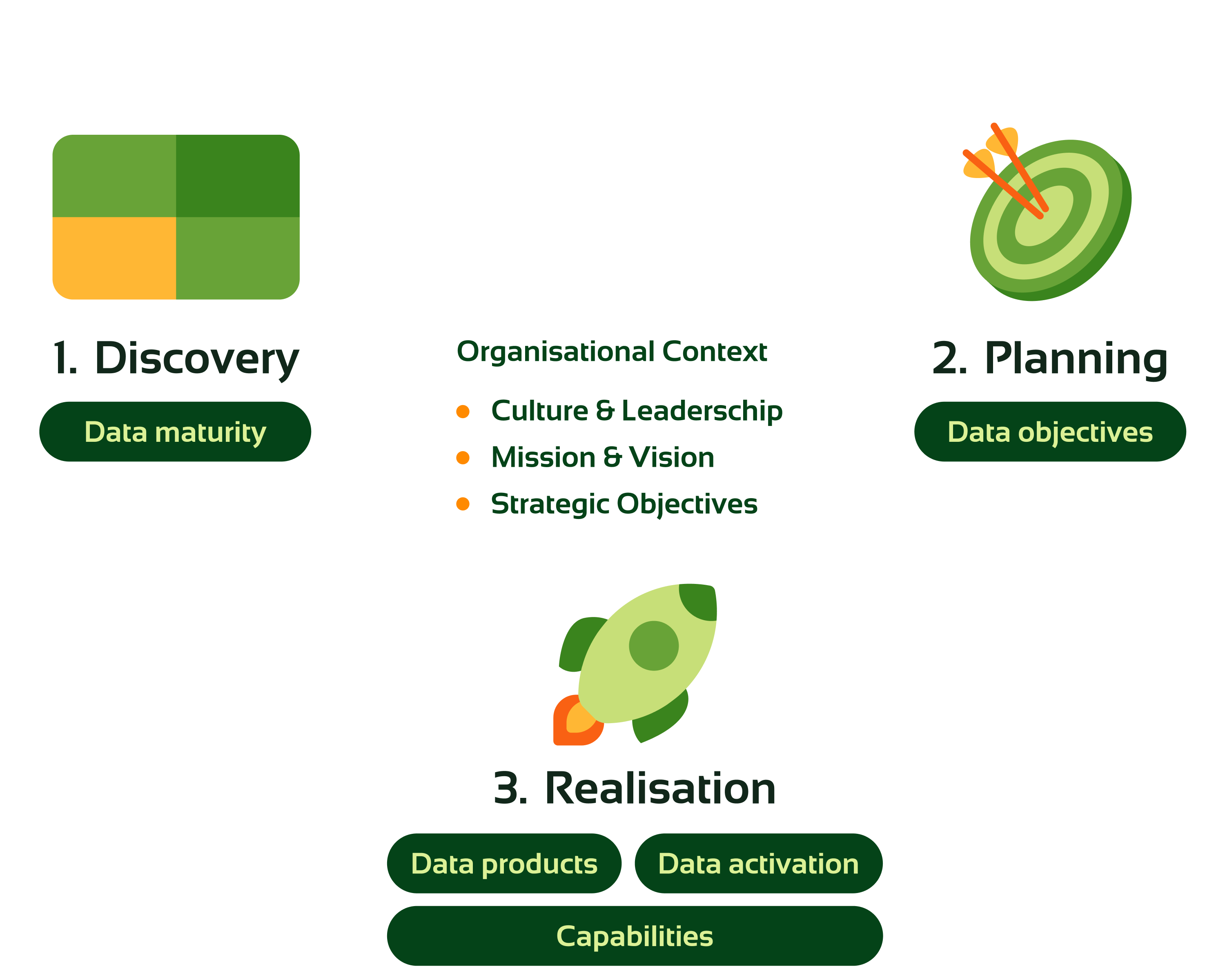
Creating a strategic data plan requires a structured approach. Our data-strategy model helps you gain an overview, spot opportunities and map out challenges.
Do you want to formulate your data strategy and embed it in day-to-day practice within your organisation? We’re happy to help you move from data (strategy) to doing. Schedule an appointment or get in touch.
This article is part of the Dutch e-book “Getting started with your data strategy”. Learn from the valuable insights of our data strategy experts, discover inspiring cases and get started with practical tips.
Eiske worked at Digital Power for over seven years, first focusing on data analysis and later on data strategy. She contributed to developing our standard approach to data strategy and took on the role of strategy consultant and project manager in client projects.
Most data strategies do not fail on paper, but when it comes to putting them into practice: in the gap between the ambition set out in the boardroom and what the organisation actually does with data on a day-to-day basis. This is the first article in a series of articles about how to enable successful SME transformations.
From dashboard to data-driven working: marketing team takes control of its own data
Retailer EyeCare Groep made the transition from an external to an internal marketing dashboard. This immediately served as the starting point for working more actively with data. Using a central dashboard as a basis, we guided the marketing team towards a new, data-driven way of working. As a result, data has become part of the conversation within the team, marketers can explore insights independently, and they can make decisions more quickly.
Resistance to data-driven working is not a knowledge problem
Every data activation programme starts with the same assumption: colleagues are not using data insights because they do not know how. The usual interventions, such as training and communication campaigns, then fail because they are designed to address a knowledge gap. But what really causes resistance to data-driven working is rarely a lack of knowledge. It is a combination of psychological drivers that cannot be resolved simply by providing more information.
AI doesn't solve your data problem. It amplifies it.
AI that creates a holiday itinerary or drafts an email in seconds already feels completely normal. That speed creates expectations. You may recognise this within your own organisation: if AI can do this at home, why shouldn't it be able to support business processes just as easily?
Your strategy is sound. Your organisation isn’t ready for it.
Your strategy is right. The leadership team has signed off on it, the presentation has been delivered, and the plans have been agreed. Yet the change fails to materialise. Where you expected momentum to build at the start of the programme, implementation is proving difficult and you are encountering resistance across the organisation. Sound familiar? In this article, we explore what is going wrong and how to address it.
Why modern data architecture is an organisational challenge
The question is no longer how you technically unlock data, but how you organise your company to create structural value from it. During the DWH & BI Summit in March 2026, data leaders, architects and governance experts came together to discuss data mesh, data governance, data products and data modelling.
This needs to be on your AI roadmap by August 2026
Want to move faster with a strategic view on your data? Every quarter, Elias zooms in on the market developments that impact your data-driven organisation.
No data strategy, no future (and therefore no autonomy)
Only two per cent of Dutch organisations have a mature data strategy, according to HPE research. The other 98 per cent? They are building their AI ambitions on quicksand. Because without a data strategy, AI does not become a smart assistant, but one that leaks sensitive business information, increases the risk of GDPR fines, and makes your organisation dependent on tech giants who do not share your interests.
Data does nothing until you use it properly: how citizenM changed its approach
What problem are you actually trying to solve? It sounds simple, but it’s exactly the question many organisations skip – and why their data projects fail. Hotel chain citizenM experienced this first-hand: their app seemed to be failing, until the data told a very different story. We supported citizenM in arriving at these insights.
What every CEO and CDO needs to know about data strategy in 2026
AI is moving into operations, data needs to be faster and more reliable, and the EU AI Act is turning governance into a boardroom topic. Five trends are putting data strategy under pressure in 2026. “Those who fail to make choices will lose ground to competitors who do focus.”
From data strategy to action: how to avoid getting stuck in planning
The scenario is all too familiar: the boardroom has approved a data strategy, dashboards have been designed, and concepts for AI projects have been drafted. Months later, the plans are still sitting on the shelf, and no one has touched the dashboard since the presentation. What went wrong? “Technology can only help you if you know what you want it to help you with,” says Elias Hassing (Data Strategist at Digital Power).
Want to move faster with a strategic view on your data? Every quarter, Elias zooms in on the market developments that impact your data-driven organisation.
What really matters for data, AI and decision-making in 2026
Want to move faster with a strategic view on your data? In the up to data: Macro Matters, Elias zooms in on the market developments that impact your data-driven organisation.
Does your organisation collect lots of data, but the step from insight to action often stalls? You’re not alone. Most companies struggle at every organisational level, from the boardroom to the frontline, to actually turn data into effective decisions. Data-driven decision-making offers the solution: a framework that brings together data, people, and technology so you can decide faster and better.
Webinar | Discover your data maturity level for optimal data value
In this webinar, you will learn what data maturity means and how to gain insight into the extent to which your organisation handles data. You will discover how to determine where you currently stand, which factors play a role in this, and which next steps you can take to get more value out of data.
Are you losing control of your data? It’s time to take the reins. Effective data governance is the key to better decision-making, sustainable growth and a supportive business strategy.
Migrating to European Tag Management and Analytics platforms
Due to recent geopolitical developments, such as heightened concerns about privacy and legislation, many organisations are reassessing their dependence on US-based software solutions. At the same time, the call for greater control over data and reduced reliance on external parties is growing louder.
The data paradox: why more data does not always lead to better decisions
Do you have access to more and more data, but find that better decisions are failing to materialise? You are not the only one. We see in many organisations that the growing amount of data actually leads to confusion and indecision.
This data paradox - more data, but not automatically more insight - is a major challenge for anyone who wants to work in a truly data-driven way.
From ambition to activation: how Ennatuurlijk really got moving with data
At energy company Ennatuurlijk, the belief grew that intuition was no longer enough to set the course. The energy market was changing rapidly, the organization was growing, and the amount of information was increasing every day. IT Manager Eric Vanderfeesten went looking for a data partner who could not only provide strategic advice on data-driven work, but could also strengthen his data team operationally. In this interview, he shares his vision, experience and results from working with Digital Power.
E-book: Getting started with your data strategy (updated version '25)
This e-book is written for decision-makers who want to harness the power of data to take their organisation to the next level. Whether you are CEO, CDO, IT director or department head: if you are responsible for the digital future of your organisation, this book will provide the insights you are looking for.
If you’ve decided to migrate your data warehouse to a European environment, taking a structured approach is key. This blog focuses on the steps needed for a smooth and successful transition.
What European data warehouse solutions are available?
Due to geopolitical developments and growing concerns about data sovereignty, more and more businesses are looking to reduce their dependence on US cloud providers.
How a Product Owner delivers data value and visibility
At Ennatuurlijk, we have been working with the Data & Analytics team to deliver on their data strategy. When their Product Owner unexpectedly became unavailable, we were able to step in quickly. What began as a temporary replacement grew into a partnership in which we shaped the organisation’s data-driven ways of working together.
Is your organisation ready for independence from the US and migrate to EuroStack?
In an era marked by international tensions, rising concerns about privacy, security, and technological sovereignty, you may find yourself re-evaluating your reliance on US technology solutions. The drive towards digital independence isn't just a political goal, but may also be a pragmatic business necessity.
Sneller vooruit dankzij een strategische blik op je data? In de eerste up to data: macro matters editie zoomt Elias in op de marktontwikkelingen die impact hebben op jouw datagedreven organisatie.
5 Questions about the free online data maturity scan
Wondering how data mature your organisation really is? Our free online data maturity scan gives you a clear view of your organisation’s current level of data maturity – in just 5 minutes. Below we answer the five most frequently asked questions about the scan.
Data maturity scan: mapping data maturity and defining next steps
“Our current focus with data is mostly operational. To truly unlock its value, we want to start using it more strategically – to make better-informed decisions with the right focus. But where do we begin? What’s the best approach, and how do we build internal support? What is our current level of data maturity, and what steps should we take to grow?” This was the question posed by an international medical device manufacturer who asked us to carry out a data maturity scan as the starting point for their journey.
From strategy to realisation: a data-driven future
Ennatuurlijk supplies sustainable heat and cold via heat networks to consumers and businesses. The internal Data & Analytics team is tasked with making the organisation data-driven. In doing so, they ran into a challenge: the many requests for data products within the organisation were difficult to manage and the impact remained limited. The management team therefore asked us to help them develop a data strategy, create a future-proof data landscape and drive a data-driven mindset within the organisation.
War Child will measure the quality of its programs using a standardised methodology: Quality of Care. War Child developed this methodology based on scientific research. Now the question is: how can this be implemented across a large number of locations with different types of programs, various partner organisations, and donors? What is War Child's data ambition concerning Quality of Care, and how can a data strategy help the organisation move forward?
Webinar: Getting started with an effective data strategy
In our webinar, we would like to inspire you about the possibilities of developing a data strategy in an accessible way. How can you approach this process? Using our data strategy model, Eiske will present concrete examples and let you take a first step towards a solid strategy for your organisation.
An insurance company approached us to assist in shaping their data strategy. Their aim was to achieve their goals and provide a seamless customer experience across all touchpoints.
In this webinar, we discuss the maturity model that we apply to quantify the maturity of different dimensions of data governance. Additionally, we provide concrete steps and implementation tips to start providing added value through data management.
Digital Power has launched a new data strategy proposition to help its clients define and realise their goals for datadriven working. “Few organisations know how to convert the insights from their data into results. What they lack is a good data strategy,” says Charlotte Vonkeman, who is responsible for the new proposition.
Data strategy expert interview: a golden mountain of data
Nowadays, almost every organisation is aware of the need to work data driven. They understand the importance, but few have managed to succesfully implement a data strategy. In this interview series we talk about the definition of data strategy, use cases, opportunities and tips from data strategy experts.
Data strategy expert interview: data strategy from a holistic perspective
Nowadays, almost every organisation is aware of the need to work data driven. They understand the importance, but few have managed to succesfully implement a data strategy. In this interview series we talk about the definition of data strategy, use cases, opportunities and tips from data strategy experts.
Data strategy expert interview: data-driven start-ups
Nowadays, almost every organisation is aware of the need to work data driven. They understand the importance, but few have managed to succesfully implement a data strategy. In this interview series we talk about the definition of data strategy, use cases, opportunities and tips from data strategy experts.
How does all the data you collect effectively contribute to achieving the organisational goals? Few organisations actually succeed in converting insights from their data into results. As a data consultancy firm, we regularly talk to organisations that are overwhelmed by the vast array of tools and the large amount of data, and can no longer see the wood for the trees. Does this sound familiar? The development and implementation of a well-thought-out data strategy will help you regain control.
Data strategy expert interview: from vision to practice
Nowadays, almost every organisation is aware of the need to work data driven. They understand the importance, but few have managed to succesfully implement a data strategy. In this interview series we talk about the definition of data strategy, use cases, opportunities and tips from data strategy experts.